




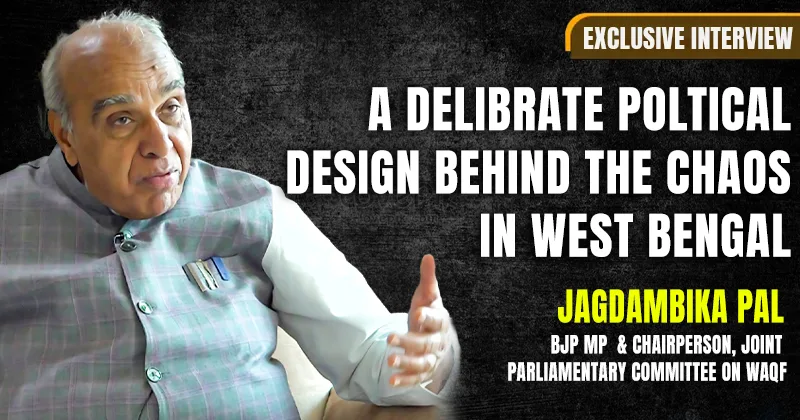
In the first week of April, the Waqf Amendment Bill was passed in Parliament following an extensive and intense debate. Almost immediately after its passage, violent protests erupted in some parts of the country, with West Bengal witnessing the most intense unrest. These protests were largely fuelled by a misinformation campaign orchestrated by certain political parties and some community leaders. To shed light on the provisions of the Waqf Amendment Act, 2025, and address the controversies surrounding it, Organiser’s Senior Assistant Editor Nishant Kumar Azad spoke with Jagdambika Pal, BJP MP and Chairperson of the Joint Parliamentary Committee on Waqf. Excerpts:
Immediately after the passage of the Waqf Amendment Bill, violent protests have erupted in West Bengal. What, in your view, is fuelling this unrest?
I fail to understand why such violence occurs exclusively in West Bengal. For over a week now, Murshidabad has been engulfed in unrest, with horrifying acts of brutality taking place. A Dalit Hindu father and his son were murdered in cold blood, and their mother was viciously attacked inside her own home. Shops belonging to Hindus were looted while the police stood by silently, making no effort to intervene.
Hindus have begun migrating in large numbers from Murshidabad to Malda out of fear and insecurity. Despite the gravity of the situation, Chief Minister Mamata Banerjee has not made an attempt to reach out to the victims. This is nothing short of State-sponsored violence.
In a parliamentary democracy, if anyone disagrees with a law, the proper course of action is to approach the Supreme Court or the High Court. If there is genuine faith in democracy, then there must also be patience to let legal processes take their course.
This law was enacted by the Central Government only after extensive consultations with stakeholders. More than 38 meetings were held in Delhi. As the Chairman of the Joint Parliamentary Committee (JPC), I personally met with over 284 delegations. In the history of the Indian Parliament, such a thorough and exhaustive process has never been undertaken neither by any Parliamentary Standing Committee, Select Committee, nor Joint Parliamentary Committee.
These consultations included major Muslim organisations such as the All India Muslim Personal Law Board, Zakat Foundation, Delhi Waqf Council, Jamiat Ulama-e-Hind, as well as Islamic scholars, the All India Pasmanda Muslim Mahaz, Rashtriya Muslim Manch, representatives from Bar Associations, former Judges, and Vice Chancellors.
If Mutawallis, caretakers, and other officials associated with Waqf Boards have been misusing Waqf properties, then Government-led reforms that bring in transparency are actually in the best interest of the Muslim community. The amended Act now ensures representation for backward communities and women in Waqf Boards. I believe this is a progressive step forward. Such representation will help safeguard the interests of the poor and marginalised within the Muslim community.
However, it is important to recognise that there is a deliberate political design behind the chaos in West Bengal engineered by the Trinamool Congress under Mamata Banerjee’s leadership.
Let me also emphasise that this was not an arbitrary report prepared in haste. The committee produced a detailed 428-page report after thorough discussion. Every clause was reviewed and put to vote, and all members participated in the deliberations. The committee proposed 14 amendments, all of which were accepted by the Government. I am both happy and grateful that the spirit of parliamentary democracy was upheld. The Bill introduced on August 8, 2024, is significantly different from the version that was ultimately passed thanks to the JPC’s amendments.
Now, Mamata Banerjee declares that this law will not be implemented in West Bengal. Several other non-BJP ruled States are also opposing the Waqf Amendment Act. It appears there is an open competition among the DMK, TMC, and Congress in Karnataka to secure the Muslim votes. These parties are solely focused on appeasement politics. They treat Muslims merely as a vote bank, rather than striving for their actual welfare and empowerment.
If they were truly sincere in their intentions, they would have acted on the findings of the Sachar Committee report submitted in 2006.
A video from one of the JPC meetings went viral, showing TMC MP Kalyan Banerjee allegedly throwing a bottle at you. Could you tell us what actually happened during that incident and what triggered such aggression?
What happens in JPC meetings is generally kept confidential. When we invited public opinion on the Bill from across the country, we received nearly 95 lakh emails. At times, we called tribal organisations, sometimes Vanvasi groups, and occasionally representatives from the Adhivakta Parishad. This is when the Opposition began objecting and they started questioning why these groups were being invited.
Leaders like Kalyan Banerjee, D. Raja, Sanjay Singh, and Asaduddin Owaisi raised objections, asking why only Muslim organisations were not being invited. But in reality, several Muslim delegations did come and many of them praised the Bill. That’s when the situation began to escalate.
“Waqf Act now ensures representation for backward communities and women in Waqf Boards, which will help safeguard the interests of the poor and marginalised within the Muslim community”
They never expected that groups like the All India Pasmanda Samaj, Rashtriya Muslim Manch, or even the Sajjada Nasheen of Ajmer Sharif, Nasiruddin Chishti would express support for the Bill. This was simply intolerable to them. They tried to disrupt the proceedings, even going so far as to snatch papers from the hands of the delegates. The scenes were worse than what we sometimes witness in Parliament. Despite all this, I maintained my composure. Even when Kalyan Banerjee hurled a bottle at me, I chose not to react.
I used to ask straightforward questions to stakeholders like the All India Muslim Personal Law Board, Khanqahs, Eidgah committees, and others. For example, I would ask: “Which section or clause of this amendment takes away your mosque? Which provision affects your Eidgah? Why are you spreading misinformation among the public?”
But rather than answering these legitimate questions, they would shout, argue, and create disruption. As the Chairman and a member of the committee, I had every right to raise such questions. And if they had come forward as stakeholders, they were obligated to respond to them.
Even then, we never expelled anyone, not even Kalyan Banerjee despite his unruly behaviour.
When the Waqf Bill was passed and notification issued, the name was changed to UMEED. What is the idea behind naming it UMEED?
There was so much despair around Waqf, but now this new law is UMEED, a ray of hope. Now Pasmanda Muslims, backward, poor people can hope for medical aid, scholarships, and marriage support. Earlier, they had no medium now Waqf gives them hope.
This Act clearly states that properties protected by the ASI and those owned by the Government are beyond the jurisdiction of the Waqf Board. But what about private properties that have been claimed as Waqf?
Under Section 40 introduced during the UPA regime the Waqf Board had the authority to declare any property as Waqf merely on the basis of its “belief,” even if the property in question was privately owned or belonged to the government. There was no provision for appeal in such cases; only a Waqf Tribunal had the jurisdiction to decide the matter.
However, with the recent amendment, this has changed. Now, any aggrieved party whether a private citizen or a government body has the right to approach the High Court or even the Supreme Court. Why should Waqf properties be treated as exceptions to the principles of justice? Under the new law, any disputed Waqf claim can now be legally challenged through proper judicial channels.
Law Minister Kiren Rijiju recently commented on the Munambam land dispute in Kerala where Christians, Hindus, and Muslims are all involved saying that affected parties can now approach the courts. However, given the already heavy backlog of cases in our judiciary, has any specific time frame been set for resolving such land-related disputes under the new provisions?
That decision ultimately lies with the courts. However, the crucial point is that people now have the right to approach the High Court or the Supreme Court. Earlier, if a property whether private or Government-owned was declared as Waqf, the matter could only be taken to the Waqf Tribunal, with no provision for appeal beyond that. Now, we have opened a vital window for justice.
In any democratic system, the right to appeal is a fundamental principle. Whether someone is aggrieved by the Government, the Waqf Board, or any other authority, they now have a clear legal remedy available to them.
Whenever a landmark law is enacted be it the CAA, the Farm Laws, the abrogation of Article 370, or now the Waqf Amendment there is always a section that resorts to violent protests. Don’t you think this is becoming a troubling and dangerous trend?
This is undoubtedly a dangerous trend. Those who once held the office of Chief Minister, and those now leading opposition parties, are the very ones instigating unrest across the country.
Take, for instance, the abrogation of Article 370 and 35A under Prime Minister Modi’s leadership. At that time, Mehbooba Mufti declared, “Blood will flow in Kashmir; no one will be left to raise the tricolour.” But what actually transpired? There was no bloodshed, no stone pelting.
On the contrary, over 27,000 villages proudly hoisted the national flag on January 26 and August 15. For the first time, panchayat and local body elections were conducted peacefully in Jammu & Kashmir. Festivals are now being celebrated without fear or disruption.
Ordinary Muslims across the country have responded positively to these reforms. Even in the case of the Waqf Amendment Act, we haven’t witnessed nationwide protests. Opposition is limited to select pockets – West Bengal, Hyderabad (led by Owaisi), and Jammu & Kashmir (led by Mehbooba Mufti and Omar Abdullah).
These leaders are not merely protesting; they are actively trying to incite unrest and damage India’s global image. It’s a deliberate attempt to provoke violence under the guise of dissent.














Comments