





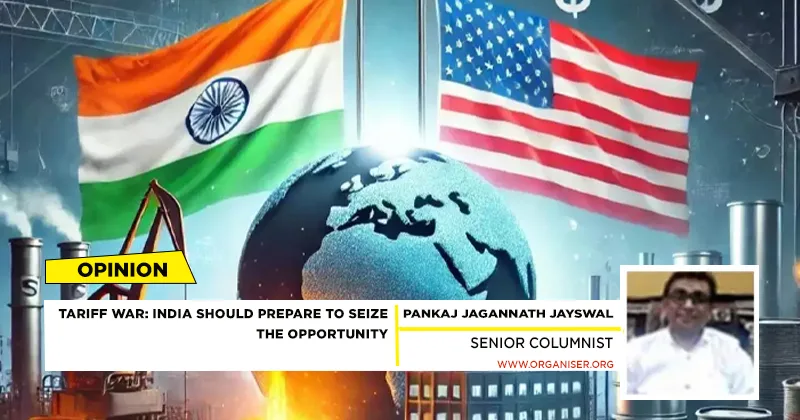
When we look at superpowers like America, China, and Russia, we can see why becoming a superpower is bad for the globe and humanity. As Bharatiyas, we believe in becoming “Vishwaguru” since it is the antidote to superpower. The superpower, which implies ego, greed, immorality, exploitation of natural resources, exploitation of developing and underdeveloped nations, a culture of conflicts and wars to control the world, economic irregularities, and so on. The globe is filled with conflicts in every sphere, including the recent economic battle, the Tariff war. Though recent events in the tarrif conflict have caused widespread disruption, Indian industry has a hidden golden opportunity that will take shape provided the correct steps are made, in the right direction, and at a faster pace.
How are superpowers losing their status of powerful nation?
Russia has ruined itself through communist dogma. China has developed strongly economically in the last 25 years since abandoning communist ideology for self-development, but they continue to use communist ideology as a foreign policy to seize lands, illegally control natural resources and properties of other nations, and their greedy nature is causing too much trouble around the world. America’s habit of controlling everything while ignoring morals and focusing on consumerism has resulted in a country with a large debt burden, producing a fear of losing the Superpower status, and so decisions are made in haste.
The Trump administration’s shift in tariff policy in the United States is adding to global uncertainty. The United States hopes that this transition would help to address trade deficits with its main partners while also boosting American manufacturing. India, a net exporter to the United States, wil not be directly affected by this policy change. According to World Bank data, total merchandise trade between India and the United States increased at a compound annual growth rate of 5% from 2014 to 2022. In 2022, the United States accounted for 11% of India’s entire trade, while India accounted for only 2.5% of the US’s total trade.
Understanding the notion of tariff
Tariffs are taxes levied by countries on imported goods to make them more expensive and unaffordable, with the goal of stimulating home manufacturing. At the same time, the global economy benefits when some commodities are imported from other nations where they are less expensive to produce while still satisfying home demand. In exchange, the importing country may generate items or innovations that benefit the exporting countries. This creates a cycle of trade flows and value chains based on comparative or absolute advantage. Tariffs are intended to protect domestic industry while addressing trade imbalances.
How India should move forward
Economic autonomy is critical to strategic autonomy, multipolarity, and improved development for the Indian people. In the event of a trade war, we really just have one pressure point: we are a major importer of American energy. We import approximately $10 billion in American oil and gas per year, which we may threaten to halt. It’s also crucial not to exaggerate America’s power over us. While the United States can significantly harm our exports, our economy isn’t very reliant on them. This becomes evident when you compare other emerging markets. Vietnam, for example, relies substantially on foreign trade, with exports accounting for about 90% of its GDP. In contrast, India’s exports account for approximately 20% of our GDP, with the majority of our economic output coming from what Indians consume.
This held us back during the hyper-globalization era, but if global trade collapses, it may serve as a layer of insulation. The Trump negotiations provide an excellent opportunity to advance tariff reform, which will be net favorable to our export prospects and competitiveness. As a result, general tariff levels have risen by 4 or 5 percent since 2015, with non-agricultural goods increasing by an average of 15 percent. The time has arrived to reduce these rates and gradually move to a level comparable to our ASEAN colleagues.
Despite the obstacles, India’s export economy has a silver lining. As US tariffs raise the cost of Chinese goods, Indian producers have an opportunity to gain market share in important industries. To capitalize on the tariff battle, an emphasis on research and innovation will be critical. Incremental innovation, technology-driven start-ups and export-oriented units, as well as rapid development of supply chain management, will undoubtedly benefit the economy in the next years. According to Oxford Economics, India received the fourth-largest benefit from trade diversions generated by Trump’s prior tariff war. According to a research by the Federation of Indian Export Organisations (FIEO), India has the potential to grow exports to the United States by $25 billion, notably in:
- Electronics & Electrical Goods
- Automotive Parts & Components
- Organic Chemicals & Pharmaceuticals
- Textiles & Apparel
- Footwear & Furniture
- Toys & Home Decor
Industries That Stand to Benefit
Manufacturing and electronics: Companies such as Tata Electronics and Dixon Technologies may benefit if US firms shift supply chains away from China.
Textiles and apparel: India may replace Chinese exports in the US garment market.
Defense and Aerospace: Trump has pushed India to increase its imports of US military equipment, which might benefit the Indian defense sector.
The Bigger Picture: Can India Seize This Opportunity? While Trump’s tariffs create market volatility, they also provide opportunities for Indian enterprises. NITI Aayog CEO BVR Subrahmanyam observed that India must “prepare itself to seize the opportunity.”
The important criteria determining India’s success in capitalizing on this trade shift are: Strengthening Manufacturing Capabilities: To meet global demand, India needs increase manufacturing using technology to improve efficiency, quality and cost of the product.
Improving Trade Agreements: Strengthening trade partnerships with major countries through Free Trade Agreements (FTAs).
Attracting Foreign Investment: Encouraging enterprises to transfer their supply chains away from China and establish operations in India.
Improving Infrastructure: Creating ports, logistics, and digital connectivity using AI and other advanced tools to help trade grow.
How is the Tariff War helping India grow?
In a strategic move to avoid growing tariffs imposed by the Trump administration, electronics behemoths Apple and Samsung are increasing production in India. This change attempts to keep their products competitively priced in the US market while minimizing dependency on manufacturing in China and Vietnam. As both corporations adjust to the changing trading scenario, major investments in Indian manufacturing are expected. This decision is in response to a reciprocal tax of 26% on Indian exports to the United States, compared to a startling 54 per cent for China and 46% for Vietnam.
Apple and Samsung’s growing focus on manufacturing in India may have far-reaching consequences for the country’s economy. With both corporations planning to spend extensively in local production, India will benefit from job creation and technological breakthroughs. The possibility for increased production capacity may potentially attract additional foreign investment, bolstering India’s position as a major player in the global electronics market.
As the United States continues to slap tariffs on Chinese and Vietnamese goods, corporations must readjust their supply chains more urgently than ever before. Apple and Samsung’s moves could encourage other international firms to consider India as a viable manufacturing base. The conclusion of ongoing trade discussions will have a significant impact on the future of global industry and trade relations.
The Reserve Bank of India (RBI) has regularly intervened in forex markets to decrease the rupee’s excessive volatility. Finance Secretary Tuhin Kanta Pandey has guaranteed that, while rupee fluctuations are being managed, India’s currency will remain a “free float” with no fixed control.
A Self-Reliant Bharat for a Brighter Future
Self-reliance is the key to strengthen the nation. Focusing on self-reliance benefits the nation by creating employment opportunities, growing entrepreneurs, expanding global markets, upgrading technology, and building skills and knowledge. The Modi government launched Aatmanirbhar Bharat, and we are already seeing the results in terms of national strength. Governments, industrialists, and society must work together to strengthen every sector, including semiconductors, defense, manufacturing, artificial intelligence, space technology, agricultural produce, food technology, pharmaceuticals, healthcare, the digital world, and environmental management. This self-reliance should be achieved without causing harm to the environment or exploiting natural resources.
Self-reliance is the solution to global economic war.















Comments