





The Mysore Urban Development Authority (MUDA) case, an ongoing and complex saga within the state’s political landscape, is drawing renewed attention as recent developments raise questions about its implications for key political figures. The investigation into alleged fraud continues to stir controversy, with Congress leaders utilizing the Lokayukta B report as a political weapon, presenting it to the public as a badge of integrity. However, the situation has become more precarious for Chief Minister Siddaramaiah, especially following the latest pronouncements from the High Court’s division bench.
On April 5 in Bengaluru, the High Court’s ruling did not grant a stay on a previous decision made by a single-member bench, which had annulled the statement and documents of former MUDA Commissioner Natesh. This key ruling has, instead, granted the Enforcement Directorate (ED) the green signal to proceed with investigations regarding other individuals implicated in the case. Crucially, this group includes Natesh and names that resonate heavily in state politics, including that of Chief Minister Siddaramaiah himself. This development has prompted intensified scrutiny and undoubtedly caused sleepless nights for the Chief Minister.
AS Ponnanna, the Chief Minister’s legal advisor, has sought to reinterpret the High Court’s ruling in a way that could mitigate the implications for his boss. He articulated a viewpoint suggesting that the ED has been instructed to investigate beyond the 14 sites linked to Siddaramaiah’s family, potentially shifting focus away from the Chief Minister as individuals close to him become entangled in the investigation. This nuanced interpretation, however, has sparked a backlash and is under considerable scrutiny.
Furthermore, the ongoing investigation casts a long shadow over the Chief Minister’s administration, with no indication that the complaints against Siddaramaiah have been dismissed or that any stay order has been placed on the investigation. Although submitted in a B format, the Lokayukta’s report remains unacknowledged by the Court of Representatives, further complicating the narrative. Notably, the Lokayukta has raised questions regarding the validity of the B report in the context of the proceedings before the ED court, underscoring the legal complexity of the situation.
The ED’s legal counsel has asserted their authority to challenge the Lokayukta report in a higher court, reinforcing their determination to pursue their inquiry. This declaration suggests that the ED has no immediate barriers preventing them from investigating Siddaramaiah, thus making it plausible that the Chief Minister could soon find himself summoned for questioning.
The FIR filed by the ED under the Prevention of Money Laundering Act (PMLA) highlights the allocation of these sites as a focal point. Yet, legal manoeuvres by the Chief Minister’s representatives have called for quashing the PMLA case, suggesting a potential conflict with ongoing investigations.
In response to Ponnanna’s interpretation and the controversy, the BJP has launched a counter-offensive, asserting that the judicial system has not mandated an investigation of anyone outside the CM’s family. The saffron party has criticized Congress for their incompetence, while former Chief Minister H.D. Kumaraswamy has cryptically stated that justice will ultimately prevail.
Union Minister H.D. Kumaraswamy Accuses CM Siddaramaiah of Direct Involvement in MUDA Scam
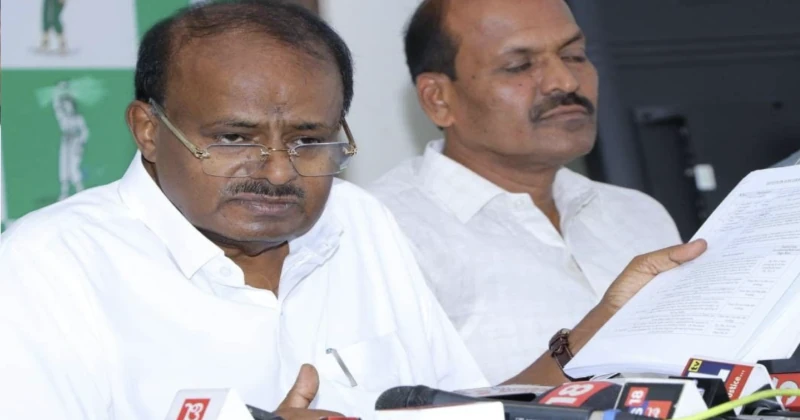
In a striking turn of events that has escalated tensions within Karnataka’s political landscape, Union Minister H.D. Kumaraswamy has levelled serious allegations against Chief Minister Siddaramaiah, claiming his direct involvement in the scandal surrounding the Mysore Urban Development Authority (MUDA). Kumaraswamy’s remarks were made during a press conference, raising eyebrows across the political spectrum and intensifying scrutiny over the Chief Minister’s actions during a critical period.
The MUDA scam has been a contentious issue in Karnataka politics, with allegations of corrupt practices and mismanagement in the allocation of government land. In his press release, Kumaraswamy disclosed that the crux of the allegations centres around an application filed by Siddaramaiah’s brother-in-law, Mallikrjuna Swamy, to denotify fifteen plots of land. He asserted that the integrity of this application was compromised, claiming that the signature affixed to the document was forged. This assertion adds a new layer of complexity to an already convoluted matter, as Kumaraswamy urged the public to take notice of these allegations seriously.
Highlighting the historical context, Kumaraswamy pointed out that Siddaramaiah served as the Deputy Chief Minister when the alleged misconduct occurred, while Bachegowda was the Urban Development Minister. During this period, the pivotal application seeking to denotify the plots was filed, ostensibly to benefit some individuals associated with the Chief Minister. Kumaraswamy’s accusations raise pertinent questions about the ethical standards those in power maintain and the potential misuse of authority for personal gain.
Furthermore, the Union Minister referred to specific contents of the Lokayukta report that underscored his allegations. Through this metaphorical lens, Kumaraswamy urged interested parties to delve into these great tales to discern the deeper truths about the ongoing controversy, possibly suggesting that integrity should be at the forefront of governance.














Comments