





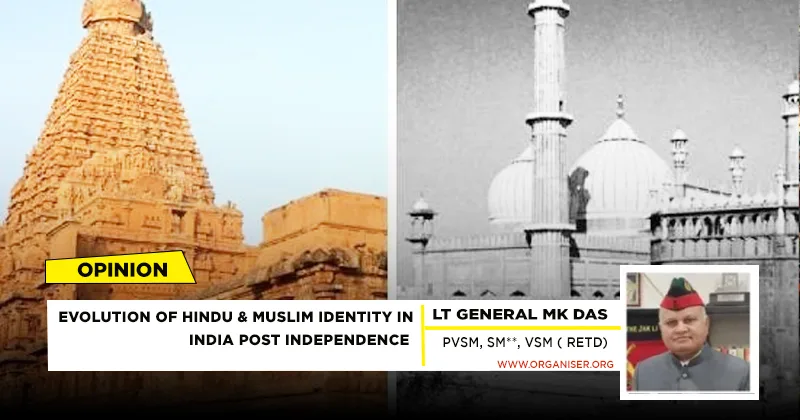
Recently, there has been friction between the Muslim community and the police in many states, Sambhal, Mhow and Nagpur being the prominent ones. Suddenly, Friday Namaz has become a sensitive issue, and the police force has to be deployed to prevent any untoward incident. The continuous use of police on unnecessary duties puts extra strain on their ability to perform their core duties. In addition, we watch news of Namaz being offered on public roads and highways. We also find extra fervour in the Hindu festivals now. All this led me to look into the issue of identity crisis post-independence amongst the Hindus and Muslims in India.
The division of India and Pakistan in August 1947 led to one of the worst carnages witnessed in human history. The unprecedented and gruesome violence post-partition led to an estimated 20 lakh people losing their lives. Another at least 1.5 crore people were displaced, with no home or shelter. Since more Hindus and Sikhs were displaced from West Pakistan, they suffered more casualties in the communal violence that followed. Thus, the relations between Hindus and Muslims started with a sense of mistrust in independent India. India’s total population was roughly 34 crores at the time of independence. This included roughly 29 crore Hindus and roughly 3.5 crore Muslims, the balance being the other communities. Both the communities were struggling economically at the time of independence.
It can be said with a degree of certainty that the Hindus and Muslims have shared uneasy relations since independence. The evolution of Pakistan also had a bearing on the psyche of Muslims in India. Pakistan became an Islamic republic in the year 1956 and became an Islamic state in 1973 after the creation of Bangladesh as an independent nation in December 1971. At this time, Muslims became an attractive vote bank in India and could influence the electoral outcomes in many constituencies. In India, the Muslim community now has a population of approximately 20 crores, roughly 14.3 per cent of India’s population. India has the third largest Muslim population in the world after Indonesia and Pakistan. Such a large population is classically not a minority population because the next minority in India is Christianity, with just 2.3 per cent of India’s population, followed by the Sikh community which is just 1.72 per cent of India’s total population. Thus, whether one likes it or not, the Muslim community has a critical hold over the electoral and political fortunes with their significant numbers. The Hindu community has continued to vote for all political parties.
I was reminded that at the time of independence, Muslim Bollywood actors would use Hindu screen names. Yusuf Khan became Dilip Kumar, Hamid Ali Khan became Ajit, and Zakaria Khan became Jayant, to name a few male actors. Among female actors, Mahjabeen Bano adopted the screen name Meena Kumari, and Mumtaz Jehan Dehlavi became Madhubala. It is also true that some actors retained their Muslim names. By the mid-1980s, Salman Khan, Aamir Khan, and Saif Ali Khan represented another set of confident Muslim actors who tasted success at the box office. I am not sure, but maybe their success brought a degree of assertiveness to the Muslim community. Such success of these Muslim actors would not have been possible without the fan following of the Hindu community. Around this time, the Bhartiya Janata Party (BJP) made serious attempts to become a formidable political force, particularly in the Hindu heartland.
By the mid-1990s, the political lines in India were drawn along communal and caste lines. The timelines may not be accurate, but it is a fact that the Muslim community became an attractive vote bank for certain political parties, regional parties and political alliances. The other day, I saw the voting pattern of the 2024 Lok Sabha elections, where more than 90 per cent of Muslims voted for one particular alliance. Having tasted political power and administrative patronage, we are in a situation where every attempt is made to fan communal tension. A situation has come where religious assertiveness has become a pathway to electoral politics.
Hindu religion and Hindutva believe in religious tolerance and peaceful co-existence. But after decades of subjugation in their own country, there is a newfound assertiveness amongst the Hindus in India. In my opinion, two major events have shaped this forcefulness and confidence amongst the Hindus. First was the rightful place for Ram Lalla at Ayodhya temple after Pran Pratistha on 22 January 2024. Lakhs of devotees have visited Ayodhya every day since that historic day. The second was exactly a year later, i.e. the successful conduct of Maha Kumbh 2025 from 14 January to 25 March, which witnessed participation by more than 66 crore devotees. So, in just one year, most of the Hindu community has reconnected to the religious and spiritual path. Sometimes, their sense of joy and fulfilment may be overboard, but it is to be expected.
The events worldwide have also fostered a sense of insecurity amongst the communities. Russia- Ukraine war of more than three years has highlighted the importance of national unity. The conflict of Israel with Hamas, Hezbollah and Houthis has demonstrated national resolve for survival. The situation in Bangladesh has established fragile religious tolerance where the Hindu minority is being persecuted. The change of regime in Afghanistan, where the Taliban has established legitimate rule, is another example. The situation in Balochistan, Pakistan, and Nepal recently highlights the importance of unity and the dangers associated with dividedness. ‘Ek Hain to Safe Hain’ echoes the sentiment of unity and national security. The identity crisis between the Hindus and Muslims is primarily to assert and retain their traditional advantage. Therefore, there is an evolving process of finding the right equilibrium and societal balance in India. Hopefully, it will settle down soon.
Hindus, by and large, have always accommodated and respected the feelings of minority communities in India. The time has come for the minority community in India to heartily reciprocate and develop a genuine respect for the sense of Hindutva. I have noticed that Hindus are generous in their respect for other religions. However, other religions also have to embrace the spirit of Hindutva. The festivals of India are to be celebrated to unite the spirit of India. Be it Deepawali, Holi, Christmas, Guru Nanak’s Birthday, or Eid, all communities should come together and celebrate. With mutual and equal respect for all religions, minor issues like the use of colours, non-vegetarian food, route of processions, etc., would automatically get sorted out. The futility of offering Namaz on the roads can also be avoided. Religion in no way should come in the way of national unity.
In the ultimate analysis, all Indian citizens are equal and are treated as such. Therefore, when Bharat becomes the third largest economy, all the citizens benefit. When India becomes a developed nation by 2047, all Indians will enjoy the fruits of development, irrespective of religion. While the individual identity is important, it has to complement the national power. The citizens of India of all faiths and all religions are equal stakeholders in its security, well-being, development and growth. Electoral politics is just one part of the democratic set-up in India, and mere political gains cannot compromise the idea of India. Hindus and Muslims constitute 95 per cent of India’s population. They have no option but to coexist peacefully. Happy Nav Ratra and Eid Mubarak, my countrymen.











Comments