Biocentrism and Indian Philosophy: The convergence of science and spirituality
December 5, 2025
  • Read Ecopy
  • Circulation
  • Advertise
  • Careers
  • About Us
  • Contact Us
Android AppiPhone AppArattai
Organiser
  • ‌
  • Bharat
    • Assam
    • Bihar
    • Chhattisgarh
    • Jharkhand
    • Maharashtra
    • View All States
  • World
    • Asia
    • Europe
    • North America
    • South America
    • Africa
    • Australia
  • Editorial
  • International
  • Opinion
  • RSS @ 100
  • More
    • Op Sindoor
    • Analysis
    • Sports
    • Defence
    • Politics
    • Business
    • Economy
    • Culture
    • Special Report
    • Sci & Tech
    • Entertainment
    • G20
    • Azadi Ka Amrit Mahotsav
    • Vocal4Local
    • Web Stories
    • Education
    • Employment
    • Books
    • Interviews
    • Travel
    • Law
    • Health
    • Obituary
  • Subscribe
    • Subscribe Print Edition
    • Subscribe Ecopy
    • Read Ecopy
  • ‌
  • Bharat
    • Assam
    • Bihar
    • Chhattisgarh
    • Jharkhand
    • Maharashtra
    • View All States
  • World
    • Asia
    • Europe
    • North America
    • South America
    • Africa
    • Australia
  • Editorial
  • International
  • Opinion
  • RSS @ 100
  • More
    • Op Sindoor
    • Analysis
    • Sports
    • Defence
    • Politics
    • Business
    • Economy
    • Culture
    • Special Report
    • Sci & Tech
    • Entertainment
    • G20
    • Azadi Ka Amrit Mahotsav
    • Vocal4Local
    • Web Stories
    • Education
    • Employment
    • Books
    • Interviews
    • Travel
    • Law
    • Health
    • Obituary
  • Subscribe
    • Subscribe Print Edition
    • Subscribe Ecopy
    • Read Ecopy
Organiser
  • Home
  • Bharat
  • World
  • Operation Sindoor
  • Editorial
  • Analysis
  • Opinion
  • Culture
  • Defence
  • International Edition
  • RSS @ 100
  • Magazine
  • Read Ecopy
Home Opinion

Biocentrism and Indian Philosophy: The convergence of science and spirituality

Biocentrism, a theory that places life and consciousness at the center of the universe’s existence, finds striking parallels in Indian philosophy, which has long emphasized the interconnectedness of all living beings and the cosmos

Prof Punit KumarProf Punit Kumar
Mar 30, 2025, 01:00 pm IST
in Opinion, Sci & Tech
Follow on Google News
FacebookTwitterWhatsAppTelegramEmail

Biocentrism, a concept that places life at the centre of the universe, challenges the traditional materialistic worldview by proposing that life and consciousness create reality rather than the other way around. This theory, primarily advocated by Dr Robert Lanza, suggests that space and time are mere constructs of human perception, and the universe itself is shaped by the conscious experience of living beings. Interestingly, this perspective has significant parallels with Indian philosophy, which has long emphasised the primacy of consciousness and the interconnectedness of all life forms.

Biocentrism challenges the conventional physics-based understanding of the universe. It posits that consciousness is fundamental, unlike materialistic science, which assumes consciousness emerges from matter. Biocentrism suggests that consciousness is the foundation of existence. According to this perspective, the universe exists because of observers. Reality, including space and time, does not have an independent existence, but is constructed through conscious perception. The physical world is secondary to biological experience, meaning that our perceptions shape the reality we experience. According to biocentrism, time is not an absolute entity, but a cognitive construct dependent on the observer.

Indian philosophical traditions, especially Vedanta and Sankhya, align closely with biocentric principles. These systems emphasize that consciousness is the ultimate reality and that the physical world is illusory or dependent on perception. The Advaita Vedanta school, founded by Adi Shankaracharya, asserts that Brahman (the ultimate reality) is pure consciousness, and the material world (Maya) is an illusion. This aligns with biocentrism’s claim that the external world exists as a projection of consciousness. The Upanishads support the idea that reality is fundamentally conscious rather than material.

Sankhya philosophy differentiates between Purusha (consciousness) and Prakriti (matter), with Purusha being the eternal observer. This distinction suggests that consciousness is not a byproduct of the physical world, but a fundamental aspect of existence. In many ways, Sankhya’s idea of Purusha as an independent, eternal observer resonates with biocentrism’s assertion that the universe requires a conscious observer to exist.

Biocentrism redefines our understanding of space and time, viewing them not as absolute constructs but as subjective experiences shaped by consciousness. Similarly, Indian philosophy has long held that time and space are not fundamental realities but aspects of Maya, the illusion that masks the true nature of existence.

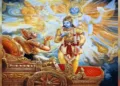
The Bhagavad Gita and the Upanishads discuss time as an aspect of the physical world that is ultimately unreal from the perspective of the eternal self (Atman). In the Bhagavad Gita, Lord Krishna describes time as a flowing force that does not affect the eternal nature of consciousness. This notion aligns with biocentrism’s claim that time is a cognitive construct rather than an independent reality.

Biocentrism and Indian philosophy both advocate for a deep respect for life and nature. The Indian ethos of “Vasudhaiva Kutumbakam” (The world is one family) reinforces the biocentric idea that all living beings are interdependent. Indian philosophy promotes Ahimsa (non-violence) toward all creatures, recognizing the intrinsic value of every life form. In contrast to anthropocentrism, which places human beings above other life forms, biocentrism and Indian philosophy emphasize ecological balance and sustainability.

The Bhagavad Gita underscores the duty (Dharma) of individuals to live in harmony with nature. This principle of harmony is also echoed in many ancient Indian texts, which view human beings as an integral part of the cosmic order (Rta). The concept of Karma, which states that actions have consequences, further strengthens the idea that human behavior should be in alignment with nature. These philosophical views mirror the ethical implications of biocentrism, which calls for an ecologically responsible approach to existence.

In the modern world, where environmental concerns have become critical, the convergence of biocentrism and Indian philosophy provides a valuable framework for fostering sustainability. If consciousness is the fundamental reality and all life is interconnected, then harming nature equates to harming oneself. This understanding could lead to a more profound sense of responsibility toward environmental conservation.

The convergence of biocentrism with Indian philosophy highlights the deep connection between science and spirituality. While biocentrism provides a scientific framework for understanding the primacy of life and consciousness, Indian philosophical traditions have long upheld similar views, offering profound insights into the nature of existence. This synergy between ancient wisdom and modern science can pave the way for a holistic worldview, fostering greater respect for life, deeper environmental consciousness, and a more meaningful understanding of our place in the universe.

The implications of this synthesis are vast. If consciousness is indeed fundamental, then the exploration of human awareness and subjective experience becomes as crucial as the study of physical laws. This perspective encourages interdisciplinary research that bridges physics, biology, neuroscience, and philosophy. Moreover, it invites a re-evaluation of scientific materialism, urging scholars to reconsider the role of consciousness in shaping reality.

Thus, biocentrism and Indian philosophy share profound commonalities in their assertion that consciousness is the foundation of reality. The philosophical insights of Vedanta and Sankhya, thought provide deep rooted perspectives that reinforce biocentrism’s claims. Further, the ethical and environmental teachings embedded in Indian traditions resonate with the biocentric call for ecological balance and respect for all life forms. As humanity grapples with existential questions about the nature of reality and the sustainability of life on Earth, the wisdom of both biocentrism and Indian philosophy offers a compelling vision for a more conscious and harmonious existence.

Topics: Bhagavad GitaBiocentrismDr Robert Lanza
ShareTweetSendShareSend
✮ Subscribe Organiser YouTube Channel. ✮
✮ Join Organiser's WhatsApp channel for Nationalist views beyond the news. ✮
Previous News

Dr Keshav Baliram Hedgewar’s Birth Anniversary: Remembering the RSS founder’s unblemished character and leadership

Next News

Kerala: Controversial film ‘Empuran’ forced to make 17 cuts after facing backlash

Related News

Karnataka: Bhagavad Gita may enter school & university curriculum as HD Kumaraswamy pushes proposal to centre

Representative Image

Gita Jayanti: The teachings of Bhagwan Krishna for enhanced life management in the corporate sector and among Gen Z

Gita Jayanti: The original prompt – Rethinking AI through Gita

Jiyo Geeta Parivar officials outlining event details at the November 16 press conference

Divya Geeta Prerana Utsav to be held in Lucknow on November 23; Dr Bhagwat to grace the occasion

Representative image

China: Bhagavad Gita celebrated as “Nectar of Wisdom” by Chinese scholars, linking ancient wisdom to modern times

Representative image

Uttarakhand urges NCERT to introduce Bhagavad Gita & Ramayana; Initiative aims to strengthen civilizational roots

Load More

Comments

The comments posted here/below/in the given space are not on behalf of Organiser. The person posting the comment will be in sole ownership of its responsibility. According to the central government's IT rules, obscene or offensive statement made against a person, religion, community or nation is a punishable offense, and legal action would be taken against people who indulge in such activities.

Latest News

Union Minister for Road Transport and Highways Nitin Gadkari (Right)

India set for highway overhaul as Union Minister Nitin Gadkari unveils nationwide shift to MLFF electronic tolling

RSS Akhil Bharatiya Prachar Pramukh Shri Sunil Ambekar

When Narrative Wars result in bloodshed, countering them becomes imperative: Sunil Ambekar

Ministry of Civil Aviation mandates emergency action: IndiGo ordered to stabilise flight operations by midnight

Chhattisgarh CM Vishnu Deo Sai at Panchjanya Conclave, Nava Raipur, Image Courtesy - Chhattisgarh govt

Panchjanya Conclave: Chhattisgarh CM Sai shares views on development projects in Maoist hotbed, women empowerment

Union Finance Minister Nirmala Sitharaman

‘TMC is holding Bengal back’: Sitharaman slams Mamata govt over industrial & healthcare setbacks

Karnataka: Muslim youth Mohammed Usman accused of sexual assault, blackmail & forced conversion in Bengaluru

Social Justice Is a cover; Anti-Sanatana dharma is the DMK’s real face at Thirupparankundram

Karnataka: Hindus demand reclaiming of Anjaneya Mandir at the site of Jamia Masjid; Setting wrongs of Tipu Sultan right

Assam govt proscribes all forms of Jihadi literatures in state; Islamic terror groups trying to recruit Muslim youth

Retired Subedar held for leaking Army details to Pak handlers posing as Indians

Gujarat ATS dismantles spy network involving Ex-Army personnel and woman for sharing information with Pakistan

Load More
  • Privacy
  • Terms
  • Cookie Policy
  • Refund and Cancellation
  • Delivery and Shipping

© Bharat Prakashan (Delhi) Limited.
Tech-enabled by Ananthapuri Technologies

  • Home
  • Search Organiser
  • Bharat
    • Assam
    • Bihar
    • Chhattisgarh
    • Jharkhand
    • Maharashtra
    • View All States
  • World
    • Asia
    • Africa
    • North America
    • South America
    • Europe
    • Australia
  • Editorial
  • Operation Sindoor
  • Opinion
  • Analysis
  • Defence
  • Culture
  • Sports
  • Business
  • RSS @ 100
  • Entertainment
  • More ..
    • Sci & Tech
    • Vocal4Local
    • Special Report
    • Education
    • Employment
    • Books
    • Interviews
    • Travel
    • Health
    • Politics
    • Law
    • Economy
    • Obituary
  • Subscribe Magazine
  • Read Ecopy
  • Advertise
  • Circulation
  • Careers
  • About Us
  • Contact Us
  • Policies & Terms
    • Privacy Policy
    • Cookie Policy
    • Refund and Cancellation
    • Terms of Use

© Bharat Prakashan (Delhi) Limited.
Tech-enabled by Ananthapuri Technologies