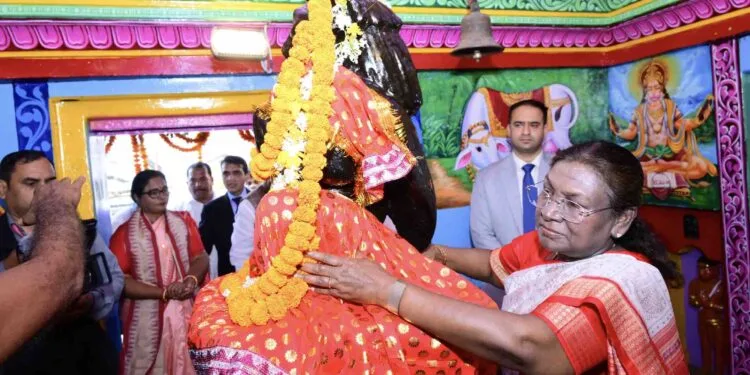
On Monday, March 24, President Droupadi Murmu took a spiritual journey to the Nilamadhaba Temple in Odisha’s Kantilo. More than just a place of worship, the temple holds a sacred significance for Hindus in Odisha. It is a living testament to how the state’s vibrant culture and traditions have evolved from ancient tribal customs, reflecting the deep-rooted connection between Dharma and the natural elements that have nurtured people for centuries. The rivers, forests, and seas have not only shaped the land but also the spiritual consciousness of its inhabitants.
The Cradle of Jagannath Worship
For the people of Odisha, Bhagwan Nilamadhaba represents an ancient and revered manifestation of Vishnu Ji. Long before Bhagwan Jagannath came to be worshipped at Puri, Nilamadhaba was worshipped with deep devotion at this very site. As per the Vishnu Sahasranama, ‘Neela Madhava’ is one of the 24 principal names of the deity. Historical records suggest that the worship of Nilamadhaba has existed for over a thousand years, dating back to at least the 4th century AD.
The roots of this sacred worship run deep along four of Odisha’s great rivers—Mahanadi, Rushikulya, Baitarani, and Prachi. Kantilo, where the temple stands, is situated on the banks of the mighty Mahanadi in Nayagarh district, approximately 110 km from Puri.
The Mystical Origins of Nilamadhaba
Odia folklore weaves a fascinating tale around the origins of Bhagwan Jagannath’s worship. It is said that in the distant Satya Yuga, a devoted king named Indradyumna had a divine dream in which Vishnu Ji revealed his presence in the form of Nilamadhaba at a hidden location along the Mahanadi. The deity was being worshipped by a tribal chief from the Shabara community under a grand tree. Inspired by this vision, the devout king sent his trusted Brahmin priest, Vidyapati, to locate the sacred idol and bring it to Puri, where a magnificent temple would be built for its worship.
After an arduous journey, Vidyapati reached the tribal kingdom, where he was welcomed by the tribal chief Bishwabasu. Seeking to earn the tribe’s trust, Vidyapati formed bonds with the community and eventually married Lalita, the daughter of Bishwabasu. However, he soon became aware of his father-in-law’s secret worship of Nilamadhaba in a hidden sanctuary deep within the forest.
Vidyaapati, eager to witness the deity, sought Lalita’s help. She persuaded her father to allow Vidyapati a darshan of Nilamadhaba. Bishwabasu agreed but blindfolded him before leading him to the sacred site. Determined to find his way back, Vidyapati cleverly carried mustard seeds in his pockets, scattering them along the path. Days later, when the seeds sprouted into tiny plants, they formed a natural trail to the hidden shrine.
When Vidyapati returned to his king with the news, Indradyumna eagerly set out with his entourage to retrieve Nilamadhaba. However, upon reaching the sacred site, they were heartbroken to find that the idol had vanished. Devastated but unwavering in his devotion, King Indradyumna renounced food and water, meditating with great penance to seek Vishnu Ji’s guidance.
Vishnu Ji finally appeared to Indradyumna and assured him that he would manifest as ‘Daaru Brahma’, a divine wooden log, on the shores of Puri. The king was instructed to construct a grand temple where the deity would be enshrined and worshipped in the form of Jagannath.
Divine Transformation into Bhagwan Jagannath
One day, a sacred log of Neem wood bearing divine markings was found on the beaches of Puri. Recognising it as the promised Daaru Brahma, King Indradyumna arranged for its transport to his palace, where Bhagwan Vishwakarma, the celestial architect, appeared in the guise of an old carpenter. He agreed to carve the idols of Jagannath, Balabhadra, and Subhadra, but on one condition: he must work in complete secrecy, behind locked doors, without any interruption.
Days passed, and the king and queen grew restless. Unable to contain their curiosity, they opened the doors before the idols were completed. At that very moment, the old carpenter vanished, leaving behind three beautiful yet unfinished idols, with incomplete hands and feet. Despite their imperfection, these idols were placed in the grand temple, where they continue to be revered by millions of devotees to this day.
The Legacy of the Daitapatis
The tribal community that had once worshipped Nilamadhaba was not forgotten. As a mark of respect for the devotion of Bishwabasu’s lineage, King Indradyumna honored them with a sacred duty. Lalita’s descendants, known as the Daitapatis, were entrusted with the special responsibility of serving Lord Jagannath. Even today, the Daitapatis play a crucial role in the rituals and ceremonies at the Jagannath Temple.
One of their most sacred duties is the ‘Naba Kalebara’ ritual, performed every 12 years. During this ceremony, new idols are carved from specially chosen Neem trees, whose locations are revealed in dreams to the Daitapatis. These trees bear divine marks such as the Shankha (conch), Chakra (disc), and other Vishnu symbols, signifying their spiritual importance.
The Eternal Connection
PM Droupadi Murmu’s visit to the Nilamadhaba Temple was not merely a political or ceremonial act—it was a homecoming, a tribute to the enduring faith of Odisha’s people. The temple stands as a bridge between ancient tribal customs and the Vaishnavite traditions that define Odisha’s spiritual identity. It reminds us that faith is not confined within temple walls but thrives in the rivers, forests, and hearts of the people who have carried its light through generations.
The legacy of Nilamadhaba continues to shine, not just in the grand temple of Puri but in the devotion of every pilgrim who bows before the deity, seeking the same divine grace that King Indradyumna once yearned for. It is a story of devotion, resilience, and an unbroken spiritual lineage that binds the past, present, and future of Odisha’s sacred heritage.