Aurangzeb: Institutionalising hatred for infidels
September 14, 2026
  • Read Ecopy
  • Circulation
  • Advertise
  • Careers
  • About Us
  • Contact Us
Android AppiPhone AppArattai
Organiser
  • ‌
  • Bharat
    • Assam
    • Bihar
    • Chhattisgarh
    • Jharkhand
    • Maharashtra
    • View All States
  • World
    • Asia
    • Europe
    • North America
    • South America
    • Africa
    • Australia
  • Editorial
  • International
  • Opinion
  • RSS @ 100
  • More
    • World Hindu Congress 2026
    • Op Sindoor
    • Analysis
    • Sports
    • Defence
    • Politics
    • Business
    • Economy
    • Culture
    • Special Report
    • Sci & Tech
    • Entertainment
    • G20
    • Azadi Ka Amrit Mahotsav
    • Vocal4Local
    • Web Stories
    • Education
    • Employment
    • Books
    • Interviews
    • Travel
    • Law
    • Health
    • Obituary
  • Subscribe
    • Subscribe Print Edition
    • Subscribe Ecopy
    • Read Ecopy
  • ‌
  • Bharat
    • Assam
    • Bihar
    • Chhattisgarh
    • Jharkhand
    • Maharashtra
    • View All States
  • World
    • Asia
    • Europe
    • North America
    • South America
    • Africa
    • Australia
  • Editorial
  • International
  • Opinion
  • RSS @ 100
  • More
    • World Hindu Congress 2026
    • Op Sindoor
    • Analysis
    • Sports
    • Defence
    • Politics
    • Business
    • Economy
    • Culture
    • Special Report
    • Sci & Tech
    • Entertainment
    • G20
    • Azadi Ka Amrit Mahotsav
    • Vocal4Local
    • Web Stories
    • Education
    • Employment
    • Books
    • Interviews
    • Travel
    • Law
    • Health
    • Obituary
  • Subscribe
    • Subscribe Print Edition
    • Subscribe Ecopy
    • Read Ecopy
Organiser
  • Home
  • Bharat
  • World
  • Operation Sindoor
  • Editorial
  • Analysis
  • Opinion
  • Culture
  • Defence
  • International Edition
  • RSS @ 100
  • Magazine
  • Read Ecopy
Home Politics

Aurangzeb: Institutionalising hatred for infidels

One of the Samajwadi Party leaders’ Abu Azmi’s comments sparked a furore once again on Aurangzeb’s legacy in Bharat. His comments came after the massive success of ‘Chhaava’, a biopic on Sambhaji, son of Chhatrapati Shivaji Maharaj, where people came to realise the torturous history of Aurangzeb

Deeksha TyagiDeeksha Tyagi
Mar 24, 2025, 07:30 pm IST
inPolitics, Bharat, Opinion
Follow on Google News
Origin of Controversy: AIMIM leader Akbaruddin Owaisi's visit to the tomb of Aurangzeb at Khuldabad
(File Photo)

Origin of Controversy: AIMIM leader Akbaruddin Owaisi's visit to the tomb of Aurangzeb at Khuldabad (File Photo)

Facebook
Twitter
WhatsAppTelegramEmail

Recently, Maharashtra witnessed yet another scandalous attempt at historical-white washing when SP legislator Abu Azmi audaciously praised Aurangzeb’s so-called ‘order’ and ‘temple-building’. Such shameless distortions conveniently forget who Aurangzeb was. Francois Benier, a French traveller, wrote: “The Great Mogol is a foreigner in Hindoustan. To maintain himself in such a country he is under the necessity of keeping up numerous armies, even in the time of peace.”

Deconstructing the Myths

Such cutting words, nearly three centuries old, capture the very essence of a ruler whose name has become a byword for religious intolerance and ruthless statecraft. Yet, in today’s Maharashtra, Aurangzeb is not merely a figure of ancient tyranny but an ever-present lightning rod for communal and political debate. While some in the popular imagination dare to elevate him as the greatest emperor of his time, one must not forget that Aurangzeb’s reign was one of the systematic destruction of Hindu temples, brutal massacres of innocent civilians, and the forcible conversion of vast swathes of the populace—a legacy that continues to stain the very soil of Bharatiya memory. The present discussion, therefore, is not an exercise in revisionist nostalgia but a historical exegesis that deconstructs the myth of Aurangzeb’s greatness. In doing so, we must remind ourselves of the long legacy of Islamic invaders whose ruthless tactics prefigured—and were ultimately amplified by—Aurangzeb’s policies. His actions, far from being isolated aberrations, were the logical, if horrific, culmination of centuries of invasion and conquest that transformed the subcontinent’s social and religious fabric. This essay scrutinises, with precision, the historical record and contemporary political controversies surrounding Aurangzeb, questioning the attempts to sanitise his legacy and calling for an unflinching acknowledgement of his cruelty.

In 1689, after the capture of Sambhaji Maharaj, the valiant son of Shivaji, Aurangzeb ordered a punishment so severe that it has become etched in the collective memory of Maharashtra

Aurangzeb’s actions against the Marathas are perhaps the most emblematic of his cruelty. In 1689, after the capture of Sambhaji Maharaj, the valiant son of Shivaji, Aurangzeb ordered a punishment so severe that it has become etched in the collective memory of Maharashtra. “On March 28, 1683, the commander-in-chief of Sambhaji Maharaj, Naroji, along with 100 Marathas, beheaded and displayed their heads in the form of a minar on Aurangzeb’s order” (Chh. Shivaji Maharaj Jhale, Mehendale, pp. 20–21). Later, on January 11, 1700, in Rahimatpur (Satara), minars constructed of the severed heads of Maratha soldiers testified to the emperor’s ruthless suppression of any form of resistance. Such acts were designed not only to demoralise the enemy but to send a clear message—any challenge to Mughal authority would be met with unrelenting brutality. Aurangzeb’s reign was also marked by the forcible conversion of Hindus. Historical records recount numerous instances of coercion:

Fanatic Tyrant

Such instances demonstrate that Aurangzeb’s policies were not merely about territorial conquest but also about the systematic “Islamisation” of the subcontinent. Forced conversions, backed by the threat of violence, served as a method of ethnic cleansing that would haunt Hindu collective memory for centuries (Archives of Foreign Sources), Vol. 6, No. 57). Perhaps the most damning evidence of Aurangzeb’s fanaticism lies in his own words. In a letter to the Subedar of Gujarat, he asserted, “At this time, I am engaged in Jihad and tirelessly working towards the extermination of wicked infidels… Every Muslim who takes pride in his religion should come forward to assist the Islamic emperor who has been engaged in Jihad at this time.” (Maasir-i-Alamgiri, p. 117)

His declaration is unambiguous. It leaves no doubt that Aurangzeb’s policies were driven by a desire to impose Islamic orthodoxy by exterminating those who did not share his beliefs. The political landscape of Maharashtra today is inextricably linked to the legacy of Aurangzeb. His name, once consigned to the records of Mughal history, now functions as a potent symbol in the charged arena of modern identity politics. Azmi’s remarks effectively sanitised the historical record by omitting the well-documented atrocities—Hundreds of Hindu Temples destroyed, innocent Hindus beheaded, and even the second Chhatrapati of Swarajya, Sambhaji Maharaj, was slaughtered. In the wake of this outcry, Azmi was suspended from the Maharashtra Assembly, which depicts the volatile nature of historical memory in the state. The battle over Aurangzeb’s legacy is not confined to academic debates—it has a tangible impact on public space. The city of Aurangabad, whose very name is a testament to the Mughal emperor’s rule, has become a focal point of renaming controversies. In 1995, the Shiv Sena-led municipal body passed a resolution to rename the city “Sambhajinagar” in honour of Sambhaji Maharaj, thereby erasing Aurangzeb’s imprint from the public consciousness. More recently, the BJP-backed Eknath Shinde government went further by renaming the city with the additional suffix “Chhatrapati,” a move that has been both celebrated and fiercely contested.

Aurangzeb’s open-air tomb in Khuldabad has likewise become a symbol of historical and political contestation. BJP’s Satara MP Udayanraje Bhosale has recently called for the demolition of the tomb, arguing that it “represents an affront to the memory of those who suffered under his reign”. In contrast, a few voices, such as that of Vanchit Bahujan Aghadi president Prakash Ambedkar, argue that history—no matter how painful—should not be erased but studied and remembered. In this scenario, we must ask:

What does it mean to celebrate an empire that was built on the annihilation of an entire cultural identity? When political leaders extol Aurangzeb as “great” or “noble,” are they not condoning the mass destruction of temples and the systematic subjugation of Hindus? Forgetting Aurangzeb’s atrocities is tantamount to forgetting the very reason behind the rise of Shivaji Maharaj’s Hindavi Swarajya.

Topics: Aurangzeb’s policiesEknath ShindeSambhaji MaharajMaharashtrShivaji Maharaj’sHindu Temples destroyed
Share
Tweet
SendShareSend
✮ Subscribe Organiser YouTube Channel. ✮
✮ Join Organiser's WhatsApp channel for Nationalist views beyond the news. ✮
Previous News

“Not Prime Minister, but pradhan sevak”: Modi’s vision for steering India’s future

Next News

Shimgotsav: Goa’s grand cultural extravaganza beyond beaches and parties

Related News

Aaditya Thakrey Hosted CJP's Saurav Das

Aaditya Thackeray hosts Saurav Das of CJP; Shinde Shiv Sena leaders say ‘Legacy of Balasaheb Thackeray insulted’

Shiv Sena (UBT) leader Uddhav Thackeray (Left) and Maharashtra Deputy Chief Minister Eknath Shinde (Right)

Maharashtra: Big setback for Uddhav Thackeray as LS speaker recognises merger of 6 (UBT) MPs with Eknath Shinde faction

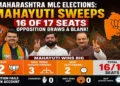
The BJP-led Mahayuti alliance secured a landslide victory in the Maharashtra MLC elections, winning 16 of 17 seats

Maharashtra MLC Elections: BJP-led Mahayuti sweeps 16 of 17 seats, delivering a crushing blow to the opposition

Shiv Sena (UBT) faces a fresh rebellion scare, prompting an emergency whip and a crucial Delhi showdown

Son with Uddhav, father with Shinde? Ashtikar family emerges as new flashpoint in Shiv Sena (UBT) crisis

Reports say, six Shiv Sena (UBT) MPs have merged with the Shiv Sena faction led by Maharashtra Deputy Chief Minister Eknath Shinde

What is Operation Tiger: How reports of 6 rebel MPs triggered fresh fears of another split in Uddhav Thackeray’s sena

Maharashtra Chief Minister Devendra Fadnavis

Maharashtra Government scraps 5% Muslim SEBC quota following legal review

Load More

Latest News

BRICS 2026: Brick by Brick

Bhagwan Ganesh

Ganesh Chaturthi: Awakening the Ganesha within

Tamil Nadu: Hindus protest TVK govt restrictions on Vinayaka Chaturthi celebrations in Muslim-dominated areas

Women’s Asia Cup 2026: India win the title; Mohsin Naqvi takes trophy away again—A breather for Pakistan’s headlines

Karnataka ‘Anti-Hindu’ face of state govt exposed? BJP leaders detained over Ganesh procession

A representative image

How PM SHRI schools are changing the way Bharat thinks about education

Cocroach Abhijit Dipke plays as MP CM, but is it an act? Who gave him this authority?

Abhijit Dipke ‘Resigns’ as MP CM, but when did he become Chief Minister & in what capacity did he use state symbols?

Ganesh Chaturthi 2026

Ganesh Chaturthi 2026: From Lalbaugcha Raja to Kolkata’s ‘New Bengal’, faith & festivity centre stage

Rashtriya Hindi Diwas (AI-generated Image)

Rashtriya Hindi Diwas 2026: From Devanagari to AI, Hindi charts a powerful new journey

Fact Check: Viral Video Falsely Claims PM Modi Said He Would End Poverty ‘In One Go’

FACT CHECK: Did PM Modi say he would end poverty in Bharat in one go? Viral video is clipped

Load More
  • Privacy
  • Terms
  • Cookie Policy
  • Refund and Cancellation
  • Delivery and Shipping

© Bharat Prakashan (Delhi) Limited.
Tech-enabled by Ananthapuri Technologies

  • Home
  • Search Organiser
  • Bharat
    • Assam
    • Bihar
    • Chhattisgarh
    • Jharkhand
    • Maharashtra
    • View All States
  • World
    • Asia
    • Africa
    • North America
    • South America
    • Europe
    • Australia
  • Editorial
  • Operation Sindoor
  • Opinion
  • Analysis
  • Defence
  • Culture
  • Sports
  • Business
  • RSS @ 100
  • Entertainment
  • More ..
    • Sci & Tech
    • Vocal4Local
    • Special Report
    • Education
    • Employment
    • Books
    • Interviews
    • Travel
    • Health
    • Politics
    • Law
    • Economy
    • Obituary
  • Subscribe Magazine
  • Read Ecopy
  • Advertise
  • Circulation
  • Careers
  • About Us
  • Contact Us
  • Policies & Terms
    • Privacy Policy
    • Cookie Policy
    • Refund and Cancellation
    • Terms of Use

© Bharat Prakashan (Delhi) Limited.
Tech-enabled by Ananthapuri Technologies