
Communal tensions flared in Giridih during Holi celebrations when a Hindu procession was attacked upon entering a lane near a mosque. The incident, which occurred on March 14, has sparked outrage over the nature of the First Information Report (FIR), which primarily frames the entry of the Hindu group into the lane as an ‘offence,’ rather than addressing the violence that ensued.
Incident Details
According to the FIR, the Holi procession, allegedly playing loud music, attempted to pass through Masjid Road, a narrow street adjacent to a mosque. At the time, members of the Muslim community had gathered for evening prayers (namaz). Officials on duty attempted to stop the procession from proceeding through the lane. However, the participants insisted on taking their usual route, as they had done in previous years.
As soon as the procession entered the lane, it was met with a violent assault. Stones, glass bottles, and petrol bombs were hurled at the procession not only from the mosque but also from surrounding areas. The violence escalated, resulting in vehicles being torched and significant damage to property. Despite the grave nature of these attacks, the FIR predominantly emphasises the entry of the Holi procession into the lane as a criminal act.
Legal Proceedings and FIR Details
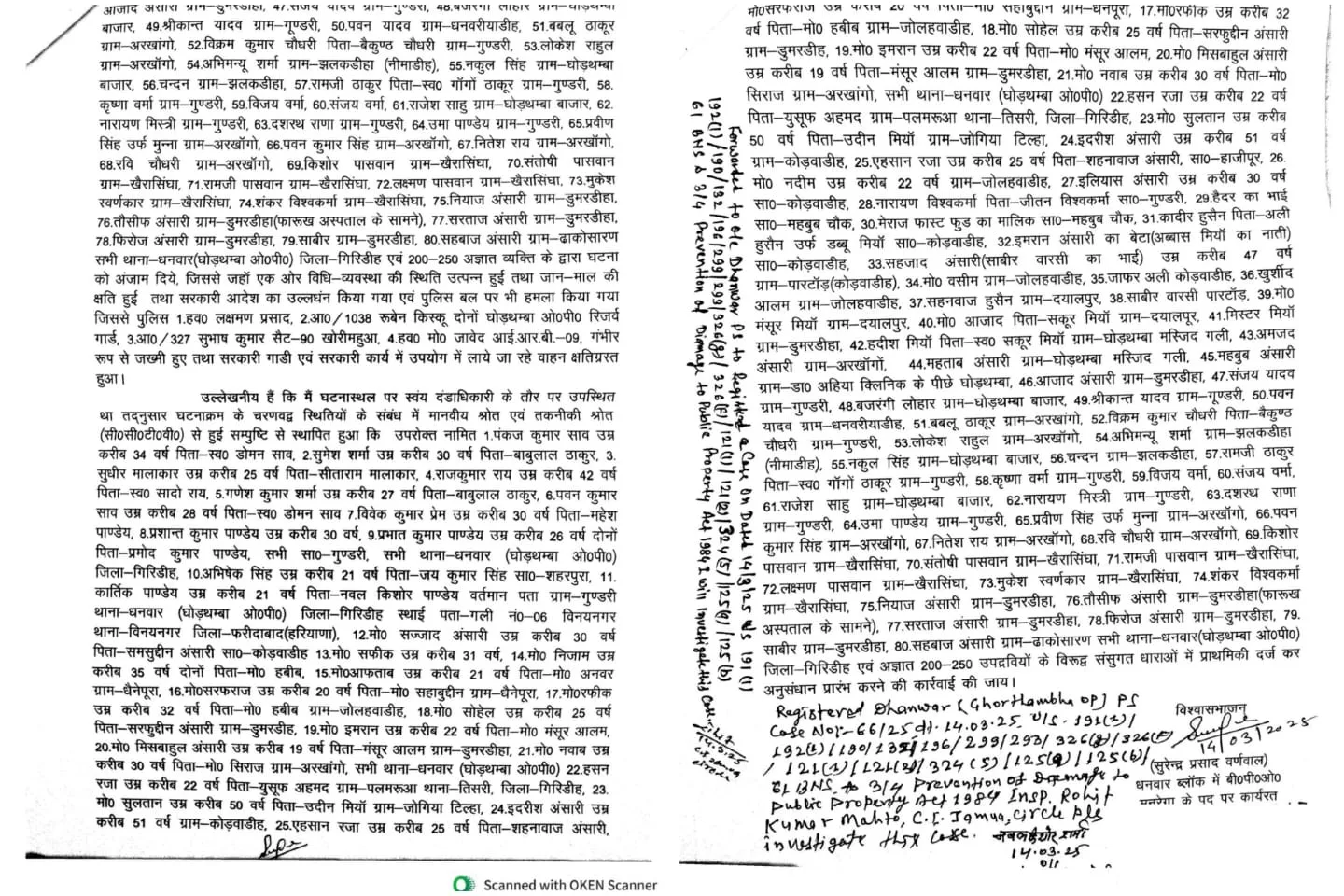
An FIR (No. 66/25) was registered at Ghorthamba Police Station on March 14, and the accused have been booked under multiple sections of the Bharatiya Nyaya Sanhita (BNS), including Sections 191(1), 192(1), 190, 132, 196, 299, 293, 326(g), 326(f), 212(1), 121(2), 324(5), 125(9), 125(b), 61 and Sections 3/4 of the Prevention of Damage to Public Property Act, 1984.
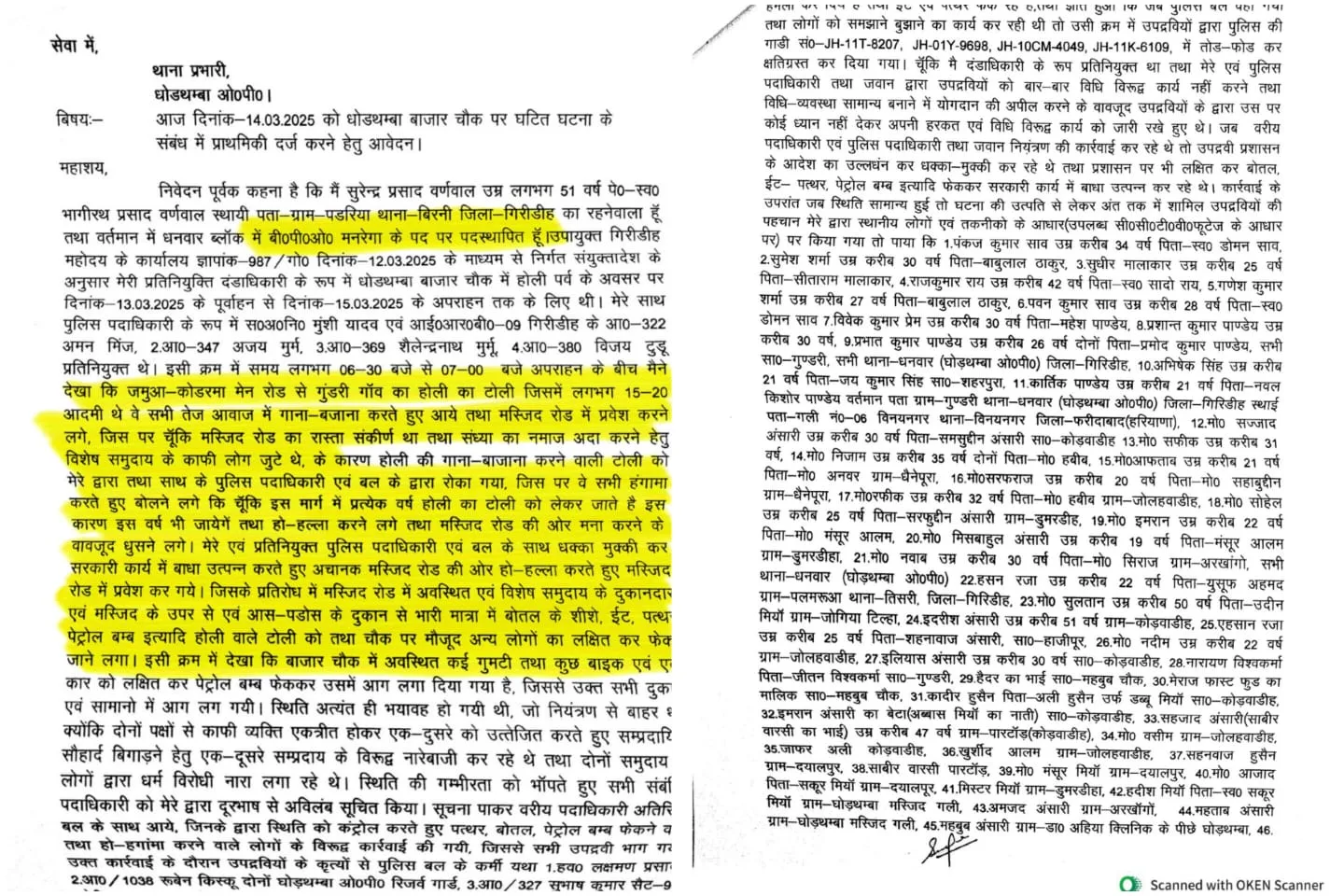
The FIR was filed by Surendra Prasad Barnwal, a 51-year-old Block Program Officer (BPO) posted in Dhanwar Block. He was deputed at Dhodthamba Bazaar Chowk during the Holi festival under official orders issued by the Deputy Commissioner of Giridih.
Account from the FIR
According to Barnwal’s statement in the FIR, the incident occurred between 6:30 PM and 7:00 PM when a group of about 15-20 people from Gundri village arrived at Masjid Road playing loud music. Given that a large congregation was present for namaz, the officials attempted to prevent the procession from proceeding through the lane. However, the group insisted on using the traditional route and proceeded forward, leading to clashes.
The FIR reads, “The Holi group, playing loud music, tried to enter the mosque road. Since it was namaz time and Muslims were gathered there, the officials tried to stop the group, but the group didn’t stop, saying they have been passing through here for years and will do so this time too.”
Following their entry, shopkeepers and individuals from the mosque and nearby buildings began pelting stones, glass bottles, and petrol bombs at the procession and others present at the chowk. The violence quickly escalated, with multiple kiosks, bikes, and cars being set ablaze. The police were overwhelmed as both communities gathered in large numbers, chanting slogans and exacerbating communal tensions.
Upon assessing the situation, senior officials rushed to the scene with additional forces to restore order. Police took action against those instigating violence, leading to the dispersal of miscreants. However, by that time, significant damage had already been inflicted. Several police personnel sustained injuries, including A/1038 Ruben Kisku (Ghorthamba OP Reserve Guard), A/327 Subhash Kumar (Set-90 Khorimahua), HW Mohd Javed (IRB-09).
The miscreants torched six motorcycles, two cars, and several kiosks, including a tire shop and a clothing store.
Additionally, reports emerged that the temple behind Masjid Gali was attacked, with individuals hurling stones and bricks. The police, in an effort to contain the situation, faced attacks on their vehicles, with several government and police cars sustaining severe damage.
Identification of Accused
After reviewing CCTV footage and gathering eyewitness accounts, police identified multiple individuals allegedly involved in the violence. Among them were:
Pankaj Kumar Sahu (34 years), Sumesh Sharma (30 years), Sudhir Malakar (25 years), Rajkumar Rai (42 years), Ganesh Kumar Sharma (27 years), Pawan Kumar Sahu (28 years), Vivek Kumar Prem (30 years), Prashant Kumar Pandey (30 years), Prabhat Kumar Pandey (26 years)—all from Gundri, Dhanwar Police Station jurisdiction.
Md. Sajjad Ansari (30 years), Md. Safiq (31 years), Md. Nizam (35 years), Md. Aftab (21 years), Md. Sarfaraz (20 years), Mohammed Rafiq (32 years), Mohammed Sohail (25 years), Mohammed Imran (22 years), Mohammed Misbahul Ansari (19 years), Mohammed Nawab (30 years), Hasan Raza (22 years), Mohammed Sultan (50 years), Idrish (age unknown)—all from various villages in Giridih District.
What is Soren Govt doing?
The violent attack in Giridih raises critical questions about the Hemant Soren government’s handling of communal tensions in the state. How can a legally permitted Hindu procession be blamed for merely following its traditional route, while those who pelted stones, hurled petrol bombs, and set vehicles ablaze are treated with leniency?
The FIR’s framing, which emphasises the entry of the procession into a lane rather than addressing the violent assault that followed, suggests an alarming bias in law enforcement. Why did the administration fail to act swiftly despite the presence of officials at the site? Why weren’t preventive measures in place when tensions were anticipated?
The government’s silence on the targeted attack against the temple behind Masjid Gali and the failure to ensure adequate security for Hindu festivals reflect a pattern of selective justice. Is the Soren government prioritising appeasement over law and order?