





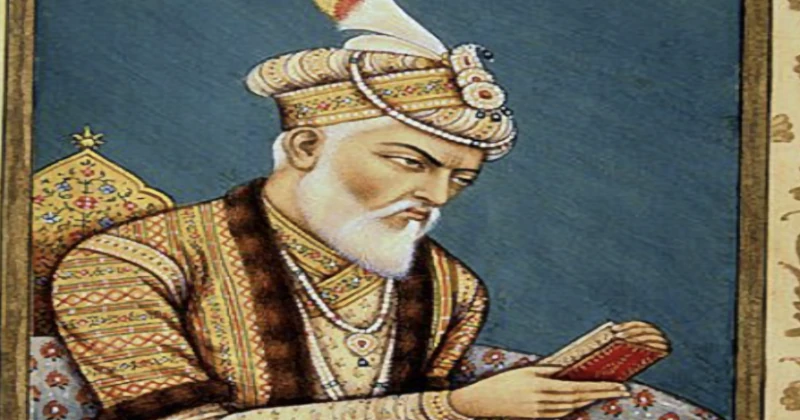
Recently, Maharashtra witnessed yet another scandalous attempt at historical-white washing when SP legislator Abu Azmi audaciously praised Aurangzeb’s so-called ‘order’ and ‘temple-building’. Such shameless distortions conveniently forget who Aurangzeb was.
Francois Benier, a French traveller, wrote: “The Great Mogol is a foreigner in Hindoustan. To maintain himself in such a country he is under the necessity of keeping up numerous armies, even in the time of peace”.
Such cutting words, nearly three centuries old, capture the very essence of a ruler whose name has become a byword for religious intolerance and ruthless statecraft. Yet, in today’s Maharashtra, Aurangzeb is not merely a figure of ancient tyranny but an ever-present lightning rod for communal and political debate. While some in the popular imagination dare to elevate him as the greatest emperor of his time, one must not forget that Aurangzeb’s reign was one of the systematic destruction of Hindu temples, brutal massacres of innocent civilians, and the forcible conversion of vast swathes of the populace—a legacy that continues to stain the very soil of Bharatiya memory.
The present discussion, therefore, is not an exercise in revisionist nostalgia but a historical exegesis that deconstructs the myth of Aurangzeb’s greatness. In doing so, we must remind ourselves of the long legacy of Islamic invaders whose ruthless tactics prefigured—and were ultimately amplified by—Aurangzeb’s policies. His actions, far from being isolated aberrations, were the logical, if horrific, culmination of centuries of invasion and conquest that transformed the subcontinent’s social and religious fabric. This essay scrutinizes, with precision, the historical record and contemporary political controversies surrounding Aurangzeb, questioning the attempts to sanitize his legacy and calling for an unflinching acknowledgement of his cruelty.
Before Aurangzeb even set foot on the throne, the subcontinent had been subjected to waves of brutal invasions. These invasions provided both the template and the ideological justification for later policies of religious intolerance.
In 1398–99, Timur’s forces swept into Delhi with a ferocity that has never been forgotten. As described by contemporaries, “within five days, looting began in the Delhi region according to Timur’s orders, and those who opposed were left only as corpses. The streets of Delhi were filled with the remains of the dead”. Timur then marched on to Haridwar, and upon reaching Gomukh—where the Ganges flows—he is reported to have “got fierce, and out of compassion, he killed many Hindu people present”. Furthermore, Timur is said to have prayed:
“I have come here for two purposes. One is to plunder the infidels [Kafirs] and facilitate their passage to the afterlife, and the other is to plunder their wealth and establish Islam in this world” (Muslamani Riyasat Part 1 pg 177-78).
This prelude of terror was not an isolated incident; it established a pattern of systematic brutality that would later find its apotheosis in Aurangzeb’s policies.
Babur’s incursions set another grim precedent. Near the village of Samana in the Sarhind region, Babur sent Tarsam Bahadur with “6,000 soldiers, horses, and elephants.” Tarsam Bahadur’s assault was merciless: the village was “attacked and fired, killing many of its inhabitants,” and approximately 1,000 men, women, and children were captured, beheaded, and their heads raised as a gruesome spectacle (Baburnama, pp. 700–701). Such actions were not sporadic; they were designed to terrorize the local populace into submission—a tactic that would later be institutionalised under Aurangzeb.
After capturing the impregnable fort of Chittorgarh in 1568, court historian Abul Fazl records that Akbar ordered the “Qatl-e-Aam” (massacre) in which “nearly thirty thousand people were killed” (Abul Fazl, as cited in Mundy). This massacre not only secured his “Ghazi” title—“One who fights for religion”—but also normalized the use of mass violence as an instrument of statecraft.
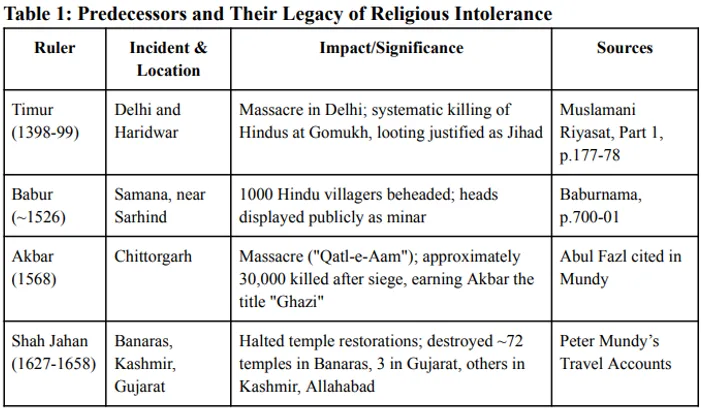
Together, these early examples of Islamic conquest provided the ideological and practical framework for a ruler who would later take the policies of terror to new extremes. Aurangzeb, far from being an anomaly, was the logical culmination of this brutal prelude. (Summarised in the table):
Aurangzeb’s rule, lasting 49 years, is widely remembered as the apex of Mughal intolerance—a period during which Islamic orthodoxy was enforced with uncompromising severity. Aurangzeb was not a ruler who wavered. “Aurangzeb belonged to the Sunni sect of Islam. He was not as liberal as Akbar and held strong religious beliefs” His personal life was characterised by a preference for the austere company of fakirs and clerics, a clear indication of his commitment to orthodox Islam. This ideological rigidity laid the foundation for his later actions, which would reshape the subcontinent’s cultural landscape through violence and coercion.
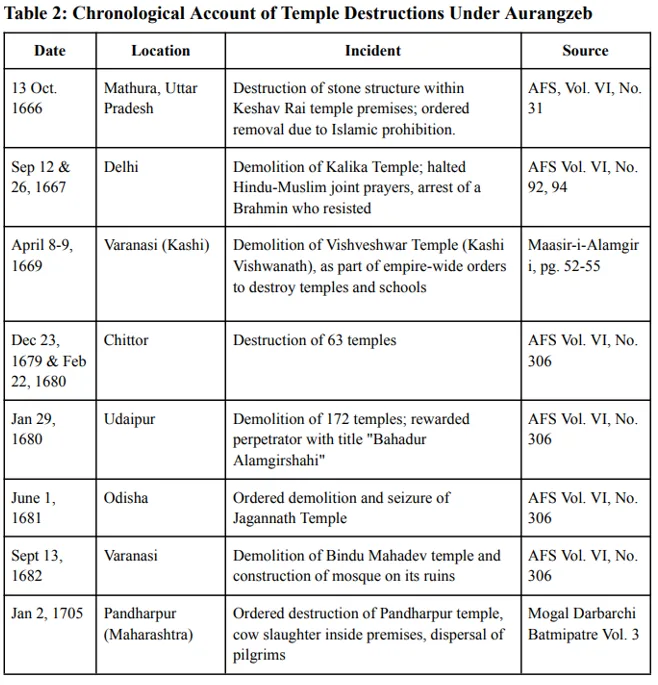
Perhaps nothing encapsulates Aurangzeb’s legacy more vividly than his systematic campaign against Hindu temples.
Aurangzeb’s actions against the Marathas are perhaps the most emblematic of his cruelty. In 1689, after the capture of Sambhaji Maharaj, the valiant son of Shivaji, Aurangzeb ordered a punishment so severe that it has become etched in the collective memory of Maharashtra. “On 28 March 1683, the commander-in-chief of Sambhaji Maharaj, Naroji, along with 100 Marathas, beheaded and displayed their heads in the form of a minar on Aurangzeb’s order” (Chh. Shivaji Maharaj Jhale, Mehendale, pp. 20–21). Later, on 11 January 1700, in Rahimatpur (Satara), minars constructed of the severed heads of Maratha soldiers testified to the emperor’s ruthless suppression of any form of resistance. Such acts were designed not only to demoralise the enemy but to send a clear message: any challenge to Mughal authority would be met with unrelenting brutality.
Aurangzeb’s reign was also marked by the forcible conversion of Hindus. Historical records recount numerous instances of coercion:
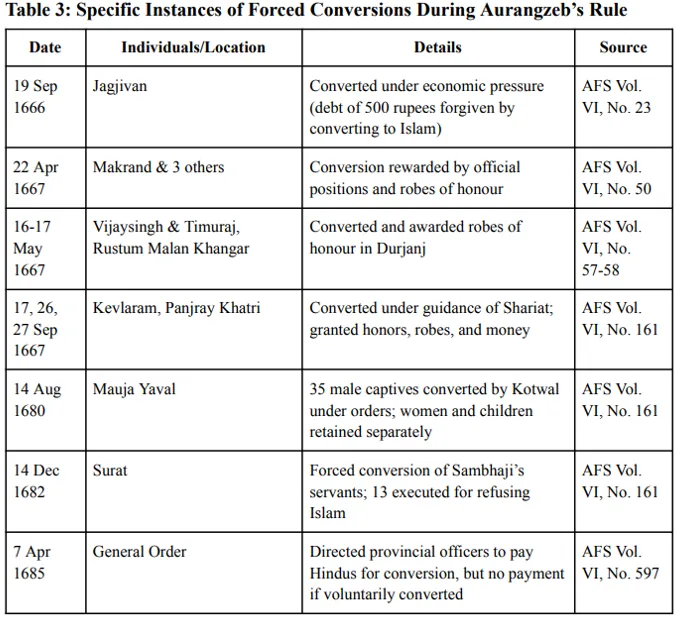
Such instances demonstrate that Aurangzeb’s policies were not merely about territorial conquest but also about the systematic “Islamisation” of the subcontinent. Forced conversions, backed by the threat of violence, served as a method of ethnic cleansing that would haunt Hindu collective memory for centuries (AFS, Vol. 6, No. 57).
Perhaps the most damning evidence of Aurangzeb’s fanaticism lies in his own words. In a letter to the Subedar of Gujarat, he asserted:
“At this time, I am engaged in Jihad and tirelessly working towards the extermination of wicked infidels… Every Muslim who takes pride in his religion should come forward to assist the Islamic emperor who has been engaged in Jihad at this time” (Maasir-i-Alamgiri, p. 117).
His declaration is unambiguous. It leaves no doubt that Aurangzeb’s policies were driven by a desire to impose Islamic orthodoxy by exterminating those who did not share his beliefs.
The political landscape of Maharashtra today is inextricably linked to the legacy of Aurangzeb. His name, once consigned to the records of Mughal history, now functions as a potent symbol in the charged arena of modern identity politics.
Azmi’s remarks effectively sanitised the historical record by omitting the well-documented atrocities—Hundreds of Hindu Temples destroyed, innocent Hindus beheaded, and even the second Chhatrapati of Swarajya, Sambhaji Maharaj, was slaughtered. In the wake of this outcry, Azmi was suspended from the Maharashtra Assembly, which depicts the volatile nature of historical memory in the state.
The battle over Aurangzeb’s legacy is not confined to academic debates—it has a tangible impact on public space. The city of Aurangabad, whose very name is a testament to the Mughal emperor’s rule, has become a focal point of renaming controversies. In 1995, the Shiv Sena-led municipal body passed a resolution to rename the city “Sambhajinagar” in honor of Sambhaji Maharaj, thereby erasing Aurangzeb’s imprint from the public consciousness. More recently, the BJP-backed Eknath Shinde government went further by renaming the city with the additional suffix “Chhatrapati,” a move that has been both celebrated and fiercely contested.
Aurangzeb’s open-air tomb in Khuldabad has likewise become a symbol of historical and political contestation. BJP’s Satara MP Udayanraje Bhosale has recently called for the demolition of the tomb, arguing that it “represents an affront to the memory of those who suffered under his reign”. In contrast, a few voices, such as that of Vanchit Bahujan Aghadi president Prakash Ambedkar, argue that history—no matter how painful—should not be erased but studied and remembered. In this time, we must ask:
What does it mean to celebrate an empire that was built on the annihilation of an entire cultural identity? When political leaders extol Aurangzeb as “great” or “noble,” are they not, in effect, condoning the mass destruction of temples and the systematic subjugation of Hindus? Forgetting Aurangzeb’s atrocities is tantamount to forgetting the very reason behind the rise of Shivaji Maharaj’s Hindavi Swarajya.
How can we reconcile the so-called greatness of Aurangzeb with the irrefutable evidence of his brutality?Despite claims by revisionist scholars that Aurangzeb maintained order and upheld religious duty, the historical record speaks otherwise. His own words— “I am engaged in Jihad and tirelessly working towards the extermination of wicked infidels” (Maasir-i-Alamgiri, p. 117)—must be read alongside eyewitness accounts of temple destructions and massacres. How can any rational observer accept such contradictions?
Can history ever be truly neutral when its narrative is so deeply politicised? The use of Aurangzeb’s legacy in contemporary political debates forces us to confront the problem of historical amnesia. How do we ensure that our study of history is not contaminated by the selective memories and ideological biases of the present? Must we not, we must decolonise our understanding by acknowledging that the “received view” of history is often nothing more than a reification of colonial epistemes?
Aurangzeb’s reign remains a dark chapter in the history of Bharatiya civilisation—a period when religious zeal was weaponised to perpetrate unspeakable atrocities. His policies, from the systematic destruction of temples to the forced conversion of millions, were not aberrations but the culmination of a centuries-long tradition of Islamic conquest and brutality. To celebrate Aurangzeb as a “great” emperor is to engage in an act of collective historical amnesia. It is to ignore the blood spilled in the streets of Delhi under Timur, the headless displays of Maratha warriors in the Deccan, and the cultural annihilation that continues to haunt our temples and traditions. The evidence is incontrovertible: Aurangzeb’s legacy is one of terror, intolerance, and the ruthless imposition of a foreign ideology upon an indigenous people.
We must ask ourselves: can we, in good conscience, celebrate a ruler who ordered, “I am engaged in Jihad and tirelessly working towards the extermination of wicked infidels” (Maasir-i-Alamgiri, p. 117)? Calling out who Aurangzeb actually was is not merely a rhetorical device; it is a moral imperative, a call to remember and to ensure that such a reign of terror is never again allowed to shape the destiny of Bharata.















Comments