





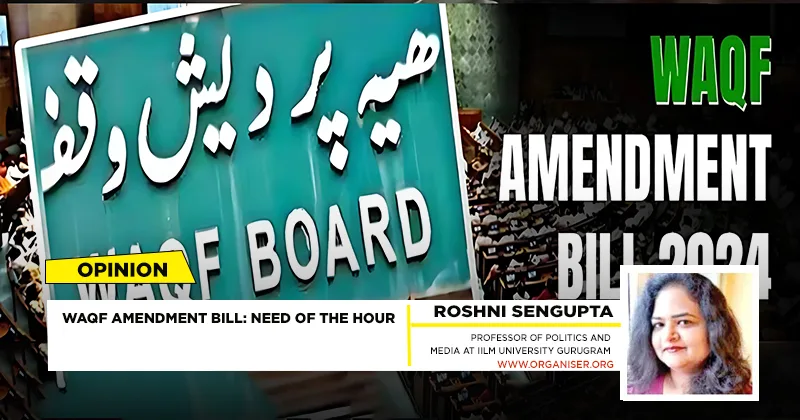
Government action on the Waqf Amendment Bill has been in the news over the past weeks for all the wrong reasons. On one hand, we have had so-called luminaries of the Muslim political class vying for media attention, exclaiming how the amendments proposed by the government will potentially bring ruination to Indian Muslims, taking away their land and properties. Some even invoked – in supercilious terms – how the Muslims had trusted the secular promise of post-independence India and not decided to migrate to the newly formed homeland for South Asia’s Muslims, Pakistan. And now, for reasons unfathomable to them, that trust was being broken and called into question by the Modi government.
Interestingly, the fear psychosis that permeated statements made by Muslim netas such as Asaduddin Owaisi, Farooq Abdullah, and Imran Masood percolated down to the masses with students launching protests in and outside Jamia Milia Islamia in New Delhi and other such Muslim-run institutions.
What is more, loud screeching from the Opposition benches forced the government to assign the amendment bill to a joint parliamentary committee, which – needless to say – did not find anything inimical to the fundamental rights of the Muslims! In fact, the amendment bills – namely the Waqf (Amendment) Bill, 2024, and the Mussalman Wakf (Repeal) Bill, 2024 – are geared towards democratising the otherwise rigid and inflexible laws, thereby potentially benefitting the Muslims. Contrary to all the unnecessary noise and superfluous politicking accompanying the tabling of the bills, both might prove to be essential and timely amendments to the existing laws for primarily two reasons. First, the amendments will possibly streamline the functions performed by the Waqf Boards, ensuring the much-needed efficient and competent management of Waqf properties. Second, the bills, especially the Mussalman Wakf (Repeal) Bill, 2024 seek to get rid of a redundant colonial-era law which has become inadequate for regulating Waqf properties in modern India. Furthermore, the amendments are a positive step towards greater democratisation of the bodies – and laws – that govern Muslim property rights, a step up after the success of the revolutionary benefits brought forth for Muslim women in India by the Muslim Women (Protection of Rights on Marriage) Act, 2019 which outlawed the practice of triple talaq.
The history of Waqf in India could be traced back to the early days of the Delhi Sultanate when Muhammad Ghori dedicated – rather donated – two villages in favour of the Jama Masjid of Multan, handing its administration to Shaikhul Islam. As the Delhi Sultanate and later Islamic dynasties flourished, the number of Waqf properties kept burgeoning.
Subsequently, in the late 19th century, a case was made for the abolition of Waqfs in India when a dispute over a Waqf property landed in the Privy Council of London during the days of the Raj. The four British judges who heard the case described the Waqf as “a perpetuity of the worst and the most pernicious kind”, declaring Waqf to be invalid. However, the decision by the four judges was not accepted in India, and the Mussalman Waqf Validating Act of 1913 was enacted to protect the institution of Waqf in India. Since then, no attempt has been made to curb Waqfs. The growth of land holdings – ostensibly donated to Allah by Muslims since that is what waqf effectively means – has been more than exponential. In fact, the land held under the institution of the Waqf is next only to the Indian Army and the Indian Railways! Wakf Boards currently control 8.7 lakh properties spanning 9.4 lakh acres across India with an estimated value of 1.2 lakh crores. As such, India has the largest waqf holding in the world. There are 356, 051 Waqf estates registered under Waqf Boards, out of which 124, 725 are in Uttar Pradesh alone.
Over the years, there have been several instances of illegal takeover of properties – even those not belonging to Muslims – by the institution of the Waqf citing the rights and protections provided by the existing Waqf Act, a legislation that has been repeatedly strengthened post-independence mainly to pander to the principle of appeasement by subsequent Congress or Congress-led governments. The Waqf Act, 1995, and its 2013 amendment have been criticised for inefficacy, leading to issues like encroachment, mismanagement, ownership disputes, and delays in registration and surveys. There is no judicial oversight on tribunal decisions, further complicating the management of Waqf institutions and properties. Without the possibility of appealing to a higher judicial body, decisions made by the Waqf tribunal are deemed to undermine transparency, and accountability in the management of Waqf properties. Having analyzed the nature and quantum of grievances received, the Ministry found that out of 148 complaints received from April, 2023, most pertained to encroachments, illegal sales of Waqf land, delays in surveys and registration, and complaints against Waqf Boards and Mutawallis. The Ministry also analysed complaints received on the Centralized Public Grievance Redress and Monitoring System (CPGRAMS) from April 2022 to March 2023 and found that out of 566 complaints, 194 related to encroachment and transfer of Waqf land illegally, and 93 were filed against the officials of Waqf Board, i.e., Mutawallis.
The alternative discourse led by the Bharatiya Janata Party – since 2014 by the Modi government – has consistently worked towards deepening and broadening democracy by wresting it out of the gilded hands of the power elite whereby the benefits of welfare percolate down to the most marginalised sections. One of the groups specifically earmarked has been the Indian Muslims who have suffered marginalisation accruing from decades of appeasement leading to nothing but deep-rooted social and economic underdevelopment. In taking the effort forward, the abolition of the triple talaq is now followed up and buttressed by the Waqf Amendment Bill – geared towards putting the house in order, so to speak. In order to ensure transparency and accountability in Waqf dealings and transactions given the surfeit of complaints and irregularities, both the Sachar Committee and the Joint Parliamentary Committee recommended the revamping of the composition of the Waqf Boards, emphasised the need for regulation of the functioning of the Mutawallis, advocated for efficient record management and stringent action against unauthorised alienation of Waqf properties, spoke in favour of institutionalising the option of taking certain matters to the Hon’ble High Court under Writ jurisdiction, and bringing the Waqf under the scheme of financial audit.
The amendment bill contains these reforms and some others, reforms that have been long pending for the betterment and progress of Indian Muslims and their properties. It also safeguards non-Muslims against arbitrary encroachments by the Waqf institutions, a much-needed measure. As much as the Owaisis, Abdullahs, and Masoods might deny it – for purposes of political expediency – the Waqf Amendment Bill tabled by the government is a huge step in the right direction and must be supported without any reservations.















Comments