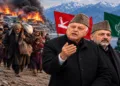
The Parliament of India made history on February 22, 1994 when a special resolution on J& K was passed unanimously by the representatives present in the two Houses. All parties cutting across the ideological barriers came to a consensus in this regard keeping in view the unity and integrity of the nation and the requirements of the times. Following increasing terrorist violence in J & K, genocide and ethnic cleansing of Hindus in Kashmir valley and Pakistan’s attempts to highlight the Kashmir issue at international level, both houses of the Indian Parliament adopted the resolution emphasizing that J & K was an integral part of India, and that Pakistan must vacate parts of the State under its occupation.
This resolution of the Parliament caught the attention of all concerned and it exhibited our national resolve in the context of J & K in the most befitting manner. Though the resolution was brought by the then Congress government in the house, the opposition in the house –the BJP extended its full and unconditional support to the resolution. In order to commemorate the spirit of this resolution, the nation has been observing February 22 every year as the “Jammu & Kashmir Sankalp-Divas”. In order to debate the issue further, it would be plausible first to go through the original text of the resolution under discussion. The resolution follows:
“This House notes with deep concern Pakistan’s role in imparting training to the terrorists in camps located in Pakistan and Pakistan Occupied Kashmir, the supply of weapons and funds, assistance in infiltration of trained militants, including foreign mercenaries into J & K with the avowed purpose of creating disorder, disharmony and subversion:
Reiterates that the militants trained in Pakistan are indulging in murder, loot and other heinous crimes against the people, taking them hostage and creating an atmosphere of terror;
Condemns strongly the continued support and encouragement Pakistan is extending to subversive and terrorist activities in the Indian state of J & K;
Calls upon Pakistan to stop forthwith its support to terrorism, which is in violation of the Shimla Agreement and the internationally accepted norms of inter-State conduct and is the root cause of tension between the two countries reiterates that the Indian political and democratic structures and the Constitution provide for firm guarantees for the promotion and protection of human rights of all its citizens;
Regard Pakistan’s anti-India campaign of calumny and falsehood as unacceptable and deplorable.
Notes with deep concern the highly provocative statements emanating from Pakistan urges Pakistan to refrain from making statements which vitiate the atmosphere and incite public opinion;
Expresses regret and concern at the pitiable conditions and violations of human rights and denial of democratic freedoms of the people in those areas of the Indian State of J & K, which are under the illegal occupation of Pakistan;
On behalf of the People of India, it firmly declares that-
(a) The State of Jammu & Kashmir has been, is and shall be an integral part of India and any attempts to separate it from the rest of the country will be resisted by all necessary means;
(b) India has the will and capacity to firmly counter all designs against its unity, sovereignty and territorial integrity;
And demands that –
(c) Pakistan must vacate the areas of the Indian State of J & K, which they have occupied through aggression; and resolves that –
(d) All attempts to interfere in the internal affairs of India will be met resolutely.”
The Resolution was unanimously adopted on February 22, 1994 by both the houses of the parliament and it became one of the five most important documents (panch-patra) regarding J & K from our national perspective. The other four documents comprise the following:
1. Instrument of Accession signed by Maharaja Hari Singh, the then ruler of the Princely state of J& K, on October 26, 1947, consequent upon Pakistan’s aggression on the state in September 1947,
2. Shimla Agreement of 1972 signed by Indira Gandhi and Z.A.Bhutto, Prime Ministers of India and Pakistan respectively, after the 1971 war between the two countries. The Agreement endorsed the position that J& K was a bilateral issue between India and Pakistan and thus virtually and practically nullified the UN Resolution on J&K which was the outcome of the follies of Jawahar Lal Nehru who took Kashmir issue to the UN in 1948 without Cabinet approval,
3. Countries including India and the United Nations demanded that Pakistan stop using its territory as a base for terrorist groups following multiple terrorist attacks by Islamic jihadists in J & K and other parts of India and Pakistan’s commitment to not allow the land under its control to be used for terrorist activities against India, and
4. Resolution passed by the parliament of India on 5th August 2019 abrogating Article 370 and 35A of the Indian constitution.
The resolution of 1994 unambiguously mentions the role of Pakistan in regard to its various attempts to annex J & K by use of force. Having failed in all its attempts to do so in the past, Pakistan adopted the route of Islamic terrorism to create pressure upon India to have negotiation on the issue of J & K. The resolution amply depicts Pakistan as the sponsor of terrorism in the Jammu and Kashmir state. It also mentions the destruction that cross-border terrorism has brought in the Indian state of Jammu and Kashmir.
It also details the pitiable conditions of the people living in those areas of the J & K state which are under an illegal occupation of Pakistan. These areas include the districts of Muzaffarabad, Mirpur and Poonch commonly called PoJK, Gilgit and Baltistan -areas of Ladakh Union Territory and also the areas in the northern part that have been ceded by Pakistan to China. The resolution expresses regret and concern at the violations of human rights and denial of democratic freedoms of the people living in these areas under the illegal control of Pakistan.
The declaration that J&K has been, is and shall be an integral part of India and any attempts to separate it from the rest of the country will be resisted by all necessary means is fundamentally a solemn pledge of the Indians in regard to the position and status of J & K. It also expresses in no uncertain words the will and capacity of the nation to firmly counter all designs against its unity, sovereignty and territorial integrity. The abrogation of Article 370 and 35A in August 2019 by the parliament is in a way an extension of the firm resolve expressed in the 1994 Resolution.
While the resolution expresses the resolve that all attempts to interfere in the internal affairs of India will be met resolutely, it asks Pakistan to vacate the areas of the Indian state of J & K which have been occupied by Pakistan through aggression in 1947. Pakistan’s anti-India campaign of calumny and falsehood has been deplored and condemned in the historic resolution.
The State of India after the 2008 Mumbai terror attacks took a hard position vis a vis Pakistan. It said that India won’t hold any talks with Pakistan up to the time the State of Pakistan continues to indulge in acts of terrorism against India directly or indirectly. In 2014, when PM Narendra Modi took over as the Prime Minister of the nation, the government of India adopted the doctrine “Terror & Talks won’t go together”. The government in tune with the will and aspirations of the people emphasized and executed the doctrine in the spirit of the 1994 resolution.
Consequent upon the implementation of the doctrine in letter and spirit by India, Pakistan over the last one decade has been completely isolated at the regional and international level. Pakistan has been severely punished by India diplomatically and politically both and given it a taste of its crimes against India and humanity.
There is an unfinished task in regard to the historic resolution and that is to recover the land that legally belongs to India and is under the illegal occupation of Pakistan. The observance of “J & K ‘s Sankalp-Divas” on February 22 every year is a reminder in this context. The nation-state of India is deeply committed to the letter and spirit of the resolution of 1994 and on this day further resolves to realize the goal set in the Historic Resolution.