From DeepSeek to DeepSeekh: Lessons for India
June 5, 2026
  • Read Ecopy
  • Circulation
  • Advertise
  • Careers
  • About Us
  • Contact Us
Android AppiPhone AppArattai
Organiser
  • ‌
  • Bharat
    • Assam
    • Bihar
    • Chhattisgarh
    • Jharkhand
    • Maharashtra
    • View All States
  • World
    • Asia
    • Europe
    • North America
    • South America
    • Africa
    • Australia
  • Editorial
  • International
  • Opinion
  • RSS @ 100
  • More
    • Op Sindoor
    • Analysis
    • Sports
    • Defence
    • Politics
    • Business
    • Economy
    • Culture
    • Special Report
    • Sci & Tech
    • Entertainment
    • G20
    • Azadi Ka Amrit Mahotsav
    • Vocal4Local
    • Web Stories
    • Education
    • Employment
    • Books
    • Interviews
    • Travel
    • Law
    • Health
    • Obituary
  • Subscribe
    • Subscribe Print Edition
    • Subscribe Ecopy
    • Read Ecopy
  • ‌
  • Bharat
    • Assam
    • Bihar
    • Chhattisgarh
    • Jharkhand
    • Maharashtra
    • View All States
  • World
    • Asia
    • Europe
    • North America
    • South America
    • Africa
    • Australia
  • Editorial
  • International
  • Opinion
  • RSS @ 100
  • More
    • Op Sindoor
    • Analysis
    • Sports
    • Defence
    • Politics
    • Business
    • Economy
    • Culture
    • Special Report
    • Sci & Tech
    • Entertainment
    • G20
    • Azadi Ka Amrit Mahotsav
    • Vocal4Local
    • Web Stories
    • Education
    • Employment
    • Books
    • Interviews
    • Travel
    • Law
    • Health
    • Obituary
  • Subscribe
    • Subscribe Print Edition
    • Subscribe Ecopy
    • Read Ecopy
Organiser
  • Home
  • Bharat
  • World
  • Operation Sindoor
  • Editorial
  • Analysis
  • Opinion
  • Culture
  • Defence
  • International Edition
  • RSS @ 100
  • Magazine
  • Read Ecopy
Home Bharat

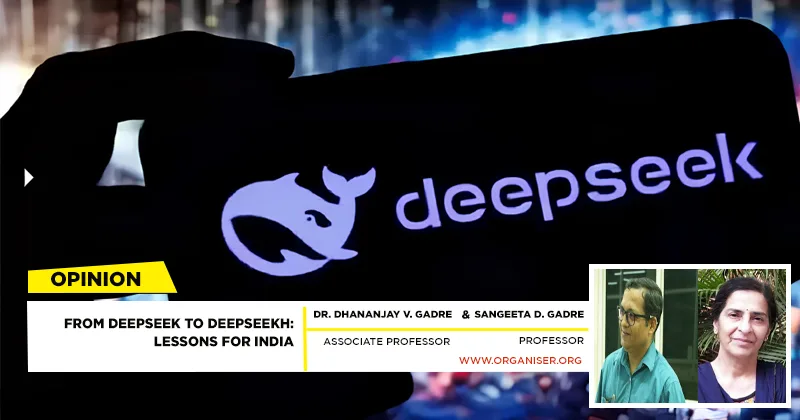
From DeepSeek to DeepSeekh: Lessons for India

The rise of China's DeepSeek, an advanced AI model, has sparked discussions on India’s approach to artificial intelligence and technological self-reliance. While DeepSeek represents China’s strides in AI innovation, India must chart its own course—DeepSeekh—rooted in indigenous research, ethical AI development, and self-sufficiency

Dhananjay V GadreSangeeta D GadreDhananjay V GadreandSangeeta D Gadre
Feb 18, 2025, 05:30 pm IST
in Bharat, China, India, Opinion, Sci & Tech
Follow on Google News
FacebookTwitterWhatsAppTelegramEmail

The phenomenal success of DeepSeek carries important lessons for India. Some view it as a significant technological leap for China, even suggesting it has dealt a major blow to the United States, as reflected in the American stock market’s sharp decline, erasing over a trillion dollars in market capitalization. However, the true significance of DeepSeek lies not in geopolitical rivalries but in the broader implications for technological self-reliance and innovation.

Two Key Takeaways for India

Belief in Indigenous Innovation
DeepSeek’s success is a reminder that with self-confidence and sustained effort, it is possible to develop high-end indigenous technologies, retain talent, and curb brain drain. The challenge in India is not a lack of capability but a lack of belief that world-class innovations can emerge from within the country.

Accountability in Higher Education
The success of DeepSeek places immense pressure on India’s premier institutions, such as the IITs and IISc, to justify the thousands of crores allocated annually by Indian taxpayers. Despite this funding, there is little evidence of significant indigenous technology development and productisation. This may be attributed to a prevailing academic culture that prioritizes research publications and patents over real-world engineering and product innovation. Faculty promotions are largely based on the number of papers published rather than their contribution to technological advancements.

Structural Problems in Indian Engineering Education

India’s engineering education system faces three fundamental challenges:

Outdated Teaching Methods: Engineering faculty largely teach from the same textbooks they studied as students, often without integrating practical engineering experience. There is little incentive to acquire hands-on expertise.

Lack of Real-World Application: Many mechanical engineering faculty members have never built a machine, electronics faculty have never designed a commercially viable circuit or system, and computer engineering faculty have never developed socially impactful software. The absence of direct industry engagement hampers innovation.

Dependence on Western Validation: Research priorities are often dictated by Western research trends with little focus on solving local problems. The lives lost due to open manholes, for instance, remain a persistent issue, yet our brightest minds seek training to serve multinational corporations rather than address pressing domestic challenges.

Beyond Increased Investment: A Need for Decolonisation

Some argue that greater investment in science, technology, and education will resolve these issues. However, despite significant government funding, India has not seen commensurate returns due to a persistent exodus of trained professionals. This is not a linear problem solvable merely by increased financial outlays—it is rooted in a history of a thousand years of cultural and linguistic colonization.

Unlike China, which was never colonized, India must undergo a process of decolonization before it can aspire to match China’s technological strides. This requires a shift in mindset—one that prioritizes self-reliance, indigenous problem-solving, and confidence in Indian ingenuity.

India must urgently revamp its school education system, particularly science education, with a sense of urgency. The introduction of Atal Tinkering Labs in schools was a welcome step, but with only 10,000 schools benefiting, it has inadvertently widened the gap between institutions. These labs should foster a genuine spirit of innovation by integrating them more deeply with science education, rather than becoming mere Arduino Training Labs.

Beyond secondary education, engineering—particularly computer engineering—remains the preferred choice for higher studies, often driven by job prospects. As a result, students who cannot afford engineering courses are the ones who typically pursue science education. This trend must change. A significant proportion of students must see science education as a viable and rewarding career path, rather than just a fallback option.

Rediscovering India’s ‘Honne’
A scene from the 2012 movie Emperor captures this sentiment well. In a conversation between General Kajima and General Bonner Fellers, Kajima explains two Japanese concepts:

“There are two Japanese words you should know. Tatemae—the way things appear. Honne—the way things really are. When you look at Japan, you see the most modern and westernized of Asian countries, but that is tatemae, the surface.”

“And honne?” asks General Fellers.

“It is the true heartbeat of my country, which is more than 2000 years old. It has nothing to do with the West. Japan runs on the ancient warrior code of loyalty and obedience.”

India, too, needs to discover its honne—the true essence of its identity and capabilities. Until we break free from the shackles of colonial-era mindsets and external validation, our technological aspirations will remain unfulfilled. The journey from DeepSeek to DeepSeekh—a pursuit of deeper learning and self-reliance—must begin now.
Topics: DeepSeekDeepSeekhGeneral Bonner Fellers
ShareTweetSendShareSend
✮ Subscribe Organiser YouTube Channel. ✮
✮ Join Organiser's WhatsApp channel for Nationalist views beyond the news. ✮
Previous News

Sanskrit is the identity of Bharat; Dayanidhi Maran should apologise

Next News

Drone flying over Ayodhya’s Ram Mandir triggers panic among devotees, YouTuber under suspicion; investigation underway

Related News

South Korea: Chinese AI app DeepSeek illegally shared data of 1.5 million Korean users

Time to address cybercrimes in digital age

OpenAI VS DeepSeek : Illusion of supremacy

Reevaluating AI development: Maximising intelligence against practical uses

A representative image

DeepSeek Faces Backlash: Texas imposes ban over data privacy risks

Representative Image

Government accelerates IndiaAI GPU access portal as DeepSeek challenges AI compute norms

Load More

Latest News

Representative Image

Karnataka Terror Link Probe: Alla Baksh arrested in Tumakuru over links with foreign terrorists

From the Vedas to modern sustainability (This is an AI Generated image)

World Environment Day: Rediscovering Vedic ecology, ancient wisdom for a green future

K Annamalai Resigns from BJP, Party accepts his resignation

Ex- Tamil Nadu party chief K Annamalai quits from BJP, Nitin Nabin accepts resignation

Tahir Hussain, accused in 2020 Delhi riots case

2020 Delhi Riots Case: Tahir Hussain’s lies exposed; Admits attacking Hindus, raising ‘Kafiro Ko Maaro’ slogans

Kurla resident Huzaifa Ansari held by Delhi police and ATS in alleged ISI-linked terror recruitment case

Delhi Police and Thane ATS arrest Kurla mechanic Huzaifa for alleged role in ISI-linked terror recruitment network

Will Mamata Accept Her Rebel's Help? Humayun Kabir Offers to Send Ex-Boss Back to House

Need a seat, Didi? Ex-TMC rebel Humayun Kabir offers Mamata Banerjee a route back to West Bengal assembly

Wipro Issues First Statement On Religious Conversion Case In Pune

Corporate Jihad Row at Wipro: Company breaks silence, issues first statement, says it is cooperating with police

Imtiyaz Jaleel and Nida Khan named in the SIT Chargesheet in Nashik TCS Corporate Jihad probe

AIMIM leader Imtiaz Jaleel under scanner in TCS Nashik Corporate Jihad case after name surfaces in SIT chargesheet

Hindu victim in the case who was trapped by Islamist senior

After TCS, Wipro, Pune insurance employee accuses Mohammad Sadiq of harassment; Arrested by police

AAP’s New Front? CJP Emerges as Congress’s Biggest Narrative Challenger

Congress Protests, CJP Trends: AAP harvests through CJP on ground tilled by Congress

Load More
  • Privacy
  • Terms
  • Cookie Policy
  • Refund and Cancellation
  • Delivery and Shipping

© Bharat Prakashan (Delhi) Limited.
Tech-enabled by Ananthapuri Technologies

  • Home
  • Search Organiser
  • Bharat
    • Assam
    • Bihar
    • Chhattisgarh
    • Jharkhand
    • Maharashtra
    • View All States
  • World
    • Asia
    • Africa
    • North America
    • South America
    • Europe
    • Australia
  • Editorial
  • Operation Sindoor
  • Opinion
  • Analysis
  • Defence
  • Culture
  • Sports
  • Business
  • RSS @ 100
  • Entertainment
  • More ..
    • Sci & Tech
    • Vocal4Local
    • Special Report
    • Education
    • Employment
    • Books
    • Interviews
    • Travel
    • Health
    • Politics
    • Law
    • Economy
    • Obituary
  • Subscribe Magazine
  • Read Ecopy
  • Advertise
  • Circulation
  • Careers
  • About Us
  • Contact Us
  • Policies & Terms
    • Privacy Policy
    • Cookie Policy
    • Refund and Cancellation
    • Terms of Use

© Bharat Prakashan (Delhi) Limited.
Tech-enabled by Ananthapuri Technologies