





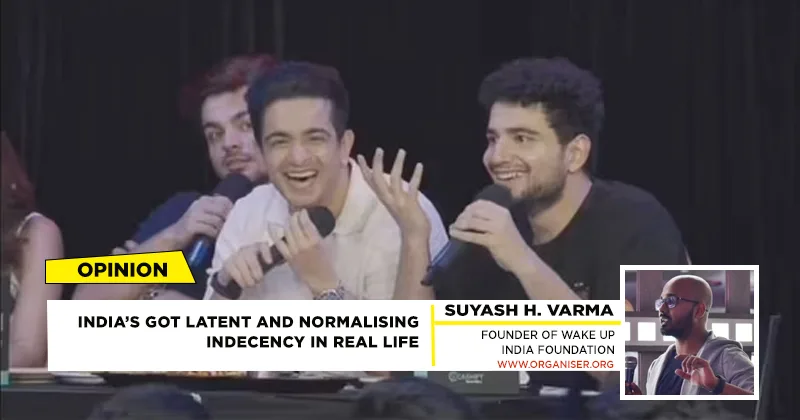
Recently, social media influencer and podcaster Ranveer Allahbadia, known as BeerBiceps, found himself in a major controversy over a crude remark made during his appearance on India’s Got Latent. His question to a contestant—so inappropriate that it need not be repeated here—sparked outrage across the internet, with critics calling it vulgar, distasteful, and reflective of the declining standards of content creation in India.
Allahbadia apologised later, admitting that his attempt at humour was inappropriate. However, the fact that such a comment was made in the first place—on a platform viewed by millions, including young, impressionable audiences—raises an important question: Is social media desensitizing us to indecency? And if so, what are the long-term consequences?
How Social Media Desensitises Us to Indecency
The digital world has blurred the lines between entertainment and reality. What people consume online influences their perception of acceptable behavior in real life. This is particularly dangerous for young and impressionable audiences, who often fail to distinguish between the two.
Constant exposure to certain types of content rewires our brain. Neuroscientific studies suggest that repeated exposure to violent, explicit, or degrading material can lead to desensitization, reducing our emotional response to such content.
Each time a user watches a video with crude humor or misogynistic jokes, their brain’s reward center is triggered, especially if the content is designed to be engaging. Over time, the shock value diminishes, and what once seemed inappropriate starts feeling normal.
The Boys Locker Room case, where a group of teenage boys on Instagram was found discussing sexually explicit content and objectifying women, is a disturbing example of this phenomenon. The group’s members had been exposed to similar themes on social media, reinforcing their belief that such discussions were normal and acceptable.
Likewise, look at the comment section of any female influencer’s social media post, and you will find a flood of vulgar remarks, sexual innuendos, and hate speech. This is not just the work of a few trolls—it is a reflection of a growing cultural shift fueled by social media algorithms that reward sensationalism over decency.
Unlike cinema, where content is regulated and not always widely accessible, social media content is hyper-personalized. Algorithms ensure that users are fed content similar to what they have previously engaged with, creating echo chambers that reinforce and normalize problematic behavior. This makes social media more dangerous than cinema in shaping cultural attitudes.
The Real-World Consequences of Online Indecency
One of the biggest issues with social media’s widespread reach is the cultural disconnect between content and its audience. A person in a rural area where women are still expected to adhere to traditional roles may come across videos of urban women using explicit language or engaging in behaviors considered inappropriate in their society. This can lead to two harmful outcomes:
Moral Policing – The individual may react by condemning and trolling such women online, reinforcing regressive attitudes and gender-based abu
Distorted Expectations – The individual may expect women in their own community to behave similarly, leading to cultural conflicts and misunderstandings.
Neither outcome is beneficial to society. The internet is global, but cultural and moral frameworks are local. Without proper media literacy, social media accelerates cultural dissonance rather than bridging gaps.
Social Media vs. Cinema: Shaping the Trend
Cinema, despite its influence, was never as unregulated and personalized as social media. A movie was a shared cultural experience—people watched the same content together and discussed it in a social context. If something was offensive, it faced censorship, and criticism had a direct impact on filmmakers and studios.
Social media, in contrast, operates in isolated echo chambers, where people are repeatedly fed content tailored to their engagement history. Unlike movies, which required active effort to seek out and watch, social media content is pushed onto users through AI-driven algorithms. Everyone has a smartphone, but not every had access to cinema.
Moreover, cinema had gatekeepers—directors, producers, regulatory boards—but social media allows anyone with an internet connection to become an influencer, often with no accountability. A single influencer’s controversial joke or remark can reach millions within minutes, far surpassing the reach of even blockbuster films.
The Way Forward
Social media companies prioritize engagement and ad revenue over content moderation. Negative, controversial, and provocative content gets more clicks, shares, and discussion—making it highly profitable. If platforms do not take responsibility, it is up to regulators and governments to step in. While banning social media is neither practical nor desirable, some measures can be taken to curb the normalization of indecency:
- Stronger Content Moderation Policies – Platforms must enforce stricter rules against offensive and harmful content. AI moderation should be improved to detect and limit the reach of degrading material.
- Age-Restricted Content – Just as cinema has age ratings, social media content should have mandatory content warnings and age restrictions enforced by real identity verification.
- Algorithmic Transparency – Platforms should be required to disclose how their recommendation systems work and provide users with more control over what content is promoted to them
- Digital Media Literacy Programs – Governments and educational institutions should implement programs that teach young users how to critically engage with social media content.
From the BeerBiceps controversy to the Boys Locker Room case, the trend is clear—what we consume online does not stay online. It is not an isolated incident—it is a symptom of a larger cultural shift where indecency, vulgarity, and offensive humor are becoming mainstreamed by social media. The dangers of this trend go beyond personal opinions or moral debates; they shape how an entire generation perceives normal behavior.
If left unchecked, the internet’s desensitization effect could lead to a world where people no longer recognize the boundaries between entertainment and real-life behavior. The responsibility to curb this trend lies not just with influencers and platforms but with society as a whole—parents, educators, brands, and governments all have a role to play.
Social media has immense potential for good. But if it continues to reward controversy over quality, the price society will pay may be too high.















Comments