





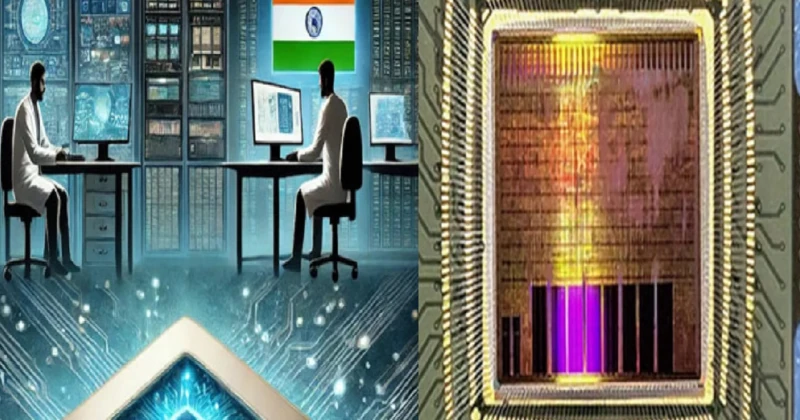
In a significant stride towards self-reliance in semiconductor technology, the Indian Institute of Technology Madras (IIT Madras) and the Indian Space Research Organisation (ISRO) have jointly developed the IRIS (Indigenous RISC-V Controller for Space Applications) chip. This project, aligned with the ‘Make in India’ and ‘Atmanirbhar Bharat’ initiatives, highlights India’s growing expertise in advanced computing technologies for aerospace and other critical sectors.
The IRIS chip, based on the SHAKTI microprocessor, represents a remarkable collaborative effort to advance indigenous semiconductor technology. Developed through the combined expertise of multiple Indian institutions, the project showcases India’s growing self-reliance in the high-tech sector. The ISRO Inertial Systems Unit (IISU), Thiruvananthapuram, played a crucial role in spearheading the initiative, while IIT Madras led the design and development of the chip.
Manufacturing was undertaken by the Semiconductor Laboratory (SCL) in Chandigarh, ensuring that the core fabrication process remained within the country. Tata Advanced Systems in Karnataka handled the packaging, further reinforcing domestic capability in semiconductor assembly. The motherboard production was carried out in Gujarat, and the final assembly took place in Chennai. This coordinated effort across different regions of India highlights the nation’s progress in semiconductor research and development, paving the way for future advancements in indigenous technology.
This effort signifies a major step in India’s ambition to achieve self-sufficiency in semiconductor technology, particularly for space applications.
Key Features of the IRIS Chip
- Specifically designed to support ISRO’s command and control systems.
- Built for high fault tolerance and reliability, making it ideal for space missions.
- Includes custom modules such as WATCHDOG timers and advanced serial buses.
- Expandable capabilities through multiple boot modes and hybrid memory extensions.
- Completely designed, manufactured, and assembled in India.
Boosting ‘Make in India’ Through Semiconductor Innovation
Professor V. Kamakoti leads the SHAKTI microprocessor project at the Prathap Subrahmanyam Centre for Digital Intelligence and Secure Hardware Architecture (PSCDISHA) at IIT Madras. SHAKTI processors use RISC-V, an open-source processor technology, under the Digital India RISC-V (DIRV) initiative, supported by the Ministry of Electronics and Information Technology (MeitY).
Professor V. Kamakoti, Director of IIT Madras, emphasized that IRIS is the third successfully fabricated SHAKTI chip, following RIMO in 2018 and MOUSHIK in 2020. Dr. V. Narayanan, Chairman of ISRO, hailed IRIS as a significant milestone in India’s semiconductor development and commended the teams at IISU and IIT Madras for their dedicated efforts. Kamaljeet Singh, Director General of SCL Chandigarh, highlighted that the IRIS chip was developed using SCL’s 180 nm technology node, demonstrating India’s advancing capabilities in semiconductor manufacturing.
The successful development of the IRIS chip reinforces India’s position as a rising player in the global semiconductor sector. It marks a breakthrough for the ‘Make in India’ and ‘Atmanirbhar Bharat’ initiatives, pushing the country towards technological self-sufficiency in aerospace applications and beyond. As India continues its advancements in semiconductor design and manufacturing, this achievement serves as a significant step in securing its place in the future of global technology.
The success of the IRIS chip marks a significant milestone in India’s semiconductor industry, paving the way for future advancements and expansion. As the demand for indigenous microprocessors grows, this breakthrough creates numerous opportunities across various sectors. Beyond aerospace, the IRIS chip has the potential to revolutionize industries such as defense and automotive, strengthening India’s technological self-reliance.
Additionally, it can drive enhanced research and development capabilities in semiconductor fabrication, fostering innovation within the country. This achievement also encourages greater collaboration between academic institutions and government organizations, accelerating progress in microprocessor technology and positioning India as a key player in the global semiconductor landscape.
India has been making significant investments in semiconductor infrastructure, with initiatives like the India Semiconductor Mission (ISM) and partnerships with global tech firms. The development of the IRIS chip aligns with these efforts, demonstrating India’s potential to become a global hub for semiconductor manufacturing and innovation.
With continued investment in fabrication facilities, research centers, and talent development, India is well-positioned to emerge as a leader in the semiconductor domain, reducing reliance on foreign imports and ensuring technological sovereignty for critical sectors.















Comments