





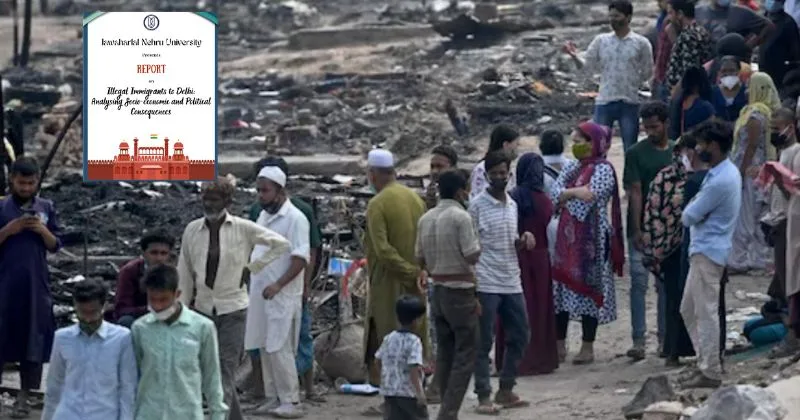
New Delhi: Ahead of the Delhi assembly elections, the Jawaharlal Nehru University report titled – Illegal Immigrants to Delhi: Analysing Socio-economic and Political Consequences revealed that the migration from Bangladesh and Myanmar has resulted in adversely affecting the lives of the slum dwellers as these illegal immigrants avail the jobs in the unorganised sectors and also take advantage of the various government schemes.
The study highlights how undocumented immigrants are occupying employment opportunities meant for Indian citizens and the slum dwellers, are taking advantage of government welfare schemes through fraudulent means, and straining public resources. The report further states that this unchecked influx has disrupted the local economy by driving down wages and increasing competition in the labour market.
Delhi’s status as India’s capital and an economic hub made it a prime destination for migrants seeking better opportunities. Internal migrants primarily arrive from Indian states like Uttar Pradesh, Bihar, and West Bengal, while international migrants, including a significant number of Bangladeshi and Rohingya immigrants, often enter illegally. The report highlights the push factors driving migration, such as poverty, unemployment, and religious-induced and environmental crises in origin regions, alongside pull factors like Delhi’s robust job market, educational institutions, and access to public services. However, the influx of migrants has led to social, economic, and political challenges, particularly concerning illegal immigration.
The arrival of illegal migrants also contributes to competition in the labour market, particularly in low-wage sectors like construction, domestic work, and manual labor. Migrants are often willing to accept lower wages and work in harsh conditions, which can drive down local wages and reduce job opportunities for Delhi’s native workers. This phenomenon contributes to unemployment and underemployment, particularly for unskilled or semi-skilled workers who are already struggling to find stable employment.
Illegal migrants take up low-wage jobs, which affects local workers who demand higher wages. This leads to job competition and wage suppression in sectors like construction and domestic work. Many local residents believe that migrants take away opportunities that should belong to them, leading to frustration and resentment. Small businesses may prefer hiring migrants due to lower wage expectations. This dynamic creates economic disparities and feelings of marginalisation among local population and the slum dwellers. The job competition also leads to increased hostility and a sense of insecurity among local job seekers.
These illegal immigrants move in a very strategic way as they stay in densely populated areas.
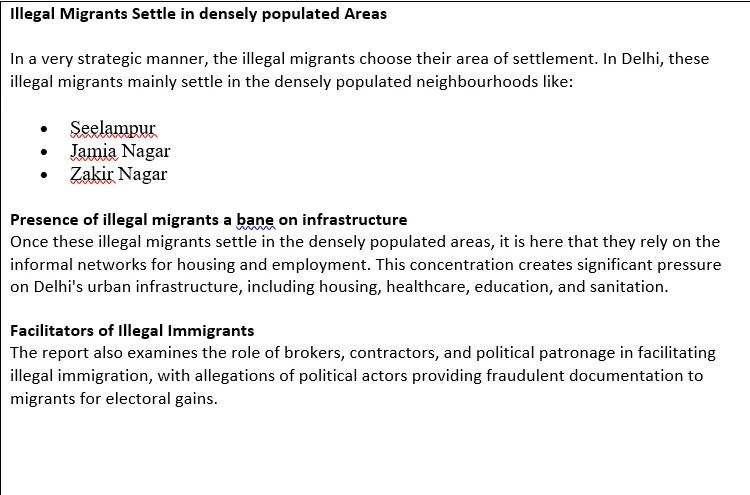
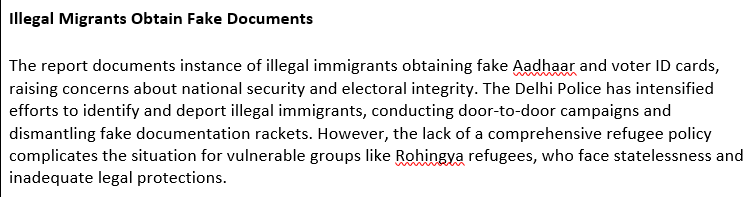
Their penetration into the densely populated areas is made easy through fraudulent documents that are provided to them either by the local politicians or brokers.
As competition for jobs increases, tensions between migrants and local workers can escalate, further deepening social divisions. Furthermore, the presence of illegal migrants places additional strain on Delhi’s social welfare systems. Migrants, who are excluded from formal welfare programs, often rely on emergency services or informal support networks.
The JNU report elaborated on how such influx of illegal settlers has not only transformed the city’s demographics but disrupted its economy, strained the resources, and also strengthened criminal networks by feeding into it.
The report also claimed that the political patronage provided to illegal immigrants, including the facilitation of voter registration, has raised concerns about electoral manipulation and democratic integrity.
“The presence of undocumented migrants complicates disaster response and crisis management, as these populations are often excluded from official relief efforts during emergencies,” it said.
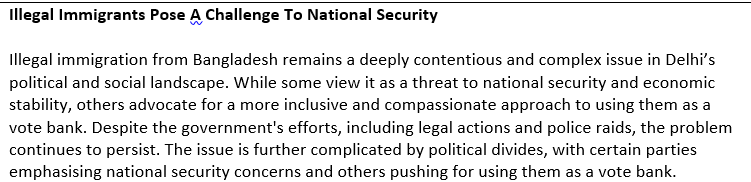
It also asserted that the porous India-Bangladesh border remains a major challenge for managing illegal immigration, with inadequate border control enabling the continued influx of migrants.
The availability of these counterfeit documents raises significant concerns about the integrity of India’s democratic processes, particularly during elections. The potential for non-citizens, even in minimal numbers, to influence electoral outcomes is a recurring issue within the political discourse, contributing to the proliferation of anti-immigrant rhetoric and calls for more stringent document verification processes
Speaking on the report, BJP MP Sambit Patra targeted the AAP and claimed that it has a “crucial” role in this.
“This report states that there has been a notable increase of Muslim population because of illegal migration from Bangladesh and Myanmar. There is a change in the demography of the city, it is said in the report…Every aspect including socio-political impact has been mentioned in this report…The report says that political patronage plays a crucial role in allowing a steady influx of undocumented Rohingyas and Bangladeshis…AAP has a crucial role in this. The report also talks about how these political parties are facilitating fake voter registration for the migrants,” Patra said.














Comments