
Reshaping Governance: Trump’s 'Deep State' reforms and their implications for India
December 5, 2025
  • Read Ecopy
  • Circulation
  • Advertise
  • Careers
  • About Us
  • Contact Us
Android AppiPhone AppArattai
Organiser
  • ‌
  • Bharat
    • Assam
    • Bihar
    • Chhattisgarh
    • Jharkhand
    • Maharashtra
    • View All States
  • World
    • Asia
    • Europe
    • North America
    • South America
    • Africa
    • Australia
  • Editorial
  • International
  • Opinion
  • RSS @ 100
  • More
    • Op Sindoor
    • Analysis
    • Sports
    • Defence
    • Politics
    • Business
    • Economy
    • Culture
    • Special Report
    • Sci & Tech
    • Entertainment
    • G20
    • Azadi Ka Amrit Mahotsav
    • Vocal4Local
    • Web Stories
    • Education
    • Employment
    • Books
    • Interviews
    • Travel
    • Law
    • Health
    • Obituary
  • Subscribe
    • Subscribe Print Edition
    • Subscribe Ecopy
    • Read Ecopy
  • ‌
  • Bharat
    • Assam
    • Bihar
    • Chhattisgarh
    • Jharkhand
    • Maharashtra
    • View All States
  • World
    • Asia
    • Europe
    • North America
    • South America
    • Africa
    • Australia
  • Editorial
  • International
  • Opinion
  • RSS @ 100
  • More
    • Op Sindoor
    • Analysis
    • Sports
    • Defence
    • Politics
    • Business
    • Economy
    • Culture
    • Special Report
    • Sci & Tech
    • Entertainment
    • G20
    • Azadi Ka Amrit Mahotsav
    • Vocal4Local
    • Web Stories
    • Education
    • Employment
    • Books
    • Interviews
    • Travel
    • Law
    • Health
    • Obituary
  • Subscribe
    • Subscribe Print Edition
    • Subscribe Ecopy
    • Read Ecopy
Organiser
  • Home
  • Bharat
  • World
  • Operation Sindoor
  • Editorial
  • Analysis
  • Opinion
  • Culture
  • Defence
  • International Edition
  • RSS @ 100
  • Magazine
  • Read Ecopy
Home Bharat

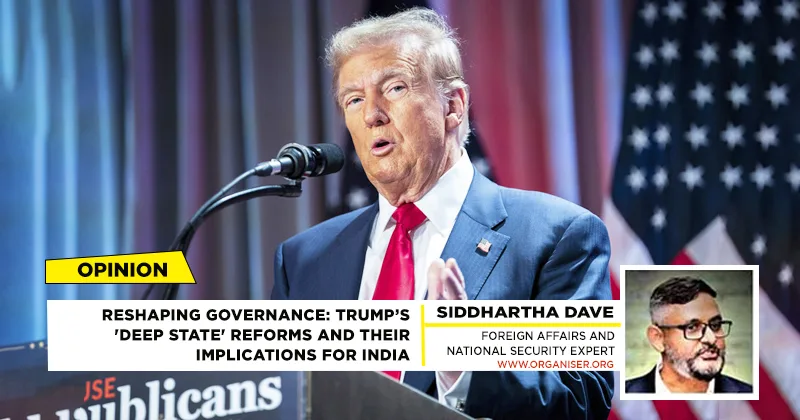
Reshaping Governance: Trump’s ‘Deep State’ reforms and their implications for India

As Donald Trump prepares to assume office in 2025, his plan to dismantle the "deep state" and reshape the US federal government is setting the stage for significant political change. This bold strategy has far-reaching implications, not only for American governance but also for India’s approach to bureaucracy and its geopolitical positioning

Siddhartha DaveSiddhartha Dave
Jan 20, 2025, 05:30 pm IST
in Bharat, Opinion
Follow on Google News
FacebookTwitterWhatsAppTelegramEmail

Donald Trump, set to assume office on January 20, 2025, is preparing to take bold steps to dismantle the “deep state” and cement control over the federal government.

President Donald Trump’s ongoing efforts to exert unparalleled control over the US federal government represent a dramatic recalibration of governance dynamics. Central to this initiative is his controversial plan to dismantle the so-called “deep state,” a term his administration uses to describe entrenched bureaucratic elements perceived as resistant to his agenda. This ambitious undertaking marks one of the most significant overhauls in the history of US federal governance, with far-reaching implications domestically and internationally.

Redefining Federal Governance: Trump’s Strategy

A cornerstone of Trump’s plan involves the rapid implementation of an executive order aimed at eliminating job protections for approximately 50,000 career federal employees. This measure would pave the way for replacing them with appointees loyal to Trump’s vision, thus embedding his influence within the federal bureaucracy. To accelerate this process, the administration is poised to expedite thousands of political appointments across federal agencies, solidifying its control over policymaking.

This overhaul extends beyond symbolic gestures. The Trump team has signalled its intentions by requesting the resignation of senior career diplomats at the US State Department and proposing “Schedule F,” a framework to reclassify career positions as political appointments. This reclassification empowers agency officials to dismiss career employees without cause, replacing them with individuals aligned with the administration’s ideological goals. Architects of this approach, such as Russell Vought and James Sherk, underscore its necessity, arguing that policymaking roles must be occupied by individuals who fully support the president’s agenda. Sherk’s reports highlight alleged instances of bureaucratic resistance that hindered Trump’s policies during his first term, further justifying this sweeping reform.

Targeting Bureaucratic Resistance

Key appointments for Trump’s prospective second term, including figures like Pam Bondi as Attorney General and Kash Patel as FBI Director, are expected to spearhead efforts to neutralize perceived resistance within the federal government. The administration’s focus extends to departments such as Education, Justice, and the national security apparatus, where entrenched bureaucrats are accused of undermining key initiatives.

Critics challenge the validity of the “deep state” narrative, viewing it as a pretext for consolidating executive power. Workforce experts and union leaders caution that measures like Schedule F could erode trust, suppress constructive dissent, and lower morale within federal agencies. James Eisenmann, a prominent expert on federal workforce policies, warns that such initiatives risk creating a culture of compliance at the expense of innovation and effective governance.

Cultivating a Loyal Bureaucratic Network

The administration’s strategy also includes identifying and sidelining officials whose priorities diverge from Trump’s agenda. Conservative organizations, such as the Heritage Foundation-backed American Accountability Foundation, are actively compiling lists of “problematic” federal employees, targeting individuals focused on diversity initiatives or perceived as obstructive to border security policies. This ideological vetting has sparked opposition from outgoing officials, like Defense Secretary Lloyd Austin, who argue that diversity and inclusion are critical to representing America’s broader societal fabric.

Despite criticism, Trump’s team remains steadfast, emphasising the need to ensure that government employees align with the administration’s principles. Spokesperson Brian Hughes underscores that this effort aims to uphold American values and taxpayer interests, framing it as a corrective measure to align governance with electoral mandates.

Indian Perspectives: Lessons and Strategic Implications

For India, Trump’s bold approach to governance offers valuable lessons and potential opportunities. India, too, has grappled with the challenges posed by bureaucratic inertia, inefficiency, and entrenched interests within its administrative framework. Trump’s strategy, controversial as it may be, demonstrates the impact of decisive leadership in dismantling institutional resistance to reform.

Moreover, the elimination of “deep state” elements within the US bureaucracy could yield indirect benefits for India. Historically, factions within the US government have occasionally supported policies contrary to India’s interests—ranging from backing Pakistan-aligned narratives to fostering instability in South Asia. A streamlined and ideologically aligned US administration might adopt a more consistent and favourable stance toward India, particularly in areas such as counterterrorism, trade, and regional security.

This shift is particularly significant in the context of Bangladesh’s political transition. The new regime’s overtures toward closer alignment with India could be bolstered by a US administration that prioritizes stability in South Asia. By curtailing external influences inimical to regional stability, a reoriented US bureaucracy could enhance India’s efforts to strengthen its partnerships in the neighbourhood.

Navigating Opportunities and Risks

While Trump’s approach underscores the transformative potential of political will, it also highlights the risks associated with undermining institutional safeguards. For Indian policymakers, the challenge lies in striking a balance between pursuing administrative efficiency and preserving democratic principles. Lessons from the US experience suggest that reform efforts must be accompanied by robust oversight mechanisms to prevent the erosion of accountability and transparency.

Conclusion: Implications for India’s Governance

Trump’s efforts to reshape the US federal government serve as both a cautionary tale and a source of inspiration. For India, the implications extend beyond governance reforms, influencing its geopolitical calculus and bilateral relations with the U.S. By leveraging these developments, India can explore innovative strategies to address its own bureaucratic challenges while safeguarding its core democratic values.

As global dynamics continue to evolve, India must remain proactive in adapting to these shifts, ensuring that its national interests are advanced in an increasingly complex and interconnected world. Trump’s governance reforms, while polarizing, offer critical insights into the interplay between leadership, bureaucracy, and national policy, underscoring the enduring relevance of adaptability and resilience in statecraft.

 

Topics: US GovernanceDonald TrumpDeep StateUS-India relationsTrump Reforms
Siddhartha Dave
Siddhartha Dave
Siddhartha Dave is an alumnus of the United Nations University in Tokyo and a former Lok Sabha Research Fellow. He writes on foreign affairs and national security. [Read more]
ShareTweetSendShareSend
✮ Subscribe Organiser YouTube Channel. ✮
✮ Join Organiser's WhatsApp channel for Nationalist views beyond the news. ✮
Previous News

Karnataka: Amidst widening rift, Siddaramaiah’s supporters plan to file complaint against Randeep Surjewala

Next News

How illegal Bangladeshi immigrants dodge deportation and why cases are a boon for them

Related News

Prime Minister Narendra Modi (Left) and US President Donald Trump (Right)

US lawmakers introduce bipartisan resolution recognising “strategic value of historical partnership” with India

Global stocks climb as courts tilt toward overturning Trump-era tariffs, boosting hopes for freer trade and lower import costs

US Supreme Court casts doubt on Trump tariff powers, global markets rally on hopes of repeal

Chinese President Xi Jinping, left, and US President Donald Trump

“China made a real mistake”: US treasury secretary vows to break Beijing rare earth monopoly within two years

Representative image

US President Trump revives third term talk as ‘2028 caps’ and VP loophole theory fuel debate on POTUS limits

Prime Minister Narendra Modi and Russian President Vladimir Putin

India defies Trump pressure, to build urea plant in Russia; Major announcement expected during Putin visit to India

US President Donald Trump, Prime Minister Narendra Modi, Chinese President Xi Jinping

Trump set to reduce US tariff on India to 15 per cent amid move to replace China as key trade partner

Load More

Comments

The comments posted here/below/in the given space are not on behalf of Organiser. The person posting the comment will be in sole ownership of its responsibility. According to the central government's IT rules, obscene or offensive statement made against a person, religion, community or nation is a punishable offense, and legal action would be taken against people who indulge in such activities.

Latest News

23rd India-Russia Annual Summit

India-Russia Summit heralds new chapter in time-tested ties: Inks MoUs in economic, defence, tourism & education

DGCA orders probe into IndiGo flight disruptions; Committee to report in 15 days

BJYM leader Shyamraj with Janaki

Kerala: Widow of BJP worker murdered in 1995 steps into electoral battle after three decades at Valancherry

Russian Sber bank has unveiled access to its retail investors to the Indian stock market by etching its mutual fund to Nifty50

Scripting economic bonhomie: Russian investors gain access to Indian stocks, Sber unveils Nifty50 pegged mutual funds

Petitioner S Vignesh Shishir speaking to the reporters about the Rahul Gandhi UK citizenship case outside the Raebareli court

Rahul Gandhi UK Citizenship Case: Congress supporters create ruckus in court; Foreign visit details shared with judge

(L) Kerala High Court (R) Bouncers in Trippoonithura temple

Kerala: HC slams CPM-controlled Kochi Devaswom Board for deploying bouncers for crowd management during festival

Fact Check: Rahul Gandhi false claim about govt blocking his meet with Russian President Putin exposed; MEA clears air

Union Minister for Road Transport and Highways Nitin Gadkari (Right)

India set for highway overhaul as Union Minister Nitin Gadkari unveils nationwide shift to MLFF electronic tolling

RSS Akhil Bharatiya Prachar Pramukh Shri Sunil Ambekar

When Narrative Wars result in bloodshed, countering them becomes imperative: Sunil Ambekar

Ministry of Civil Aviation mandates emergency action: IndiGo ordered to stabilise flight operations by midnight

Load More
  • Privacy
  • Terms
  • Cookie Policy
  • Refund and Cancellation
  • Delivery and Shipping

© Bharat Prakashan (Delhi) Limited.
Tech-enabled by Ananthapuri Technologies

  • Home
  • Search Organiser
  • Bharat
    • Assam
    • Bihar
    • Chhattisgarh
    • Jharkhand
    • Maharashtra
    • View All States
  • World
    • Asia
    • Africa
    • North America
    • South America
    • Europe
    • Australia
  • Editorial
  • Operation Sindoor
  • Opinion
  • Analysis
  • Defence
  • Culture
  • Sports
  • Business
  • RSS @ 100
  • Entertainment
  • More ..
    • Sci & Tech
    • Vocal4Local
    • Special Report
    • Education
    • Employment
    • Books
    • Interviews
    • Travel
    • Health
    • Politics
    • Law
    • Economy
    • Obituary
  • Subscribe Magazine
  • Read Ecopy
  • Advertise
  • Circulation
  • Careers
  • About Us
  • Contact Us
  • Policies & Terms
    • Privacy Policy
    • Cookie Policy
    • Refund and Cancellation
    • Terms of Use

© Bharat Prakashan (Delhi) Limited.
Tech-enabled by Ananthapuri Technologies