





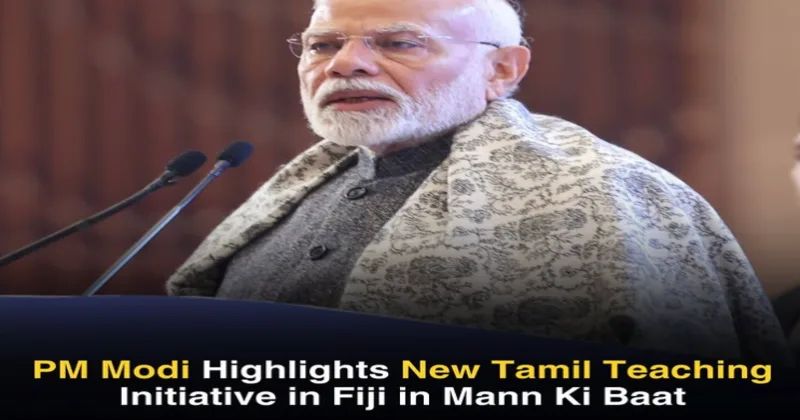
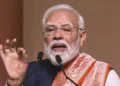
In his 117th Mann Ki Baat address on December 29, 2024, Prime Minister Narendra Modi emphasized the growing global recognition of Tamil, one of the world’s oldest languages. The Prime Minister lauded the increasing popularity of Tamil in Fiji, a South Pacific archipelago, and highlighted India’s cultural outreach in promoting the language.
PM Modi expressed pride in the launch of a Tamil Teaching Programme in Fiji, supported by the Indian government. For the first time in 80 years, trained Tamil teachers are teaching the language in Fiji, reflecting the Indian diaspora’s enduring connection with its cultural roots. The Prime Minister noted the enthusiasm of Fijian students in learning Tamil and exploring its rich heritage, calling the initiative a “success story and a saga of cultural preservation.”
He remarked, “These efforts underline the profound impact of India’s culture on the global stage, filling every Indian with pride.” Modi also mentioned the broader global interest in India’s cultural heritage, citing examples of art competitions in Egypt and Ayurveda consultations in Paraguay.
Tamil in Global Spotlight
PM Modi’s remarks come against the backdrop of sustained efforts to promote Tamil culture and literature globally. He highlighted the cultural ties between India and Fiji, with Tamil being a vital link. This initiative is part of India’s broader cultural diplomacy, aiming to strengthen its soft power.
The Prime Minister’s appreciation of Tamil is not new. Over the years, he has consistently upheld the significance of the language. At the United Nations General Assembly (UNGA) in 2019, he quoted Tamil poet Kaniyan Pungundranar’s verse “Yaadhum Oore Yaavarum Kelir” (We belong to all places and to everyone), describing it as a reflection of India’s inclusive ethos. Similarly, he has frequently cited verses from Tamil classics like Tirukkural in speeches, including during his Independence Day address and interactions with world leaders.
Political Implications in Tamil Nadu
Modi’s promotion of Tamil also holds domestic significance, particularly in Tamil Nadu, where his government has often been accused by Dravidian parties of neglecting the language. However, BJP Tamil Nadu chief K. Annamalai countered these claims, calling PM Modi a “Tamilian at heart.” Annamalai emphasized that Modi’s frequent references to Tamil literature, such as Thirukkural and Purananooru, and his inauguration of cultural events like the Kashi Tamil Sangamam and Saurashtra Tamil Sangamam, showcase his genuine affection for the Tamil language and its people.
In July, Annamalai remarked, “PM Modi need not be born in Tamil Nadu to be treated as a Tamilian. Anyone who cherishes Tamil is a Tamilian.” He even questioned why a non-Tamilian who respects and promotes Tamil cannot be considered part of the Tamil identity, drawing a parallel with the acceptance of migrants in Tamil Nadu.
Broader Cultural Diplomacy
Beyond Tamil, PM Modi’s Mann Ki Baat also highlighted India’s cultural engagements elsewhere. He praised a competition in Egypt where 23,000 students created artworks depicting Indian culture, and applauded Erica Huber in Paraguay for promoting Ayurveda despite being an engineering graduate. Modi reiterated India’s commitment to showcasing its cultural and intellectual heritage worldwide.
Reflecting on the efforts, he said, “The more the world learns about India’s culture, the deeper the appreciation grows. From art to Ayurveda, and from language to music, India offers a treasure trove of knowledge and creativity.”
PM Modi concluded his address with a message of pride for every Indian, underscoring that initiatives like the Tamil Teaching Programme and the growing global interest in Indian culture are testimonies to the nation’s rich heritage. His consistent celebration of Tamil has struck a chord among language enthusiasts and has positioned India’s ancient culture as a global asset.










Comments