
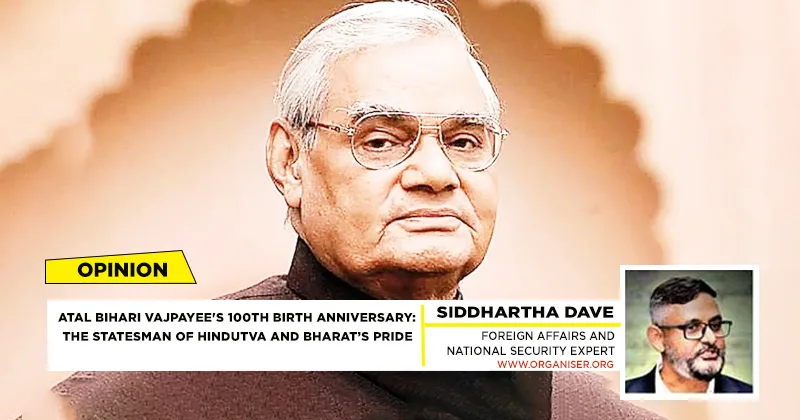
As Bharat approaches the 100th birth anniversary of Atal Bihari Vajpayee on December 25, 2024, it is time to revisit the extraordinary life of a leader who stood as a beacon of Hindutva, nationalism, and cultural pride. Vajpayee was not merely a statesman; he was an ideologue, poet, and visionary who firmly believed in the ideals of a strong and self-reliant Bharat rooted in its Sanatan values. Through his leadership, Vajpayee nurtured and expanded the vision of Hindutva, transforming it into a national movement that resonates even today.
Born in Gwalior on December 25, 1924, into a family steeped in values and education, Vajpayee imbibed the essence of nationalism from an early age. His father, Krishna Bihari Vajpayee, a schoolteacher and a scholar, was instrumental in shaping Atal’s intellectual and spiritual pursuits. Inspired by Veer Savarkar’s revolutionary thoughts and Dr. Syama Prasad Mukherjee’s ideals, Vajpayee became an active member of the Rashtriya Swayamsevak Sangh (RSS) during his youth. The RSS instilled in him the principles of selfless service, cultural pride, and unwavering commitment to Bharat Mata.
Even as a student, Vajpayee exhibited remarkable oratory and writing skills. His essays and speeches reflected his deep understanding of Hindutva, nationalism, and governance. These formative years in the RSS and his association with stalwarts like Guru Golwalkar laid the foundation for his lifelong dedication to the cause of Hindutva and Bharat’s resurgence.
Vajpayee’s entry into politics began with the formation of the Bharatiya Jan Sangh (BJS) in 1951 under the leadership of Dr. Syama Prasad Mukherjee. As a founding member, Vajpayee became the voice of a nationalist Bharat, tirelessly advocating for cultural and ideological unity. His speeches in Parliament were a masterclass in statesmanship, blending intellectual rigor with ideological conviction. They were a clarion call for Bharat to reclaim its civilizational heritage while navigating modern challenges.
Dr. Mukherjee’s untimely death in 1953 left a void in the Jan Sangh, but Vajpayee, with his charismatic leadership, ensured the party’s growth. He positioned the Jan Sangh as the political expression of Hindutva, emphasizing the importance of integrating Jammu and Kashmir fully with Bharat and safeguarding the rights of Hindus across the nation. His consistent advocacy for the abolition of Article 370 and his vision for a united Bharat underlined his unwavering commitment to cultural nationalism.
The Emergency of 1975, declared by Indira Gandhi, was a dark chapter in Bharat’s democracy, but it also highlighted Vajpayee’s unwavering commitment to democratic values and Hindutva principles. As democratic freedoms were crushed, Vajpayee became a symbol of resistance, enduring imprisonment for his defiance. His speeches and writings during this period reinforced the essence of Hindutva, advocating for a society where dharma and democracy coexist harmoniously.
Despite ideological differences, Vajpayee’s relationship with Indira Gandhi was marked by mutual respect. In a remarkable gesture of bipartisanship, Gandhi chose Vajpayee to represent Bharat at the United Nations in 1977. There, he delivered a historic speech in Hindi, emphasizing Bharat’s cultural pride and sovereignty. This act not only elevated Bharat’s stature globally but also underscored Vajpayee’s belief in projecting Bharat’s Hindutva-rooted identity on the world stage.
Following the dissolution of the Janata Party, Vajpayee played a pivotal role in the formation of the Bharatiya Janata Party (BJP) in 1980. Alongside LK Advani, Vajpayee envisioned the BJP as a political platform to propagate Hindutva in a modern, inclusive framework. While Advani’s organizational acumen galvanized the grassroots, Vajpayee’s eloquence and moderation made Hindutva accessible and appealing to diverse sections of society.
Vajpayee’s emphasis on cultural nationalism and “Integral Humanism,” inspired by Pandit Deendayal Upadhyaya, became the cornerstone of the BJP’s philosophy. He often spoke of Bharat as a civilizational entity, where governance must align with the ethos of dharma. His articulation of “Sarva Dharma Sambhava” (equal respect for all religions) was rooted in Hindutva’s inclusive vision, ensuring that the BJP emerged as a party that could lead Bharat into the 21st century while preserving its cultural roots.
As Prime Minister, Vajpayee exemplified the ideals of Hindutva through his bold decisions, whether it was defending Bharat’s borders, asserting its nuclear sovereignty, or fostering economic independence. His tenure (1996, 1998-2004) was a testament to his vision of Bharat as a global leader grounded in its cultural identity.
The Pokhran-II nuclear tests of 1998 were a defining moment in Bharat’s history. By making Bharat a declared nuclear weapons state, Vajpayee ensured that the nation could defend itself against any external threat. His statement, “It is not aggression but self-defense,” reflected Hindutva’s ethos of strength toughened with responsibility. Despite international sanctions, Vajpayee’s diplomacy turned adversities into opportunities, strengthening Bharat’s global alliances while upholding its sovereignty.
Vajpayee’s economic policies, including the Golden Quadrilateral highway project and IT advancements, were not just infrastructural milestones but expressions of his belief in a strong and self-reliant Bharat. He championed privatization and globalization, ensuring that Bharat’s economy resonated with its civilizational values of enterprise and innovation. His policies reflected the Hindutva principle of ensuring progress without compromising cultural identity.
Vajpayee was a leader who embodied Hindutva not just in ideology but in action. His speeches often invoked Bharat Mata and its glorious heritage, inspiring millions to take pride in their identity. Yet, his leadership was marked by empathy and inclusivity, reflecting the true essence of Hindutva.
During crises like the Gujarat earthquake of 2001, Vajpayee’s compassionate leadership reassured the nation. His emphasis on relief and rehabilitation showcased Hindutva’s principle of seva (selfless service). Similarly, his initiatives to address rural poverty and promote education demonstrated his commitment to ensuring holistic development for all sections of society.
Vajpayee’s humor was legendary and often disarmed critics. During a parliamentary session, when a fellow member accused him of “not doing enough,” Vajpayee replied with his characteristic wit, “Some people wake up only to criticise. But I’m glad they at least woke up.” Such moments exemplified his ability to navigate intense political debates with grace and good humor.
His poetry, often laced with philosophical undertones, spoke of resilience, hope, and a vision for Bharat that transcended politics. Lines like “Haar nahi manunga, raar nahi thanunga, kaal ke kapaal par likhta mitata hoon” captured the spirit of a leader who remained steadfast in the face of challenges.
Atal Bihari Vajpayee’s legacy is intertwined with the resurgence of Hindutva as a guiding force in Bharat’s governance and identity. He transformed the BJP into a national force, making Hindutva a mainstream ideology that shaped policies and governance. His belief in cultural nationalism, dharma, and Bharat’s sovereignty continues to inspire the nation.
As we celebrate his centenary, it is not just Vajpayee the statesman we remember, but Vajpayee the torchbearer of Hindutva. His vision of Bharat—a strong, united, and culturally proud nation—remains a guiding light for the BJP and all who believe in the essence of Sanatan Bharat.