
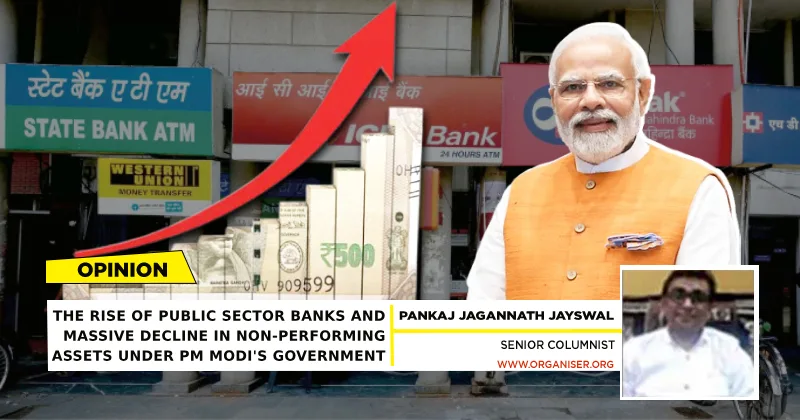
India’s Public Sector Banks (PSBs) achieved their highest-ever aggregate net profit of ₹1.41 lakh crore in fiscal year 2023-24. This historic performance underscores the sector’s strong recovery, which is supported by a major increase in asset quality. The Gross Non-Performing Assets (GNPA) ratio fell dramatically, down to 3.12% in September 2024. In the first half of 2024-25, they had a net profit of ₹ 85,520 crore, indicating continuous growth. In addition to their excellent performance, PSBs have contributed significantly to shareholder returns, paying a total dividend of ₹61,964 crore over the last three years. This tremendous financial increase demonstrates the sector’s operating efficiency, higher asset quality, and stronger capital foundation.
How the banking sector suffered as a result of massive non-performing assets generated during the Congress government
Let’s go back before 2014 when PM Modi was not in power, many social media experts and politicians were not aware how these NPA’s generated. (Non-Performing Assets), as per RBI report and information given by FM Nirmala Sitharaman, Gross advances of the state owned bank increased from Rs 18.19 lakh crore in FY 2008 to Rs 52.16 lakh crore as on FY 2014 (before PM Modi). She also informed that this aggressive lending practices, wilful default, corruption in some cases and economic slowdown led to spurt in stressed assets.
It was easier for PM Modi to come forward after being elected in May 2014 and release a white paper with facts and numbers on how the economy was given over to him, mentioning that he wouldn’t be able to do anything for the next five years. PM Modi is known for dealing with adversity and being a man of action. He decided to tackle this as a challenge and began working with then-FM Late Shri Arun Jaitley. He did the right thing by not hiding NPA but bringing it to the surface for action. Mentioning a few steps to understand the acts accomplished.
The IBC (Insolvency and Bankruptcy code), SARFAESI (Securitisation and Reconstruction of Financial Assets and Enforcement of Security Interest) act and stressed asset management verticals…
The government has taken comprehensive steps under it’s 4R’s strategy,
Recognising NPA’s transparently
Resolving and Recovering value from stressed accounts
Recapitalising PSB’s
Reforms in banks and financial ecosystem to ensure a responsible and clean system.
These numerous approaches enabled the government recover Rs 3.59 lakh crore from PSBs by April 2019 and the Gross Non-Performing Assets (GNPA) ratio fell dramatically, down to 3.12% in September 2024.
Decline in GNPA: Strengthening PSB Resilience
The Gross NPA ratio of Public Sector Banks has undergone a significant turnaround, decreasing to 3.12% in September 2024 from a peak of 14.58% in March 2018. This large drop indicates the success of focused actions to relieve stress in the banking sector. The Asset Quality Review (AQR), undertaken by the Reserve Bank of India in 2015, marked a watershed moment. This initiative sought to uncover and resolve latent stress in banks by requiring the transparent identification of NPAs. It also reclassified previously restructured loans as NPAs, causing a significant increase in reported NPAs. During this period, banks faced increased provisioning requirements that limited their ability to lend and assist productive industries.These were written off but ultimately recovered. As a result, do not confuse waive-off with written-off. The process is ongoing, and no one will be spared by PM Modi within the confines of the law of the land, which is why fear mongering and the creation of false news with distorted data are being distributed on many platforms to harm his reputation. Finally, this allows social media warriors to go extensively into the claims against PM Modi in order to uncover true evidence about prior corruption or malpractices committed by the bosses of false news providers.
We are witnessing lot of mis-information being spread in social media about loan written off for big industrialists or people shown close to PM Modi by main stream media. The ultimate purpose is to show PM Modi is corrupt and dancing to the tunes of these biggies.
Let’s understand the difference between written off and waive off in simple terms.
If someone borrows Rs 100 from you this month but is unable to repay you during the fiscal year as promised, you will write off this amount from your balance sheet as per long-standing accounting practice (not discovered by PM Modi), but you will still pursue him to recover your money, and you may use legal action against him if he does not follow the agreement/contract. When you waive off a debt, you are entirely releasing him from the need to pay a specific sum, and there will be no legal penalties for the debtor. A loan waiver for farmers is an appropriate example.
Expanding Financial Inclusion
Beyond their financial accomplishments, these banks have played an important role in promoting financial inclusion. They have implemented critical government schemes, such as the Atal Pension Yojana and the Pradhan Mantri Jeevan Jyoti Bima Yojana, to name a few. These efforts have guaranteed that critical benefits reach underrepresented areas of society. The government of India has actively supported the sector with reforms, welfare initiatives, and strong policies. This has enhanced the banking system by promoting greater openness, stability, and inclusivity.
PSBs continue to expand their presence across the country, hence increasing financial inclusion. Their stronger financial base and improved asset quality have allowed them to enter markets freely, lessening their need on government recapitalization. Here’s how PSBs and SCBs are promoting financial inclusion: Various key financial inclusion projects (PM Mudra, Stand-Up India, PM-SVANidhi, and PM Vishwakarma) have sanctioned.
54 crore Jan Dhan accounts and over 52 crore collateral-free loans.
The number of bank branches has expanded from 1,17,990 in March 2014 to 1,60,501 in September 2024, with 1,00,686 located in Rural and Semi-Urban (RUSU) areas.
The Kisan Credit Card (KCC) Scheme attempts to offer farmers short-term agricultural financing. As of September 2024, the total number of operative KCC accounts was 7.71 crore, with a total outstanding of Rs. 9.88 lakh crore.
The Government of India (GoI) has continually provided affordable loans to the MSME sector through a variety of initiatives. MSME advances have grown at a CAGR of 15 per cent over the last three years, with total advances as of March 31, 2024 standing at Rs. 28.04 lakh crore, or a 17.2 per cent annual growth rate. Scheduled Commercial Banks’ gross advances climbed from Rs. 8.5 lakh crore to Rs. 61 lakh crore between 2004 and 2014, and have since expanded significantly to Rs. 175 lakh crore by March 2024.
In recent years, India’s public sector banks have made amazing progress, reaching new financial milestones and considerably contributing to the country’s economic stability and growth. The decrease in Gross Non-Performing Assets (GNPA) and the improvement in Capital to Risk (Weighted) Assets Ratio (CRAR) demonstrate the sector’s resilience and good risk management methods. The EASE framework has been critical in implementing changes, encouraging cautious lending, and leveraging technology to improve banking services. The focus on financial inclusion has increased access to banks, providing millions with affordable credit and insurance. PSBs, with a stronger financial foundation and enhanced asset quality, are well-positioned to contribute to India’s development agenda and drive inclusive growth.