The quest to comprehend the universe, from its vast cosmic expanse to its tiniest components, has been a universal endeavour throughout human history. Ancient Bharatiya philosophy and metaphysics have always explored fundamental questions about matter and existence. Particle physics too, is rooted in quantum mechanics and the Standard Model. Contemporary scientific ideas resonating with ancient Bharatiya concepts surely is a breath of fresh air.
Vaisheshika Sutra and Jainism
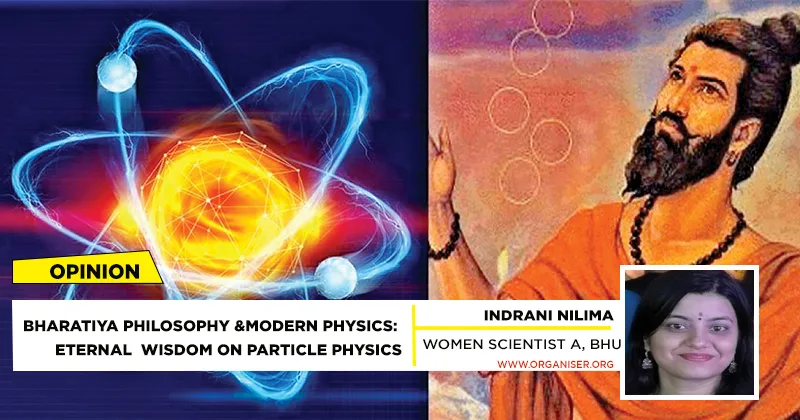
Ancient Bharatiya literature, including the Vedas, Upanishads, as well as Buddhist and Jain philosophies, reflect a deep fascination for understanding the fundamentals of reality. For example, around the 6th century BCE, Bharatiya philosopher Kanad proposed a theory of matter in the Vaisheshika Sutra. He proposed that everything in the universe can be broken down into smaller parts, but this process cannot continue indefinitely. Eventually, there must be fundamental, indivisible entities (Paramanu) that are eternal. These tiny particles combine in various ways to form complex substances and bodies, each with its own unique identity. This idea completely explains the modern understanding of atoms as the fundamental building blocks of matter.
Jain philosophy takes this further by defining matter (pudgala) as eternal and divisible into the tiniest possible units. The term Pudgala comes from two Sanskrit words: “pud,” meaning supplementation or fusion (the process of adding or combining), and “gala,” meaning disintegration, division, or fission. Therefore, Pudgala refers to all things that are constantly changing through the processes of addition and disintegration — essentially, matter. The basic unit of Pudgala is called Paramanu, which is the fundamental material from which everything is made. Through the process of supplementation (combining), Paramanu can come together to form larger structures, known as Skandha. These aggregates are composed of multiple Paramanus and represent the more complex forms of matter we encounter.
The modern scientific concept of particle-antiparticle creation and annihilation observed in high-energy physics is directly aligned with the dynamic cycle of creation and destruction in Hindu scriptures, particularly in Shiva’s cosmic dance (Tandav). In Advaita Vedanta, realising oneness with Brahman involves understanding that the world of appearances such as matter and individuality is temporary and ultimately an illusion. The only true, unchanging reality is Brahman. Similarly, Einstein’s equation E = mc2 demonstrates that mass and energy are not distinct entities but interchangeable forms of the same essence, reflecting a comparable idea of unity underlying apparent diversity.
The foundational ideas initiated by ancient Bharatiya philosophers were echoed and expanded upon by Bharatiya scientists, influenced Western scientists, who in turn made groundbreaking contributions to the field of physics. The Nobel laureate physicist, Erwin Schrödinger was deeply inspired by the Upanishads. He spoke about them often and made a conscious effort to integrate their teachings into his life. His epitaph reflects this philosophical influence, stating, “So all Being is an one and only Being; And that it continues to be when someone dies; [this] tells you, that he did not cease to be.”Schrödinger wasn’t the only scientist moved by Bharatiya philosophy. Niels Bohr famously remarked, “I go to the Upanishads to ask questions,” highlighting the influence of these ancient texts on his thinking. Werner Heisenberg, after meeting Rabindranath Tagore, found great solace in Bharatiya philosophy, as described in Fritjof Capra’s The Tao of Physics (1975).
J. Robert Oppenheimer, leader of the Manhattan Project, also embraced Bharatiya thought. He learned Sanskrit to read the Bhagavad Gita in its original form. Witnessing the first atomic bomb test, he was reminded of a verse from the Gita where Krishna reveals his cosmic form to Arjuna. Oppenheimer translated it as, “Now I am become death, the destroyer of worlds.” These examples show how Bharatiya wisdom profoundly influenced some of the most inquisitive minds in modern physics, offering them philosophical insights that assisted in their groundbreaking scientific discoveries.
‘Modernity’ of Bharatiya Physicists
Bharat has produced several notable physicists who have made significant contributions to the field of particle physics and related disciplines. While their work is more empirical and experimental, it often touches on questions similar to those pondered by ancient philosophers, such as the nature of matter and the structure of the cosmos. Early pioneers like Sir C. V. Raman, J. C. Bose, and Satyendra Nath Bose shaped the foundation of modern physics and worked on groundbreaking discoveries, such as the Raman Effect and Bose-Einstein statistics. After independence, prominent figures like Subrahmanyan Chandrasekhar and Homi J. Bhabha continued to elevate Bharat’s reputation in global physics, with Chandrasekhar’s work on stellar evolution and Bhabha’s contributions to nuclear physics being particularly noteworthy.
In the subsequent phase, physicists like Prahalad Chunnilal Vaidya, Amal Kumar Raychaudhuri, Jayant Narlikar made important strides in the study of general relativity, further advancing theoretical physics. Later generations of physicists, including E. C. George Sudarshan and modern theorists like Ashoke Sen, have continued to contribute to cutting-edge developments in quantum field theory, string theory, and other areas of modern physics, bringing Bharat global recognition. The ongoing progress in the field reflects Bharat’s rich legacy and continuing impact on the world of science. Bharat plays a significant role in global particle physics through association with CERN, particularly in experiments at the Large Hadron Collider (LHC). Bharatiya institutions like TIFR, IMSC, and the Bharatiya Neutrino Observatory (INO) continue to advance our understanding of the subatomic world.
The progression from ancient Bharatiya philosophy to modern particle physics reflects a continuous pursuit of knowledge, discoveries and possibilities. By approaching the age old concepts not as alternatives, but as complementary viewpoints, we can enrich our understanding of the universe. This rich heritage highlights Bharat’s lasting impact on understanding the universe, from its tiniest particles to its immense cosmic scale.
Advancing particle physics research inspired by Bharatiya scriptures requires an interdisciplinary approach that blends traditional knowledge with modern scientific practices. Associating across fields such as physics, history, linguistics, and philosophy allows for the reinterpretation of profound philosophical concepts like Lokas (Dimensions), Anu/ Parmanu (atoms and subatomic particles), or Shakti (energy) in the light of quantum mechanics, string theory or cosmology. This approach encourages innovative thinking, opening new avenues for theoretical development and experimental exploration.