





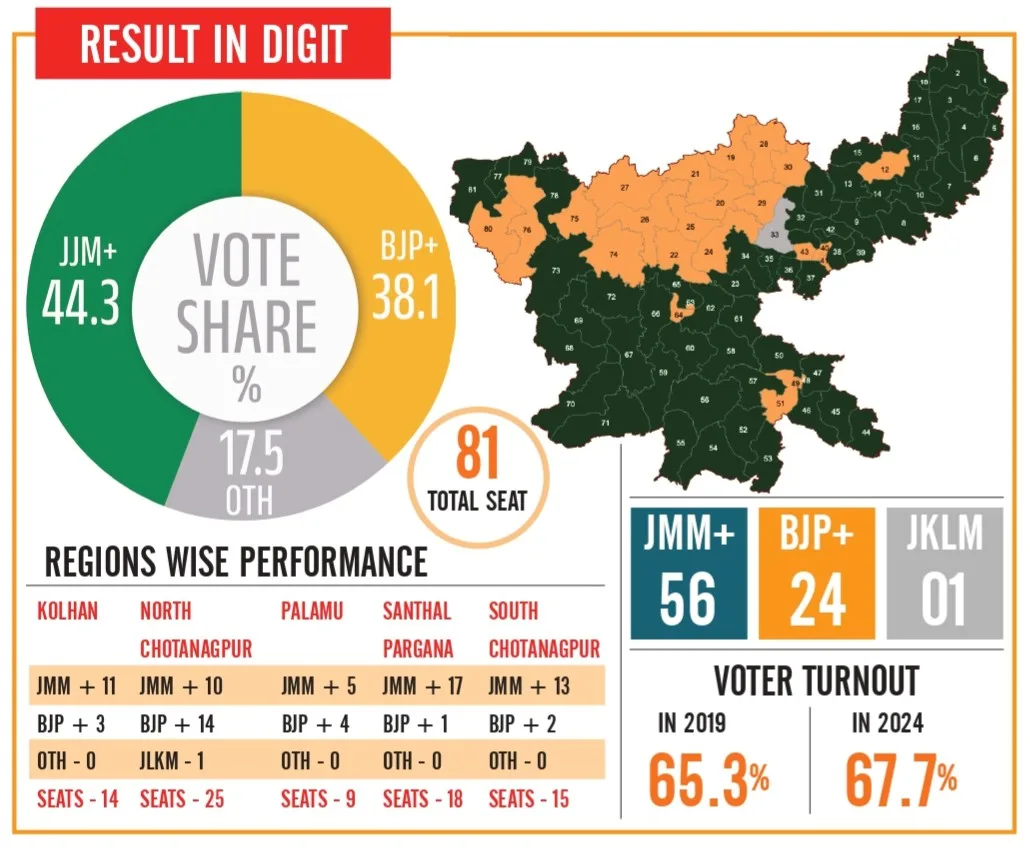
The 2024 Jharkhand Assembly elections resulted in a significant victory for the Jharkhand Mukti Morcha (JMM)-led INDI Alliance. They secured a total of 56 seats out of 81; JMM won 34 seats, the Congress secured 16, and the RJD claimed 4. On the other hand, the BJP-led National Democratic Alliance (NDA) managed to win 24 seats, with the BJP itself taking 21 seats. The alliance secured a comfortable majority, allowing Hemant Soren to retain his position as Chief Minister. The BJP, despite its strong campaigning, fell short of expectations.
But the talking point is how this election witnessed a mix of victories for various parties across the state’s constituencies. The entire election was marked by a complex interplay of socio-political issues, with religious conversions and demographic shifts emerging as dominant themes. These issues, particularly in regions like Santhal Pargana and Kolhan division, had a direct impact on voter behaviour and political strategies, shaping the overall outcome of the elections on November 23.
A Visible Shift
The state of Jharkhand was formed in the year 2000 to address the aspirations of its tribal population, ensuring their socio-cultural and economic upliftment. Vanvaavis make up about 26% of the state’s population, making Jharkhand one of the few states in India with a significant tribal demographic.
Over the years, however, the state has witnessed an increasing influence of non-tribal settlers, religious conversions, and demographic changes. During the 2024 Jharkhand elections, BJP prominently raised the issue of illegal Bangladeshi immigrants, particularly in the Santhal Parganas and Kolhan regions. The party claimed that unchecked infiltration was altering the demographic balance, reducing the tribal population, and threatening cultural heritage. Prime Minister Narendra Modi, Union Home Minister Amit Shah, and other BJP leaders including Assam Chief Minister emphasised this prominently in rallies, blaming the ruling JMM and its allies for allegedly facilitating such infiltration.
The party even proposed measures like reclaiming tribal lands allegedly occupied by infiltrators and creating committees to investigate infiltration claims. However, the JMM and Congress dismissed these allegations, accusing the BJP of exploiting communal tensions for electoral gain. They also pointed out that border security falls under the central government’s jurisdiction, challenging BJP’s claims of large-scale infiltration under its watch.
Team Organiser, also noticed a similar pattern when we visited the state for Assembly polls. We witnessed this demographic shift first hand in villages such as Uttar Palasgachi of Sahebganj, which now host a predominantly Muslim population, with Hindu and tribal families becoming minorities.
Similarly, missionary activity in Jharkhand has been a contentious issue for decades. Tribals, primarily Sarna worshippers with deep-rooted cultural traditions, have increasingly converted to Christianity due to the influence of missionaries.
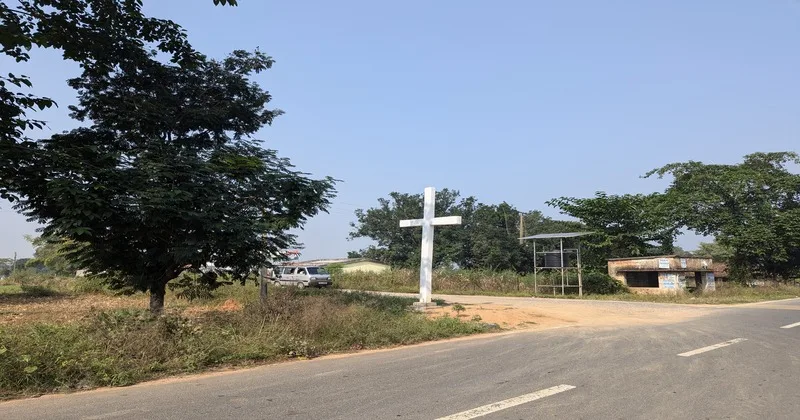
We noticed in regions such as Latehar or Gumla, basic infrastructure like healthcare and schools were missing, yet missionaries established well-funded churches. The village of Ribika Paharia – the tribal girl who was chopped into 51 pieces by her partner Dildar Ansari – has no roads but it has a huge church. This paradox raises questions about funding sources. For example, Christian organisations often operate schools and hospitals in areas where state services are weak, indirectly influencing local populations. Critics allege that foreign funding may support such activities, enabling large-scale religious conversions. In 2023, similar concerns arose nationwide, prompting the Indian government to tighten regulations on foreign contributions under the Foreign Contribution Regulation Act (FCRA). This aligns with fears that external actors exploit poverty and lack of development to foster religious dependency.
Just like demography, the issue of religion and tribal identity, particularly around Christian converts within Scheduled Tribes (STs) significantly shaped the poll results. In constituencies where converted tribals are a decisive factor, BJP has been able to secure seats whereas the JMM alliance swept those constituencies.
In Jharkhand, districts with significant Christian populations have predominantly elected candidates from JMM and INC. West Singhbhum, with a Christian population of 67.31%, saw JMM securing victories in Chaibasa, Majhgaon, Manoharpur, and Chakradharpur, while INC won in Jaganathpur. Simdega, where Christians make up 70.78 per cent of the population, elected INC candidates in both Kolebira and Simdega constituencies.
Pakur district, with a 42.10 per cent Christian population, was split between JMM and INC, with JMM winning Litipara and Maheshpur, and INC claiming Pakur. In Lohardaga, where the Christian population stands at 56.89%, INC emerged victorious. Similarly, in Latehar’s Manika constituency (Christian population 45.54%), INC won the seat.
Khunti district, with the highest Christian population of 73.25%, elected JMM candidates in both Torpa and Khunti. Gumla, where Christians constitute 68.94% of the population, also leaned heavily towards JMM, which won Sisai, Gumla, and Bishunpur constituencies. This trend highlights the strong influence of JMM and INC in areas with substantial Christian demographics in Jharkhand.
In Urban constituencies, where concerns over illegal migration and cultural changes were more pronounced, leaned toward the BJP. The party’s promises to tackle demographic challenges and promote industrial development resonated with urban voters. In rural and remote areas where the missionary penetration is highest, BJP clearly suffered electorally.
JLKM’s Rise, Vote-Splitting and Electoral Impact
The recently concluded polls also brought the Jharkhand Loktantrik Krantikari Morcha (JKLM)into sharp focus. The party, led by Jairam Mahato, not only disrupted the traditional dominance of major parties like the BJP and the JMM but also played a critical role in reshaping electoral outcomes across key constituencies. An analysis of Election Commission data underscores JLKM’s influence. In 17 key constituencies, the party consistently secured significant vote shares, often affecting the margins between leading candidates. For instance:
● Ichagarh: JMM won with 57,125 votes, AJSU secured 45,070, while JLKM garnered 38,974 votes.
● Chandankiyari: JMM triumphed with 90,027 votes, but JLKM, with 56,294 votes, pushed BJP (56,091) to third place.
● Dumri: JLKM’s Jairam Mahato won decisively, bagging 94,496 votes against JMM’s 83,551 and AJSU’s 35,890.
JKLM’s emergence has deeply impacted the BJP alliance. In many constituencies, JLKM drew a significant chunk of NDA-aligned votes, diluting BJP’s support base. For example:
● Mandu: AJSU narrowly defeated Congress by just 231 votes, with JLKM securing 70,696 votes.
● Latehar: BJP won by a slim margin of 434 votes, while JLKM made a modest yet impactful entry with 4,235 votes.
The data reveals that JLKM has not only won seats like Dumri but also influenced the outcome in multiple constituencies by splitting votes, highlighting its role as a disruptor. The BJP and its allies face tough questions about their organizational strategies and ability to counter JLKM’s rise.
In the 2024 Lok Sabha elections, JLKM fielded candidates in eight constituencies, including Giridih, Ranchi, Hazaribagh, Koderma, and Dhanbad. Although the party did not win any seats, it demonstrated its growing strength by securing notable vote shares. Jairam Mahato himself contested the Giridih seat as an Independent and garnered an impressive 347,322 votes, positioning himself as a rising star in Jharkhand politics.
The Cultural Implications
Cultural implications of missionary activities in Jharkhand are immense. Beyond electoral politics, conversions have led to significant cultural transformations. Traditional tribal festivals, rituals, and community practices are being replaced by Christian traditions in converted areas. This cultural shift has deepened the divide between Christian and non-Christian tribes, creating new socio-political dynamics.
As demographic and cultural changes continue, the future of Jharkhand’s tribal identity remains uncertain. The Jharkhand election is not about some periodical change in ruling dispensation. Something more sinister and permanent is changing on the ground. It’s a matter of grave concern and serious investigation that the remote places where even basic amenities are not available how come missionaries are reaching? Their faith in their religious system is another matter but building such infrastructure needs money. Who funds that? If foreign powers are involved in proselytising, then these churches and missionaries cannot be viewed as some “tribal, isolated minority facing Hindu majoritarian system” as the narrative is being set. In simple layman terms, they are the local nodal offices of a much powerful global syndicate.
The Niyogi Committee Report and its relevance:
In 1956, the Madhya Pradesh Government formed The Niyogi Committee to investigate missionary activities in central India, particularly Madhya Pradesh. The report of the Committee was an eye-opener. It highlighted the rampant conversion activities, and how conversions often exploited poverty, lack of education, and poor health infrastructure, creating socio-religious tensions. Present day Jharkhand shows nothing has changed. Foreign-funded missionary activities still thrive on the helplessness of needy people; on poverty, lack of education and basic amenities. The conversion of tribal groups through schools and hospitals led to shifts in local customs and resistance from Hindu and tribal groups. The findings of the Niyogi Report provide historical context to current debates. Forming another such fact-finding Committee, this time on central level, with more powers is the need of the hour which the Indian Government needs to focus on.
Beyond election results, Jharkhand’s need for a cultural renaissance is vital. For example, BJP’s push for “ghar wapsi” campaigns highlights a cultural resistance to religious shifts. Promoting tribal languages, rituals, and self-governance could counter external influences and help preserve Jharkhand’s indigenous heritage. Cultural revival programs and community-driven development might reduce dependence on foreign-funded organizations, addressing concerns about cultural erosion. The results also serve as a lesson for national parties like BJP: Core ideological issues ultimately change and determine the local dynamics and electoral politics in the long run.












Comments