Oil-for-Food Scandal: The untold story of Congress and Natwar Singh’s alleged role in global corruption
June 10, 2026
  • Read Ecopy
  • Circulation
  • Advertise
  • Careers
  • About Us
  • Contact Us
Android AppiPhone AppArattai
Organiser
  • ‌
  • Bharat
    • Assam
    • Bihar
    • Chhattisgarh
    • Jharkhand
    • Maharashtra
    • View All States
  • World
    • Asia
    • Europe
    • North America
    • South America
    • Africa
    • Australia
  • Editorial
  • International
  • Opinion
  • RSS @ 100
  • More
    • Op Sindoor
    • Analysis
    • Sports
    • Defence
    • Politics
    • Business
    • Economy
    • Culture
    • Special Report
    • Sci & Tech
    • Entertainment
    • G20
    • Azadi Ka Amrit Mahotsav
    • Vocal4Local
    • Web Stories
    • Education
    • Employment
    • Books
    • Interviews
    • Travel
    • Law
    • Health
    • Obituary
  • Subscribe
    • Subscribe Print Edition
    • Subscribe Ecopy
    • Read Ecopy
  • ‌
  • Bharat
    • Assam
    • Bihar
    • Chhattisgarh
    • Jharkhand
    • Maharashtra
    • View All States
  • World
    • Asia
    • Europe
    • North America
    • South America
    • Africa
    • Australia
  • Editorial
  • International
  • Opinion
  • RSS @ 100
  • More
    • Op Sindoor
    • Analysis
    • Sports
    • Defence
    • Politics
    • Business
    • Economy
    • Culture
    • Special Report
    • Sci & Tech
    • Entertainment
    • G20
    • Azadi Ka Amrit Mahotsav
    • Vocal4Local
    • Web Stories
    • Education
    • Employment
    • Books
    • Interviews
    • Travel
    • Law
    • Health
    • Obituary
  • Subscribe
    • Subscribe Print Edition
    • Subscribe Ecopy
    • Read Ecopy
Organiser
  • Home
  • Bharat
  • World
  • Operation Sindoor
  • Editorial
  • Analysis
  • Opinion
  • Culture
  • Defence
  • International Edition
  • RSS @ 100
  • Magazine
  • Read Ecopy
Home Politics

Oil-for-Food Scandal: The untold story of Congress and Natwar Singh’s alleged role in global corruption

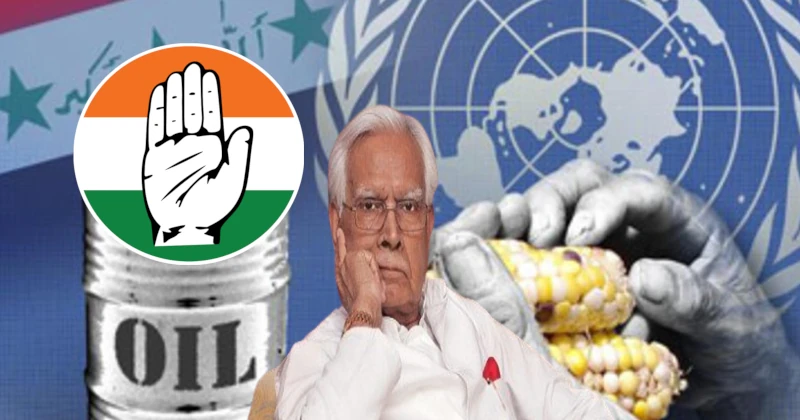
The Oil-for-Food scandal exposed Congress and Natwar Singh’s alleged involvement in illegal oil deals under Saddam Hussein's regime, as revealed by the UN's Volcker Report. Despite calls for transparency, Congress dismissed the findings, avoided a JPC, and kept the Pathak Committee report unpublished, raising suspicions of a cover-up

WEBDESKWEBDESK
Nov 26, 2024, 01:00 pm IST
in Politics, Bharat
Follow on Google News
FacebookTwitterWhatsAppTelegramEmail

In August 1990, Iraq’s invasion of Kuwait triggered global condemnation and the first Gulf War. In response, the United Nations Security Council (UNSC) imposed strict sanctions on Iraq in 1991, including a ban on oil exports. These measures, designed to cripple Saddam Hussein’s military funding, inadvertently devastated Iraq’s civilian population, plunging the nation into economic and humanitarian crises.

To address this, the UN launched the Oil-for-Food Program (OFFP) in 1996, allowing Iraq to sell oil under strict conditions. Proceeds from these sales were placed in escrow accounts, managed by third parties, and exclusively used to purchase food, medicine, and other humanitarian goods. Despite its noble intent, the program became a breeding ground for widespread corruption, with global implications that would later implicate India’s Congress Party and senior leader Natwar Singh.

The Volcker Report

The scandal came to light in 2004 when Iraq’s Al Mada newspaper published a list of individuals and entities allegedly involved in illicit oil transactions under the OFFP. In response, UN Secretary-General Kofi Annan appointed an investigative committee led by Paul Volcker, former chairman of the US Federal Reserve.

The 2005 Volcker Report uncovered systemic corruption, naming over 2,000 beneficiaries worldwide, including governments, private companies, and individuals. Among the names were India’s Congress Party and Natwar Singh, then India’s External Affairs Minister.

According to the Volcker Report, both the Congress Party and Natwar Singh were “non-contractual beneficiaries” of illegal oil allocations by Saddam Hussein’s regime. The report accused Natwar Singh of receiving 4 million barrels of oil, while the Congress Party was allocated another 4 million barrels.

The transactions allegedly began in 2001, during a visit to Iraq by Natwar Singh, his son, and other Congress leaders, including P. Shiv Shankar, A.R. Antulay, and Delhi-based exporter Andaleeb Sehgal. Sehgal’s company, Hamdan Exports, was accused of facilitating the sale of oil to a Swiss firm on the black market, with the profits benefiting Natwar Singh and the Congress Party.

Of the 8 million barrels allocated, 3 million were reportedly lifted:

  • 2 million barrels from Natwar Singh’s share.
  • 1 million barrels from Congress’s allocation.

The Fallout in 2005

The release of the Volcker Report created a political firestorm in India. Natwar Singh, then a senior member of the UPA government, was forced to resign from his ministerial post amid mounting pressure. In an attempt to deflect blame, the UPA government established the R.S. Pathak Committee to investigate the allegations.

While the Pathak Committee implicated Natwar Singh’s associates, it gave the Congress Party a clean chit—a conclusion many viewed as politically motivated. Natwar Singh vehemently denied the allegations, accusing Sonia Gandhi of conspiring against him to protect the party’s image.

A Tale of Two Reports: Volcker vs. Pathak

The Volcker Report, a UN-backed investigation with global credibility, explicitly named the Congress Party as a beneficiary of Saddam’s illicit oil allocations. In stark contrast, the Indian government’s Pathak Committee cleared Congress of wrongdoing, fueling suspicions of a cover-up.

Key questions remain unanswered:

Why Did Congress Dismiss the Volcker Report?

Congress, in recent controversies, has relied on external investigations such as the Hindenburg Report to demand accountability. However, in 2005, the party dismissed the globally respected Volcker Report, branding it biased and politically motivated. This contradiction raises questions about the party’s selective approach to external investigations. Why did Congress trust a foreign report in one instance but reject another when its own reputation was at stake?

Why Wasn’t a Joint Parliamentary Committee (JPC) Formed?

Congress has been a vocal proponent of Joint Parliamentary Committees (JPCs) to investigate allegations of corruption. Yet, when the oil-for-food scandal broke, the party avoided forming a JPC. A JPC could have ensured a transparent and bipartisan investigation, addressing public concerns about political shielding. The lack of such a mechanism further fuels suspicions of a cover-up.

Why Is the Pathak Committee Report Still Unpublished?

Transparency demands that the findings of the R.S. Pathak Committee be made public. However, nearly two decades later, the report remains under wraps. This secrecy only deepens doubts about the credibility of the investigation and whether it was tailored to protect Congress from global embarrassment.

The oil-for-food scandal remains a black mark on Congress’s legacy. Allegations of corruption at an international level, coupled with the perception of political shielding, have tarnished the party’s credibility. Meanwhile, Natwar Singh, once a trusted Congress stalwart, continues to claim he was scapegoated to save the party’s reputation.


Topics: Natwar SinghVolcker ReportOil-for-Food ScandalR.S. Pathak CommitteeOil-for-Food ProgramCongressUNCorruption
Share12TweetSendShareSend
✮ Subscribe Organiser YouTube Channel. ✮
✮ Join Organiser's WhatsApp channel for Nationalist views beyond the news. ✮
Previous News

India’s Dairy Revolution: From shortage to global leadership

Next News

Remembering Major Sandeep Unnikrishnan: A hero of the 26/11 Mumbai attack

Related News

12 years of Modi Govt: Meaningful philosophy or manufactured phenomenon; Bharat’s tryst with democracy

Kochi IPL Mystery: Why Did Sunanda Pushkar Surrender Stake Amid Benami Claims Tied to Shashi Tharoor, Sonia Gandhi?

Kochi IPL Mystery: Why Did Sunanda Pushkar Surrender Stake Amid Benami Claims Tied to Shashi Tharoor, Sonia Gandhi?

AAP’s New Front? CJP Emerges as Congress’s Biggest Narrative Challenger

Congress Protests, CJP Trends: AAP harvests through CJP on ground tilled by Congress

MK Stalin with Sonai Gandhi; MK Stalin with Rahul Gandhi (File Photos) (Left to Right)

Tamil Nadu: DMK says no to INDIA Alliance meet in Delhi, blames Congress for political backstabbing

From Partition to the National Advisory Council in 2004, Congress-led decisions are seen as having lasting impacts on India’s territorial integrity

Dark Chapter of Congress: How partition, territorial concessions and political decisions shaped India’s troubled legacy

Himachal Municipal Election Results: BJP sweeps Dharamshala, Mandi & Solan; Congress retains Palampur

Load More

Latest News

Hawkers protest in West Bengal

The Left’s Selective Morality: From Sainbari to Hawker protests

Odisha CM Mohan Charan Majhi and Union Minister of Law and Justice Arjun Ram Meghwal along with other dignitaries on the stage on the occasion of completion of 12 years of the Central Government

PM Modi’s 12-years of governance marks era of transformation, growth & global recognition: Odisha CM Mohan Majhi

Modi govt clears Rs 13,000 Crore Great Nicobar Airport Project (This is an AI generated image)

India’s strategic move in Great Nicobar: Rs 13,000 crore airport to double strength in the Indian Ocean

Redistricting efforts across the United States continue to redefine electoral boundaries and congressional competition before the 2026 midterms.

America’s electoral map shifts ahead of 2026 Midterms; Courts back redistricting push

India Deploys 12 Nuclear Warheads: Heralds doctrinal shift to script strategic deterrence against multi-front threat

J&K: Zojila tunnel clears key hurdle; Signals new era of connectivity for Ladakh

How Cockroach politics is hollowing out Bharatiya democratic culture

RSS centenary year is a time for renewed resolve and greater commitment to nation-building: Dr Mohan Bhagwat

Ex-DMK Minister Senthil Balaji (Right Side-File Photo)

Tamil Nadu: CBI books Rs 397 cr transformer tender scam from ex-DMK Minister Senthil Balaji’s tenure (2021-2023)

Border Security Force (BSF) officials inspect the Single Row Fencing (SRF) at a Border Out Post area (India-Bangladesh border)

Infiltration and Border Management: Saving the Siliguri corridor

Load More
  • Privacy
  • Terms
  • Cookie Policy
  • Refund and Cancellation
  • Delivery and Shipping

© Bharat Prakashan (Delhi) Limited.
Tech-enabled by Ananthapuri Technologies

  • Home
  • Search Organiser
  • Bharat
    • Assam
    • Bihar
    • Chhattisgarh
    • Jharkhand
    • Maharashtra
    • View All States
  • World
    • Asia
    • Africa
    • North America
    • South America
    • Europe
    • Australia
  • Editorial
  • Operation Sindoor
  • Opinion
  • Analysis
  • Defence
  • Culture
  • Sports
  • Business
  • RSS @ 100
  • Entertainment
  • More ..
    • Sci & Tech
    • Vocal4Local
    • Special Report
    • Education
    • Employment
    • Books
    • Interviews
    • Travel
    • Health
    • Politics
    • Law
    • Economy
    • Obituary
  • Subscribe Magazine
  • Read Ecopy
  • Advertise
  • Circulation
  • Careers
  • About Us
  • Contact Us
  • Policies & Terms
    • Privacy Policy
    • Cookie Policy
    • Refund and Cancellation
    • Terms of Use

© Bharat Prakashan (Delhi) Limited.
Tech-enabled by Ananthapuri Technologies