Time to inculcate conviction that traditional medical systems are vast repositories of knowledge and skills
July 22, 2026
  • Read Ecopy
  • Circulation
  • Advertise
  • Careers
  • About Us
  • Contact Us
Android AppiPhone AppArattai
Organiser
  • ‌
  • Bharat
    • Assam
    • Bihar
    • Chhattisgarh
    • Jharkhand
    • Maharashtra
    • View All States
  • World
    • Asia
    • Europe
    • North America
    • South America
    • Africa
    • Australia
  • Editorial
  • International
  • Opinion
  • RSS @ 100
  • More
    • Op Sindoor
    • Analysis
    • Sports
    • Defence
    • Politics
    • Business
    • Economy
    • Culture
    • Special Report
    • Sci & Tech
    • Entertainment
    • G20
    • Azadi Ka Amrit Mahotsav
    • Vocal4Local
    • Web Stories
    • Education
    • Employment
    • Books
    • Interviews
    • Travel
    • Law
    • Health
    • Obituary
  • Subscribe
    • Subscribe Print Edition
    • Subscribe Ecopy
    • Read Ecopy
  • ‌
  • Bharat
    • Assam
    • Bihar
    • Chhattisgarh
    • Jharkhand
    • Maharashtra
    • View All States
  • World
    • Asia
    • Europe
    • North America
    • South America
    • Africa
    • Australia
  • Editorial
  • International
  • Opinion
  • RSS @ 100
  • More
    • Op Sindoor
    • Analysis
    • Sports
    • Defence
    • Politics
    • Business
    • Economy
    • Culture
    • Special Report
    • Sci & Tech
    • Entertainment
    • G20
    • Azadi Ka Amrit Mahotsav
    • Vocal4Local
    • Web Stories
    • Education
    • Employment
    • Books
    • Interviews
    • Travel
    • Law
    • Health
    • Obituary
  • Subscribe
    • Subscribe Print Edition
    • Subscribe Ecopy
    • Read Ecopy
Organiser
  • Home
  • Bharat
  • World
  • Operation Sindoor
  • Editorial
  • Analysis
  • Opinion
  • Culture
  • Defence
  • International Edition
  • RSS @ 100
  • Magazine
  • Read Ecopy
Home Bharat

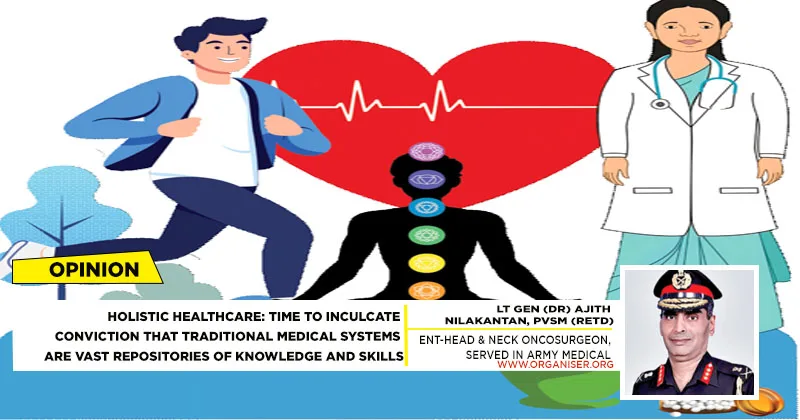
Time to inculcate conviction that traditional medical systems are vast repositories of knowledge and skills

It is time allopathic practitioners shun their ‘superior’ attitude and work in tandem with those of traditional Indian systems to provide holistic healthcare to patients

Lt Gen (Dr) Ajith Nilakantan, PVSM (Retd)Lt Gen (Dr) Ajith Nilakantan, PVSM (Retd)
Sep 25, 2024, 08:30 pm IST
in Bharat, Opinion
Follow on Google News
FacebookTwitterWhatsAppTelegramEmail

The current practice of ‘Modern Medicine’ in our country has been facing a lot of challenges regarding the question of integration with various forms of traditional medicines which form an integral part of the healthcare landscape across various regions. It must be acknowledged that since ‘Allopathy’ expanded its footprint adopting the garb of Modern Medicine, there has been some conflict and some confrontation even though some amount of co-existence has always existed. The current debate is about how to integrate all systems in the interest of holistic healthcare for our citizens adapted to the unique genius of our country, giving due recognition to our cultural heritage and practices. The establishment of the Ministry of AYUSH was specifically aimed at this objective, and while much progress has been achieved on this front, we still have a long way to go. It is rather unfortunate that many practitioners of Allopathy have unwittingly developed a feeling of contempt and disregard for AYUSH modalities, which extends to a tendency to put down AYUSH practitioners as inferior in stature and status. There is a tendency to brand them as semi-quacks and there exists a sort of determination to prevent any collaboration with them citing scientific ‘purity’. Anecdotal evidence of adverse effects and outcomes are often quoted to discredit AYUSH practice, wilfully ignoring the fact that Allopathic medications, too, have side-effects and that no system can always claim guaranteed outcomes. Also, the ground reality that quackery and malpractices exist in all streams of medical practice is selectively ignored. It is almost like an exclusivist ‘caste system’ or ‘elite club’ mindset denying entry to the ‘others’. It cannot be denied that there are obvious elements of a ‘colonial mentality’ in this attitude which unwittingly looks down on indigenous native systems as lacking in ‘modernity’ and scientific temper.

This was most evident in the widespread opposition within the Allopathy fraternity to the ‘Bridge Course’ which was proposed some time ago to enable AYUSH graduates to practice primary level Allopathy after a structured training. The primary argument was that mixing systems of medicine (euphemistically termed ‘Mixopathy’) would be unscientific as the basic tenets and approach of these systems are not mutually compatible. Of course, the economic argument that the ‘Bridge qualified’ AYUSH doctors would compete with Allopathy doctors for employment opportunities was a prime factor. The question, however, remains unresolved whether these Bridge qualified AYUSH doctors could potentially have served to address the need for more qualified primary care doctors in rural and remote areas.

Holistic Integration

True integrated medical practice and healthcare aims to provide all modalities to the patient seamlessly in a scientifically valid manner as per the individual needs of a patient, avoiding the pitfalls inherent in fragmented and uncoordinated approach. Various forms and modes of integration are in vogue, including horizontal linking at the same level and vertical linking of different levels of care. In the Bharatiya context, holistic integration cannot be achieved till we are able to devise a working model that effectively brings together Allopathy and AYUSH modalities to achieve cost-effective healthcare delivery in the service of the community. The primacy of Ayurveda in this context must be acknowledged, and efforts should be made primarily to formulate a working plan to integrate these two systems – of course the other systems also need to be fitted into this as appropriate.

One issue that needs to be addressed clearly is that this integration does not mean random mixing up different systems of medicine by unqualified medical professionals. This apprehension has to be tackled in different steps. These must be aimed at resolving certain widespread concerns which have been raised over the years, which include issues regarding unscientific mixing of systems, potential adverse effects and cross-reactions of medications/ interventions of other systems, consequences of ignorance about other systems and the issue of primary responsibility for outcomes. All these can suitably be resolved provided the necessary will and determination is brought to the table. Firstly, it must be ensured that evaluation and management according to each system is carried out by suitably-qualified medical professionals in their respective systems. Secondly, the issue of adverse cross-interactions due to medications and other interventions from different systems needs to be studied scientifically and necessary precautions taken – this can only be done by well-structured research. Thirdly, effective collaboration can only be achieved when medical practitioners have some elementary conceptual understanding of the basic tenets of the other systems – this mandates that these aspects should be incorporated in the Indian Medical Graduate (IMG) studies curriculum by the National Medical Commission (NMC) in a suitably-structured manner.

We need to inculcate a firm conviction in the minds of our medical students and young doctors that our traditional medical systems are vast repositories of knowledge and skills which need to be effectively deployed for the benefit of our population. Only then can true health in all its dimensions – physical, mental and social – be achieved for our citizens. In fact, preservation and propagation of this heritage is our duty to mankind – surely it is evident that if we do not preserve Ayurveda, the world will lose Ayurveda. That is the responsibility incumbent on us, which we must own up to and deliver in the interest of mankind.

Let us all reiterate our resolve, as per the traditional Shanti Path invocation, to make all beings free of disease – Sarve Santu Niramaya.
Topics: AllopathyModern medicineHolistic IntegrationAYUSH graduatesscientific temper
Share8TweetSendShareSend
✮ Subscribe Organiser YouTube Channel. ✮
✮ Join Organiser's WhatsApp channel for Nationalist views beyond the news. ✮
Previous News

Union Government to launch Prime Minister’s internship scheme, top CSR spenders to lead initiative

Next News

First ‘Make in India’ driverless train rolls into Delhi metro, phase 4 expansion on track

Related News

Holistic & Integrated Healthcare: Experts call for bridging the gap between various pathies at Ayushman Bhava Conclave

Representative image

Supreme Court criticises Allopathic doctors for prescribing expensive medicines; calls for IMA accountability

International Yoga Day: 20 minutes of Yoga a day is enough to realise its wonders

RSS Sarsanghchalak Mohan Bhagwat (File/Indian Express)

RSS Sarsanghchalak advocates for affordable, accessible healthcare to empower society

Load More

Latest News

Telangana BJP president N. Ramchander Rao and party workers detained by Hyderabad Police

Telangana: BJP leaders detained for protesting against demonstration by Rahul Gandhi near PM Modi’s residence

Khalistan terror group enters CJP protests: SFJ’s Pannun offers $1 million, threatens India’s disintegration

Ayurveda is rapidly emerging as one of India's strongest tools of global health diplomacy and soft power

From Jamnagar to the World: How Ayurveda is transforming India’s global health diplomacy and soft power

BJP Keralam vice president Adv. Shon George (Left)

Keralam: BJP’s Shon George says Supreme Court order vindicates party’s stand on Kerala Waqf Board

Writer Taslima Nasrin

Taslima Nasrin: A voice under attack from fundamentalism and leftist groups

Government of India Must Constitute a High-Level Committee to Ensure Transparency and Institutional Reforms in Competitive Examinations: ABVP

Students will not become instruments for narrow political interests and anti-national conspiracies: ABVP

Tamil Nadu: TVK Minister attends CJP protest over NEET; BJP questions the government’s stand

Odisha CM Mohan Charan Majhi

NITI Aayog’s IFI 2026: Odisha emerges as a leading investment destination, ranks among India’s top five states

(Left) Accused Noor Hussain arrested by police (Right) House of accused Noor set ablaze by angry locals

Assam Love Jihad: Noor posed as Rahul trapped and abducted minor Hindu girl; Raped and tortured her for 4 days

Lieutenant Governor Manoj Sinha addresses 'Shakti Mimansa' symposium

J&K: LG Manoj Sinha urges Sanskrit scholars to dwell deep during ‘Shakti Mimansa’ symposium

Load More
  • Privacy
  • Terms
  • Cookie Policy
  • Refund and Cancellation
  • Delivery and Shipping

© Bharat Prakashan (Delhi) Limited.
Tech-enabled by Ananthapuri Technologies

  • Home
  • Search Organiser
  • Bharat
    • Assam
    • Bihar
    • Chhattisgarh
    • Jharkhand
    • Maharashtra
    • View All States
  • World
    • Asia
    • Africa
    • North America
    • South America
    • Europe
    • Australia
  • Editorial
  • Operation Sindoor
  • Opinion
  • Analysis
  • Defence
  • Culture
  • Sports
  • Business
  • RSS @ 100
  • Entertainment
  • More ..
    • Sci & Tech
    • Vocal4Local
    • Special Report
    • Education
    • Employment
    • Books
    • Interviews
    • Travel
    • Health
    • Politics
    • Law
    • Economy
    • Obituary
  • Subscribe Magazine
  • Read Ecopy
  • Advertise
  • Circulation
  • Careers
  • About Us
  • Contact Us
  • Policies & Terms
    • Privacy Policy
    • Cookie Policy
    • Refund and Cancellation
    • Terms of Use

© Bharat Prakashan (Delhi) Limited.
Tech-enabled by Ananthapuri Technologies