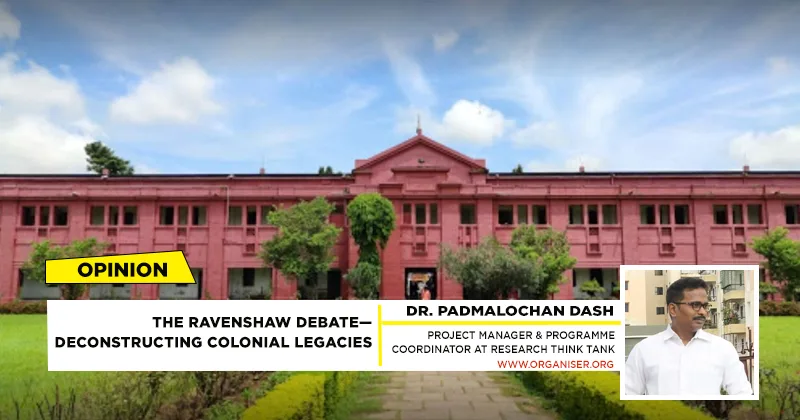
Union Education Minister Dharmendra Pradhan’s recent pitch to rename Ravenshaw University in Odisha has ignited a larger debate. Although Pradhan’s proposal seems symbolic, it signals the government’s intent to realign India’s educational framework with Bharat’s civilisational knowledge inheritance. While the government seeks to reclaim and redefine India’s educational framework by challenging the legacy of British-established institutions and dismantling the enduring influence of the colonial education system, the actualisation of this intent will be far more complex. The success, therefore, will hinge on the broader efforts by the central government and the comprehensive implementation of the National Education Policy (NEP) 2020, by strictly keeping the Indian Knowledge System (IKS) at its core.
The Colonial Legacy
The colonial legacy deeply embedded within India’s education system remains pervasive, even decades after independence. British-established institutions like Ravenshaw University were originally designed to produce a class of workers—clerks, administrators, and bureaucrats—who would serve the British Empire. This utilitarian approach to education, crafted for the colonizers’ needs, unfortunately persisted post-independence. The rulers of Independent India could not envision their own utilitarian goal, distinct from their colonial predecessors, and therefore failed to develop an education system that could serve the enrichment of India’s civilizational nation-building objectives. As a result, the education system, still patterned after colonial designs, continues to inflict an irreparable rupture in India’s intellectual and cultural landscape, reducing the nation’s rich holistic knowledge traditions to mere skill-development workouts.
In this context, the ongoing debate over renaming Ravenshaw University should not be viewed as simply changing a name but as a challenge to the enduring influence of this colonial system. It is about filling the large voids created by the colonial education model and embracing a vision of education that aligns with India’s civilizational approach.
British Education System
British educational institutions in India were never intended to nurture the intellectual, scientific, or spiritual potential of the Indian populace. Instead, they functioned as factories, producing an English-literate workforce whose primary role was to sustain the colonial machinery. The colonial objective was clear: they focused on creating skilled labourers and obedient clerks to serve their empire. Thus, even in the domain of skill development, the Macaulay education system never aimed to enrich the already prevailing numerous and diverse traditional skill proficiencies. Rather, it played to its own necessity at their deterioration.
Therefore, the education system introduced by the colonials, through the forceful and destructive replacement of India’s highly enriched traditional educational structures, reduced the nation’s rich traditions of holistic learning to a utilitarian exercise aimed at serving colonial interests. Unfortunately, decades after independence, India’s education system remains heavily burdened by this colonial model. It continues to focus on producing a skilled workforce tailored to fit the Western-dominated globalized market, rather than nurturing thinkers, innovators, and leaders who can fill the voids left for the great Indian civilizational resurgence.
Skills at the Expense of Intellect: A Colonial Hangover?
Modern India remains entrenched in the colonial obsession with skill development, treating it as the core of education. The British legacy of producing factory-furnished servants continues to resonate in India’s mainstream educational discourse. While skills are undoubtedly essential, the singular focus on them raises questions about the broader vision and management of our education system. Should India’s education system not aim at fostering holistic individual growth, creativity, and the inherent potential of its people, thereby manifesting self-reliance?
The argument must be straight: the emphasis on skills, often at the expense of intellectual enrichment, should go back over. The time has come to break free from the colonial hangover and prioritize nurturing a self-sufficient, intellectually vibrant, and self-reliant India over serving the interests of external economic forces—economic forces that must be kept at a certain stoppage.
De-Christianising the Sanatan Minds: A Forgotten Imperative?
The British did not merely impose an education system as a means of advancing their economic interests; they purposefully aimed to penetrate their colonial objectives into the deepest core of Indian cultural and civilizational standards and legacy. The goal was to Christianise the minds of a population deeply rooted in the Sanatan value system. The impact of this colonial strategy has been so profound that it has left a lasting imprint, sustainably altering Indian thought processes and tilting their subconscious alignment towards Western paradigms, often at the denial of their indigenous knowledge systems.
The question that arises is whether we are truly serious about decolonising our long-colonised psyche, and if so, what concrete steps are we undertaking to purge this colonial indoctrination from our education system. In this context, the proposal to rename Ravenshaw University emerges as a rejoinder towards reclaiming our intellectual sovereignty—a symbolic act but the first hit on the right target.
Enduring Influence to Systematic Overhaul, When?
The entire bureaucratic and administrative apparatus of the country, including India’s vast educational setup, remains heavily patterned after the ‘Western-Spaghetti model’ rather than the sixth-dimension wisdom. This deeply entrenched system cannot be replaced overnight; it requires a gradual, systematic, and well-crafted approach rooted in a long-term strategic vision. However, this transformation must be driven by a genuine commitment from the government to integrate the Indian Knowledge System (IKS) into the mainstream educational landscape. The National Education Policy (NEP) 2020 offers a framework for this change, but its success hinges on the robustness of its implementation. The critical question remains: Are we prepared to undertake this monumental task of overhaul, or will the colonial vestiges continue to dominate?
Decolonising Sanatan-Psyche: Is NEP 2020 Serving Its Purpose?
The National Education Policy (NEP) 2020 is a step in the right direction, aiming to revamp the Indian education system by placing the Indian Knowledge System (IKS) at its core. However, the effectiveness of this policy remains elusive. The aspiration of decolonising the Sanatan psyche will depend on how swiftly and comprehensively the core objectives of NEP 2020 are made to manifest on the ground.
It is felt that the success of NEP 2020 directly depends on its implementation in pilot project mode. With domain-specific policy enforcement and implementation clusters led by IKS experts—spearheaded by the Ministry of Education—the implementation of NEP 2020 in its entirety across the country must be strategized and executed at the earliest. It is now upon the Union Education Minister to ensure that NEP 2020 is not just another policy document but a transformative force that gradually cleanses the over-coating rust of the 200-years Macaulay education models.
Rebranding Ravenshaw University: A Symbolic Act with Substantive Implications?
The debate over renaming Ravenshaw University transcends a mere name change; it is about reclaiming our educational heritage and aligning it with India’s cultural and intellectual identity. Union Education Minister Dharmendra Pradhan’s initiative should be seen as part of a broader effort to eradicate the colonial education system and embed India’s values and aspirations into our educational framework.
This rebranding represents a symbolic yet significant step towards this goal. However, such symbolic acts must be accompanied by substantive changes in the education system to fully realise this vision. True decolonisation of the Indian education system requires a profound and comprehensive effort to integrate the Indian Knowledge System into its core. Only through this approach can we reclaim our intellectual sovereignty and fully rise to our inherent civilisational potential.