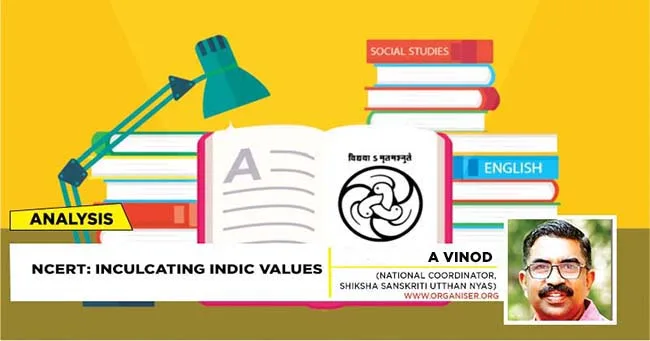
NCERT: Inculcating Indic Values
June 16, 2026
  • Read Ecopy
  • Circulation
  • Advertise
  • Careers
  • About Us
  • Contact Us
Android AppiPhone AppArattai
Organiser
  • ‌
  • Bharat
    • Assam
    • Bihar
    • Chhattisgarh
    • Jharkhand
    • Maharashtra
    • View All States
  • World
    • Asia
    • Europe
    • North America
    • South America
    • Africa
    • Australia
  • Editorial
  • International
  • Opinion
  • RSS @ 100
  • More
    • Op Sindoor
    • Analysis
    • Sports
    • Defence
    • Politics
    • Business
    • Economy
    • Culture
    • Special Report
    • Sci & Tech
    • Entertainment
    • G20
    • Azadi Ka Amrit Mahotsav
    • Vocal4Local
    • Web Stories
    • Education
    • Employment
    • Books
    • Interviews
    • Travel
    • Law
    • Health
    • Obituary
  • Subscribe
    • Subscribe Print Edition
    • Subscribe Ecopy
    • Read Ecopy
  • ‌
  • Bharat
    • Assam
    • Bihar
    • Chhattisgarh
    • Jharkhand
    • Maharashtra
    • View All States
  • World
    • Asia
    • Europe
    • North America
    • South America
    • Africa
    • Australia
  • Editorial
  • International
  • Opinion
  • RSS @ 100
  • More
    • Op Sindoor
    • Analysis
    • Sports
    • Defence
    • Politics
    • Business
    • Economy
    • Culture
    • Special Report
    • Sci & Tech
    • Entertainment
    • G20
    • Azadi Ka Amrit Mahotsav
    • Vocal4Local
    • Web Stories
    • Education
    • Employment
    • Books
    • Interviews
    • Travel
    • Law
    • Health
    • Obituary
  • Subscribe
    • Subscribe Print Edition
    • Subscribe Ecopy
    • Read Ecopy
Organiser
  • Home
  • Bharat
  • World
  • Operation Sindoor
  • Editorial
  • Analysis
  • Opinion
  • Culture
  • Defence
  • International Edition
  • RSS @ 100
  • Magazine
  • Read Ecopy
Home Bharat

NCERT: Inculcating Indic Values

To make Bharat a source of universal knowledge, our educational textbooks need to be overhauled. We need to inculcate Indic values that are eternal and universal. Bharatiyata needs to reflect in new textbooks prepared by NCERT. Thankfully, NEP, which replaces outdated model prepared by Commie historians and patronised by Congress regime, emphasises value based education

A VinodA Vinod
Sep 3, 2024, 08:00 pm IST
in Bharat, Opinion, Education
Follow on Google News
FacebookTwitterWhatsAppTelegramEmail

National Council of Educational Research and Training (NCERT) has now started releasing the much awaited textbooks. According to the new National Education Policy, NCERT had published the foundation stage syllabus last year. Under this, a teacher’s aid for the Balawadi level (ages three to six) and a learning material for children to learn by doing “Jadu Ki Pitara” were launched. Its feasibility has been tested through selected central schools and started regularly from this year. Then Mathematics and language books for classes one and two were released. Thus, this new academic year started with the foundation stage textbooks, teaching aids and study materials for the first five years of schooling. Books for the world around us, Mathematics, Art, Physical Education, along with three languages, have come for Class three.

Approach, content and structure are all important when textbooks are brought to the third stage where subject-based learning begins. Moreover, these books are also hints of the textbooks to come in the higher stages. National Curriculum Framework (NCF) has put forward the main changes to be made through the new textbook, which is the emphasis on Indianness, the learning method that gives children experiential knowledge, scientific perspective and rational thinking as eternal life values, and the possibilities of inculcating them at the practical level. A glance at the textbooks does 100 per cent justice to NCF. Books are so loving and caring for children. This was also the most important demand of those who wanted a modern Bharatiya model to replace the outdated and flawed existing system. Against this backdrop, textbooks are at once exciting and comforting.

Studying History Scientifically

We can also see the way the study of History is approached in a very scientific and comprehensive manner in the arrangement of the lessons. The History lessons grow in a rational way like the chapters named as timeline and source of History, (what is History, History Studies, where Human History is) and then to our history through the topics India that is Bharatiya. We need to study everything right from the beginning of Indian Civilisation, India’s cultural roots, unity in diversity or many in one, family and community. In this way, the approach of the textbook is to mark History in its entirety and mark India’s place in it. Special attention has been given to inculcate motivation and self-esteem in students by introducing Bharatiya thought at the beginning of every lesson. The makers of the book have noticed that India’s cultural heritage is something that needs to be experienced beyond bookish knowledge while arranging each lesson. Democracy, debating culture, truth-seeking and experiential learning are embedded here as learning methods. Almost all the lessons are presented in a way that inculcates curiosity and practical wisdom (hands on experience) in the children. These textbooks have risen to a greater standard in formulating the core of the National Education Policy envisioned to create a modern ‘Knowledge driven economic society’ by integrating Bharat’s achievements in various spheres of life, our life values and knowledge tradition.

We know that the social science textbook in the initial stages deals with History, Geography, Political Science and Economics in an integrated way. Here, too, the content is embedded in the same manner. But all the lessons mainly go through five basic thoughts. One is geoscientific and the second is historical. Third, each part goes through investigations into cultural heritage and its characteristics, the values that drive it forward as a society, how those values were articulated and what their relevance is today. Through it, the new generation not only gets knowledge about the cultural heritage of Bharat but also gets an opportunity to appreciate it. It will surely create self-esteem in them. At every level, the child is given an opportunity to realise his role as an individual, to understand his duties and responsibilities with a sense of rights, and duties to understand the democratic system as a good citizen. The textbook has taken special care to create the conviction to put this civic sense into practice at an early age. The textbook deals with the field of economics through the Bharatiya perspective of achieving total well-being through the mutually beneficial support of natural and human resources. It permeates through history, geography and the challenges and opportunities of the modern age. It also creates a vision of how the global citizens of the modern age should approach it.

Grasping Our Rich Heritage

An attempt has also been made to infuse the exhortations of the great personalities and quotations from the ancient texts in a manner which is not superfluous or obnoxious, in order to give the necessary philosophical support to all these cases. The child also recognises that while the essence of India’s culture is on the oneness of all (Ekam Sat Vipra Bahuta Vadanti), it is expressed through different levels. It is also discussed that India’s intellectual heritage has been expressed in different forms such as art, literature, science, medicine, yoga, religion, governance, martial arts, architecture, sculpture, crafts, and paintings. Outside of this expression, the diverse philosophies of India, Samkhya Nyaya Yoga, Dvaita Advaita thought are presented in an engaging and intriguing manner. Through these textbooks, we can see the insight of how India has progressed through the integration of various religious practices like Shaiva, Vaishnava, Buddhist, Jain, Sikh, Sufi systems that emerged in India, and the seeding of the sense of mission (integrating different religious and ideological thoughts in the world) to be performed by India that is Bharat and we Bharatiya in the construction of the coming world order.

Topics: National Education PolicyNational Council of Educational Research and TrainingMathematics and languageHistory ScientificallyIndia's cultural heritage
Share1TweetSendShareSend
✮ Subscribe Organiser YouTube Channel. ✮
✮ Join Organiser's WhatsApp channel for Nationalist views beyond the news. ✮
Previous News

Pakistani Army doesn’t have many options left in Balochistan

Next News

Electric Vehicles: Enabling the EV mode

Related News

ABVP’s National Executive Council Meeting began in Bhubaneswar with Prof. Raghuraj Kishore Tiwari, Dr Virendra Singh Solanki and Shri Ashish Chauhan inaugurating the event

ABVP National Executive Council Meet: “Three-language policy to strengthen Indian languages,” says Dr Virendra Singh

Dr Krishna Gopal, RSS Sah Sarkaryavah, Ravindra Kanhere, Akhil Bharatiya Adhyaksh, Vidya Bharati, Deshraj Sharma, General Secretary, Vidya Bharati, and Govind Mahant, Organising Secretary, offering floral tributes to Maa Bharti and Maa Saraswati on the inaugural day of AGM 2026

Vidya Bharati AGM 2026: Harmonising education

“Vidya Bharati aims to nurture future generations who are culturally grounded and globally competent”: Deshraj Sharma

Representative Image

NCERT’s new books to redefine learning for classes 1 to 8, emphasises on concept-based learning

NCERT issues unconditional apology to judiciary (Image Generated by AI)

NCERT issues “unconditional” apology for withdrawn class 8 book over inappropriate content on judiciary

Representative image

Union Budget 2026-27: India to form ‘Education to Employment and Enterprise’ Committee

Load More

Latest News

U.S. Consulate General Hyderabad Office
(Inside box- Telangana CM Revanth Reddy)

BJP Telangana questions Congress and CM Revanth Reddy over renaming a road in Hyderabad as ‘Donald Trump Avenue’

ABVP protests at Telangana School Education Directorate over closure of 24,000 government schools

Rabindranath Tagore

Rabindranath Tagore and the revival of Hindu civilisational pride

Representative Image

Viksit Bharat Shiksha Adhishthan Bill 2025: Mandate to promote Bharatiya ‘Gyan’ & ‘Bhasha’

Uttar Pradesh: Digital democracy dialogue ‘Triveni’ concludes; Focused on inclusive growth & cultural discourses

RSS Pune organises workshop on “Preparing for the AI Era”; Experts stress on AI literacy and Atmanirbharata in AI

Assam Governor Lakshman Prasad Acharya leads sacred Buddha relics mission to Mongolia

India- Mongolia Relations: Celebrating the spiritual neighbourhood

The AN-32: Service, sacrifice and the search for a successor

The Baya River of Bihar: How Jan Andolan brought the dying stream back to life

Oplus_16908288

Love Jihad in Assam: Illias Ahmed trapped Noida Hindu girl with fake identity; Held in Guwahati, victim untraceable

Load More
  • Privacy
  • Terms
  • Cookie Policy
  • Refund and Cancellation
  • Delivery and Shipping

© Bharat Prakashan (Delhi) Limited.
Tech-enabled by Ananthapuri Technologies

  • Home
  • Search Organiser
  • Bharat
    • Assam
    • Bihar
    • Chhattisgarh
    • Jharkhand
    • Maharashtra
    • View All States
  • World
    • Asia
    • Africa
    • North America
    • South America
    • Europe
    • Australia
  • Editorial
  • Operation Sindoor
  • Opinion
  • Analysis
  • Defence
  • Culture
  • Sports
  • Business
  • RSS @ 100
  • Entertainment
  • More ..
    • Sci & Tech
    • Vocal4Local
    • Special Report
    • Education
    • Employment
    • Books
    • Interviews
    • Travel
    • Health
    • Politics
    • Law
    • Economy
    • Obituary
  • Subscribe Magazine
  • Read Ecopy
  • Advertise
  • Circulation
  • Careers
  • About Us
  • Contact Us
  • Policies & Terms
    • Privacy Policy
    • Cookie Policy
    • Refund and Cancellation
    • Terms of Use

© Bharat Prakashan (Delhi) Limited.
Tech-enabled by Ananthapuri Technologies