


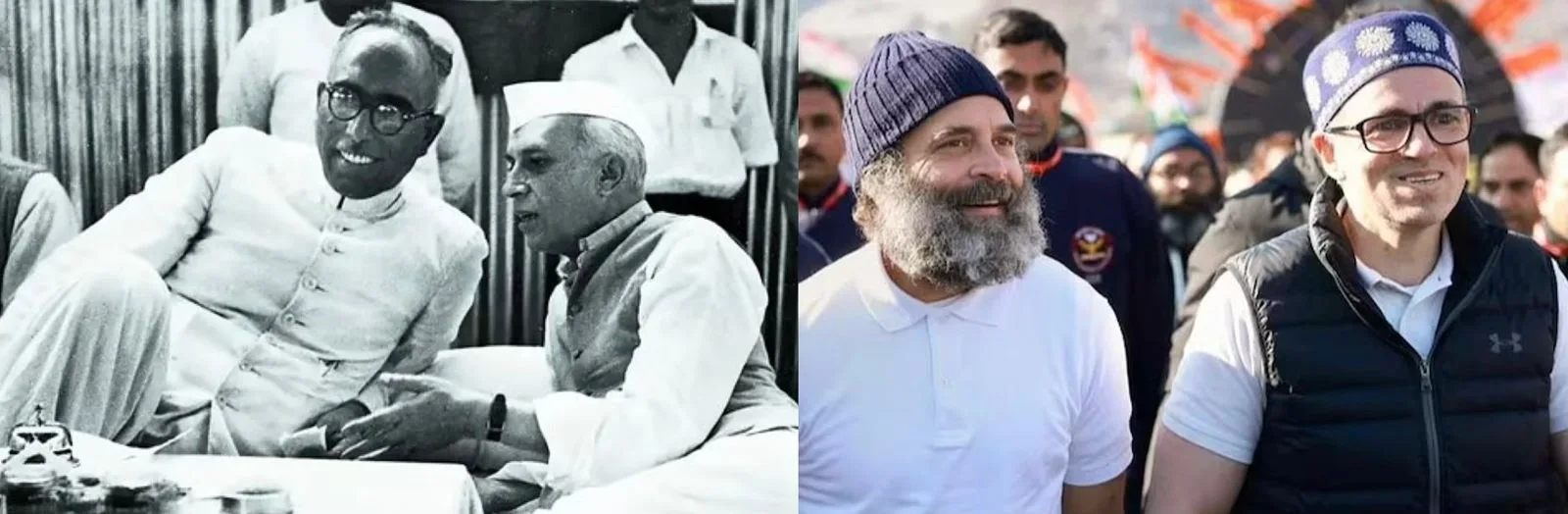
When Dynasty is Above Democracy: From Sheikh-Nehru to Omar-Rahul on Jammu-Kashmir & 370
December 5, 2025
  • Read Ecopy
  • Circulation
  • Advertise
  • Careers
  • About Us
  • Contact Us
Android AppiPhone AppArattai
Organiser
  • ‌
  • Bharat
    • Assam
    • Bihar
    • Chhattisgarh
    • Jharkhand
    • Maharashtra
    • View All States
  • World
    • Asia
    • Europe
    • North America
    • South America
    • Africa
    • Australia
  • Editorial
  • International
  • Opinion
  • RSS @ 100
  • More
    • Op Sindoor
    • Analysis
    • Sports
    • Defence
    • Politics
    • Business
    • Economy
    • Culture
    • Special Report
    • Sci & Tech
    • Entertainment
    • G20
    • Azadi Ka Amrit Mahotsav
    • Vocal4Local
    • Web Stories
    • Education
    • Employment
    • Books
    • Interviews
    • Travel
    • Law
    • Health
    • Obituary
  • Subscribe
    • Subscribe Print Edition
    • Subscribe Ecopy
    • Read Ecopy
  • ‌
  • Bharat
    • Assam
    • Bihar
    • Chhattisgarh
    • Jharkhand
    • Maharashtra
    • View All States
  • World
    • Asia
    • Europe
    • North America
    • South America
    • Africa
    • Australia
  • Editorial
  • International
  • Opinion
  • RSS @ 100
  • More
    • Op Sindoor
    • Analysis
    • Sports
    • Defence
    • Politics
    • Business
    • Economy
    • Culture
    • Special Report
    • Sci & Tech
    • Entertainment
    • G20
    • Azadi Ka Amrit Mahotsav
    • Vocal4Local
    • Web Stories
    • Education
    • Employment
    • Books
    • Interviews
    • Travel
    • Law
    • Health
    • Obituary
  • Subscribe
    • Subscribe Print Edition
    • Subscribe Ecopy
    • Read Ecopy
Organiser
  • Home
  • Bharat
  • World
  • Operation Sindoor
  • Editorial
  • Analysis
  • Opinion
  • Culture
  • Defence
  • International Edition
  • RSS @ 100
  • Magazine
  • Read Ecopy
Home Politics

When Dynasty is Above Democracy: From Sheikh-Nehru to Omar-Rahul on Jammu-Kashmir & 370

The history of Jammu & Kashmir under the Nehru-Sheikh Abdullah alliance highlights the dangers of prioritising personal relationships over national interests. With the new partnership between Rahul Gandhi and Omar Abdullah, terrorism, corruption, and dynastic politics that emerged from the earlier alliance now threatens to derail the good work done by the Modi Government

Yatharth SikkaYatharth Sikka
Sep 2, 2024, 08:00 pm IST
in Politics, Bharat, Special Report, Jammu and Kashmir
Follow on Google News
FacebookTwitterWhatsAppTelegramEmail

If one looks at the past, the history of Jammu & Kashmir deeply revolves around the friendship of Jawaharlal Nehru and Sheikh Abdullah. Their personal friendship and political alliance, which shaped the early years of the State are often cited as the reason why Kashmir fell into a spiral of terrorism, corruption, and dynastic politics. From the controversial decision to implement Article 370 and Article 35A to the enduring political influence of the Abdullah and Nehru families, the seeds sown by them continue to give bitter fruit in Kashmir. The brand new alliance between Rahul Gandhi’s Congress and Omar Abdullah’s National Conference (NC), is more problematic for the national integrity as NC has promised to restore Article 370 and 35A, if it returns to power. This will take back Kashmir to the troubled State it was in during the regime of Nehru and Sheikh Abdullah.

Friendship dangerous for Bharat

Nehru, who saw a spirit of secularism and socialism in Sheikh Abdullah, supported him to rose to power in Kashmir, side-lining the legitimate ruler Maharaja Hari Singh. The Instrument of Accession signed by Maharaja Hari Singh in 1947, was meant to integrate Kashmir into Bharat while allowing its autonomy in certain areas. However, Nehru’s insistence on Article 370, which granted special status to Jammu and Kashmir, created a legal barrier between Kashmir and the rest of the country. Sheikh Abdullah, who became the Prime Minister of Kashmir, used Article 370 and Article 35A as tools to maintain his political dominance, ensuring that Kashmir remained under his control rather than a fully integrated part of Bharat.

The autonomy granted under Article 370 allowed corruption and nepotism in Kashmir’s political system. Abdullah’s NC turned Governance into a family affair. This laid the foundation for dynastic politics that continue to plague Kashmir, where political power is passed like an inheritance property rather than in a democratic way.

The seeds of discontent with Nehru-Abdullah’s Kashmir policy were evident in the early 1950s with the rise of the Praja Parishad movement. The Praja Parishad, a political party in J&K opposed Article 370 and demanded the full integration of the State with India. The movement gained momentum as it became clear that Article 370 was being used not to protect the unique identity of Kashmir but to shield Sheikh Abdullah’s autocratic rule.

The Nehru-Abdullah friendship laid the foundation for the dynastic politics that continue to plague Kashmir, where political power is passed like an inheritance property

Kashmiris soon realised that Article 370 had nothing to do with the federal Constitution. Sheikh Abdullah initially brainwashed Nehru into believing that it was at his behest that the Muslims of the State had embraced India instead of the Islamic country of Pakistan. Nehru began to accept his baseless assumption and continued to maintain their friendship.

Rather than engaging with the legitimate concerns of the Praja Parishad, Nehru sided with Abdullah, even rejecting the nomination papers of 13 of its candidates in the 1951 elections. This decision further reinforced the perception that Nehru prioritised his friendship with Abdullah over the interests of the State.

Article 370 and 35A: Tools of Division and Corruption

Implementation of Article 370 and 35A not only created a constitutional barrier between Kashmir and the rest of India, but also resulted in corruption and unaccountability in the State’s administration. These articles allowed Jammu and Kashmir to have its own Constitution and flag, fostering a political environment dominated by the Abdullah and Nehru families. This set-up prioritised the interests of these two families over the development of the State. Instead of fostering progress, the special status facilitated nepotism, political favouritism and inequality, worsening the condition of the State. The meaning of the development was to preserve the power and privileges of separatists rather than addressing the needs of the general public.

The Article 35A, which gave the State the right to determine who is a permanent resident of the State, was not inserted into the Constitution by an amendment passed by the Parliament. It was inserted by the President following the advice of Jawaharlal Nehru in the Constitution on May 14, 1954, by issuing a similar order, using the powers granted to the President by Article 370 of the Constitution. This deprived the people of Jammu and Kashmir of the full benefits offered by the Constitution of Bharat, including representation and reservations for Scheduled Castes (SC) and Scheduled Tribes (ST). Notably, Congress these days is fighting elections across the country, alleging that BJP will finish the reservation. In contrast, it is in alliance with the National Conference, which had said in its manifesto to restore 35A, which will take away all the benefits from SCs and STs granted under the Constitution of Bharat.

Breeding ground for terrorists

The rise of terrorism in Kashmir was the result of the policies of Nehru and Abdullah. Political instability and a lack of economic opportunities in the State, with the inclusion of corruption and dynastic rule made Kashmir a breeding ground for Islamists. The insurgency that erupted in the 1990s was not only fueled by external factors like Pakistan but also by decades of misgovernance under the Nehru-Abdullah regime. The insurgency, which has claimed thousands of Hindu lives is a tragic reminder of the long-term consequences of this alliance. The failure to fully integrate Kashmir into Bharat coupled with the misuse of Articles 370 and 35A further nurtured separatist elements.

A New Dawn for Kashmir

The abrogation of Article 370 and 35A by the Narendra Modi Government on August 5, 2019, marked a significant turning point in Kashmir’s history. The decision, which brought Jammu and Kashmir fully under the purview of the Indian Constitution, was seen by many as the fulfillment of a long-standing demand. The abrogation of Article 370 and 35A has also opened up new opportunities for the region. With the removal of the special status, the Union Government has been able to push forward with much-needed reforms in the State, including the implementation of anti-corruption measures, reservation policy, infrastructure development, etc. The return of normalcy to the region, with a reduction in terror activities and an increase in tourism, is a testament to the positive impact of these changes.

Congress-NC Alliance: Threat of a Return to Old Order

The alliance between the Rahul Gandhi, great-grandson of Pt. Nehru, and Omar Abdullah, grandson of Sheikh Abdullah, has raised concerns among those who fear that these parties, if they come to power, will undo the progress made in recent years. The National Conference has made it clear in its manifesto that it intends to restore Article 370, a move that would effectively reverse the gains made since its abrogation. It has also promised the release of political prisoners (separatists). This alliance between the new generation dynasts of Congress and National Conference is viewed by many as an attempt only to regain power rather than to offer a vision for Kashmir’s future.

The new partnership between the Nehru-Abdullah families could lead to a resurgence of corruption and anarchy that have plagued Kashmir for decades, as well as a potential revival of separatist sentiments and terrorism. As Jammu and Kashmir stand at a crossroads with the potential for a new era of peace and development, it is crucial that the lessons of the past are not forgotten in the upcoming elections.

Topics: PakistanArticle 370Jammu & Kashmir370 and 35AJawaharlal Nehru Sheikh AbdullahOmar Abdullah- Rahul Gandhi
Yatharth Sikka
Yatharth Sikka
Yatharth Sikka is a PhD Research Scholar and a dynamic media professional, working as an Anchor, Writer, Researcher, and Voice-Over Artist. He has also served as a Research Assistant for two books and has produced one documentary, adding depth and scholarly rigour to his journalistic work. As one of the emerging young voices in Indian media, Yatharth extensively covers political and socio-cultural issues with a strong focus on North India — Punjab, Jammu & Kashmir, Haryana, Delhi, and Himachal Pradesh. His storytelling reflects a keen interest in the intersections of politics, sports, society, and everyday life, decoding how policy and power shape public experiences. He has conducted interviews with prominent political leaders, sportspersons, film figures, and cultural commentators, bringing authentic ground-level perspectives to his audience. Yatharth has participated in several national and international conferences and seminars, further strengthening his academic engagement and research capabilities. Combining research-backed analysis with sharp on-ground reporting, Yatharth continues to contribute to contemporary Indian journalism and Research Field. [Read more]
ShareTweetSendShareSend
✮ Subscribe Organiser YouTube Channel. ✮
✮ Join Organiser's WhatsApp channel for Nationalist views beyond the news. ✮
Previous News

Andhra Pradesh: Archaeologists unearth 139,000-year-old tools that draw parallels to modern craftsmanship

Next News

Haryana Assembly Elections: Heading for new equations

Related News

Retired Subedar held for leaking Army details to Pak handlers posing as Indians

Gujarat ATS dismantles spy network involving Ex-Army personnel and woman for sharing information with Pakistan

Pakistan's Prime Minister Shehbaz Sharif Afganistan's Foreign Minister Amir Muttaqi and India's Foreign Minister S Jaishankar

Afghanistan rebukes Pakistan, defends right to build stronger ties with India

Site of the Delhi Blast that took place on November 10, 2025

Delhi Red Fort Blast: Pakistan signals new phase of Jihad against Bharat

Pakistan's Chief of Army Staff Asim Munir, Aleema Khan and ex-Pak PM Imran Khan

Aleema Khan, sister of Imran Khan, accuses Asim Munir of Islamist hardline driving Pakistan toward conflict with India

From Maqbool Sherwani to Maqbool Butt: Jammu Kashmir dwindles Between Nationalism and Separatism

Former Pakistani Prime Minister Imran Khan (Left) and Field Marshal Asim Munir (Right)

Pakistan: Imran Khan claims severe mental torture in jail, blames Asim Munir for harsh treatment

Load More

Comments

The comments posted here/below/in the given space are not on behalf of Organiser. The person posting the comment will be in sole ownership of its responsibility. According to the central government's IT rules, obscene or offensive statement made against a person, religion, community or nation is a punishable offense, and legal action would be taken against people who indulge in such activities.

Latest News

PM Modi presents Putin with Bhagavad Gita, chess set, and silver horse

Cultural ties strengthened: PM Modi presents Putin with Bhagavad Gita, chess set, and silver horse

Image for representational purpose only, Courtesy Vocal Media

Bihar to get ‘Special Economic Zones’ in Buxar and West Champaran

Thirupparankundram Karthigai Deepam utsav

Andhra Pradesh: AP Dy CM Pawan Kalyan reacts to Thirupparankundram row, flags concern over religious rights of Hindus

23rd India-Russia Annual Summit

India-Russia Summit heralds new chapter in time-tested ties: Inks MoUs in economic, defence, tourism & education

DGCA orders probe into IndiGo flight disruptions; Committee to report in 15 days

BJYM leader Shyamraj with Janaki

Kerala: Widow of BJP worker murdered in 1995 steps into electoral battle after three decades at Valancherry

Russian Sber bank has unveiled access to its retail investors to the Indian stock market by etching its mutual fund to Nifty50

Scripting economic bonhomie: Russian investors gain access to Indian stocks, Sber unveils Nifty50 pegged mutual funds

Petitioner S Vignesh Shishir speaking to the reporters about the Rahul Gandhi UK citizenship case outside the Raebareli court

Rahul Gandhi UK Citizenship Case: Congress supporters create ruckus in court; Foreign visit details shared with judge

(L) Kerala High Court (R) Bouncers in Trippoonithura temple

Kerala: HC slams CPM-controlled Kochi Devaswom Board for deploying bouncers for crowd management during festival

Fact Check: Rahul Gandhi false claim about govt blocking his meet with Russian President Putin exposed; MEA clears air

Load More
  • Privacy
  • Terms
  • Cookie Policy
  • Refund and Cancellation
  • Delivery and Shipping

© Bharat Prakashan (Delhi) Limited.
Tech-enabled by Ananthapuri Technologies

  • Home
  • Search Organiser
  • Bharat
    • Assam
    • Bihar
    • Chhattisgarh
    • Jharkhand
    • Maharashtra
    • View All States
  • World
    • Asia
    • Africa
    • North America
    • South America
    • Europe
    • Australia
  • Editorial
  • Operation Sindoor
  • Opinion
  • Analysis
  • Defence
  • Culture
  • Sports
  • Business
  • RSS @ 100
  • Entertainment
  • More ..
    • Sci & Tech
    • Vocal4Local
    • Special Report
    • Education
    • Employment
    • Books
    • Interviews
    • Travel
    • Health
    • Politics
    • Law
    • Economy
    • Obituary
  • Subscribe Magazine
  • Read Ecopy
  • Advertise
  • Circulation
  • Careers
  • About Us
  • Contact Us
  • Policies & Terms
    • Privacy Policy
    • Cookie Policy
    • Refund and Cancellation
    • Terms of Use

© Bharat Prakashan (Delhi) Limited.
Tech-enabled by Ananthapuri Technologies