





The concept of simultaneous elections has been discussed and considered over the years. The idea was first proposed in the 1983 Annual Report of the Election Commission of India. It even received support in the 170th Report of the Law Commission in 1999. In 2015, the Parliamentary Standing Committee’s 79th Report recommended simultaneous elections for the Parliament and State legislatures. The Election Commission of India also backed the idea in 2015, outlining logistical and financial requirements. Additionally, in January 2017, NITI Aayog produced a working paper titled “Analysis of Simultaneous Elections: The What, Why, and How.” The Law Commission of India, in its ‘Draft Report on Simultaneous Elections’ published in August 2018, proposed a mechanism for conducting simultaneous elections while considering its feasibility and legality.
The incumbent Union government has time and again, at various platforms called for simultaneous Elections across the country. The issue has gained momentum recently after the announcement of a special five-day session of Parliament to be held from September 18 to 22, when the Union Government will set up a high-level committee headed by former President Shri Ram Nath Kovind, which is mandated to assess and propose specific changes to the Constitution, the Representation of the People Act, and other laws and regulations necessary to facilitate simultaneous Lok Sabha and the Assembly elections.
One Nation, One Election, or Simultaneous Elections would ordinarily mean elections being conducted simultaneously for all the three tiers of governments, viz. Lok Sabha, Vidhan Sabha and Panchayats, in a synchronised manner. This would mean that a voter casts their vote for electing members to all the tiers of the Government on the same day. However, Panchayat Elections have deliberately been left out of the same because of three reasons – firstly, the elections to the local bodies are a State subject and are conducted by respective State Election Commissions; secondly, the procedure and mechanism of local body elections vary from state to state; and thirdly, the number of local bodies is too large which makes it challenging to be synchronised and aligned with the other two tiers.
Simultaneous polls were the norm until 1967, but the premature dissolution of some State Assemblies in 1968 and 1969 and advancement of parliamentary polls to 1971 disturbed this harmony. Benefits for conducting simultaneous polls include reduction in electoral costs for the stakeholders, increased voter turnout, reduction in temporal embargo on policymaking due to Model Code of Conduct, better logistical dividend by reducing the continuous deployment of security and support staff, ease of governance and focus on development rather than continuous election campaigning and reduction in adoption of populist polices due to elections that is otherwise held in one or other part of country every six months.
A Suitable Model
Bharat has had experience of simultaneous elections at the Centre and State levels in the initial years following independence, yet at this point, the feasibility of rebooting the current system is low. However, this is not to rule out the possibility of conducting synchronised elections at all three levels of Indian governance together in one phase in the near future. A push for one phased simultaneous election alongside the Lok Sabha elections will result in the premature dissolution of several state assemblies. At the same time, such a model shall be feasible only if there is also a simultaneous extension of the tenure of several other state assemblies. In the alternative, a phased synchronisation of parliamentary and State Elections has been suggested.
The Union Government formed a committee on September 2 to explore the possibility of ‘One Nation, One Election’. The committee on One Nation One Election, apart from former President Ram Nath Kovind, who is Chairman, comprises Home Minister Amit Shah, Congress leader Ahir Ranjan Chowdhury, former Leader of Opposition in Rajya Sabha Ghulam Nabi Azad, former Finance Commission Chairman NK Singh, former Lok Sabha Secretary General Subhash C Kashyap, Senior Advocate Harish Salve and former Chief Vigilance Commissioner Sanjay Kothari.
It is suggested that the holding of simultaneous elections in two phases with some assemblies going to vote with the Lok Sabha in Phase I and the rest of the State Assemblies undergoing elections at the midterm of the Lok Sabha. In this model, it is further suggested that elections are held every 2.5 years in Bharat, till the time the entire electoral cycle of the Parliament and all state assemblies becomes synchronized.
While State Assembly elections may individually entail expenditure of less money and dedication of lesser resources as compared to parliamentary elections, nevertheless taken together, an endeavour to carry out elections simultaneously across all state assemblies in India would involve huge expenditure and dedication of resources. The resultant situation may be one of chaos, both from an organisational perspective and an administrative viewpoint. As a result, it would be more practical to begin the exercise of simultaneous elections, with half of the state assemblies going to vote at the same time as the Parliament. Although this too is likely to be a herculean task for the Election Commission to handle, it is far more likely to be successful than a haphazard system where all governments in the country go to vote at the same time.
“Since we have multiple polls on multiple occasions, it hampers political and governance stability hugely. Every election, following disproportionate media attention, is considered to be a verdict on governance, which should not be ” — Dr Vinay Sahasrabuddhe, Former Rajya Sabha MP and Chairman of the Indian Council of Cultural Relations, in Organiser (July 2018)
It is therefore recommended that the Election Commission should be permitted to carry out the electoral cycle in a two-phased manner, with a potential of shifting to an entirely synchronised two-phased model on successful conduct of the first version in recent times. Hence, an analysis of timeframe of prospective elections as routinely scheduled in different states has been done.
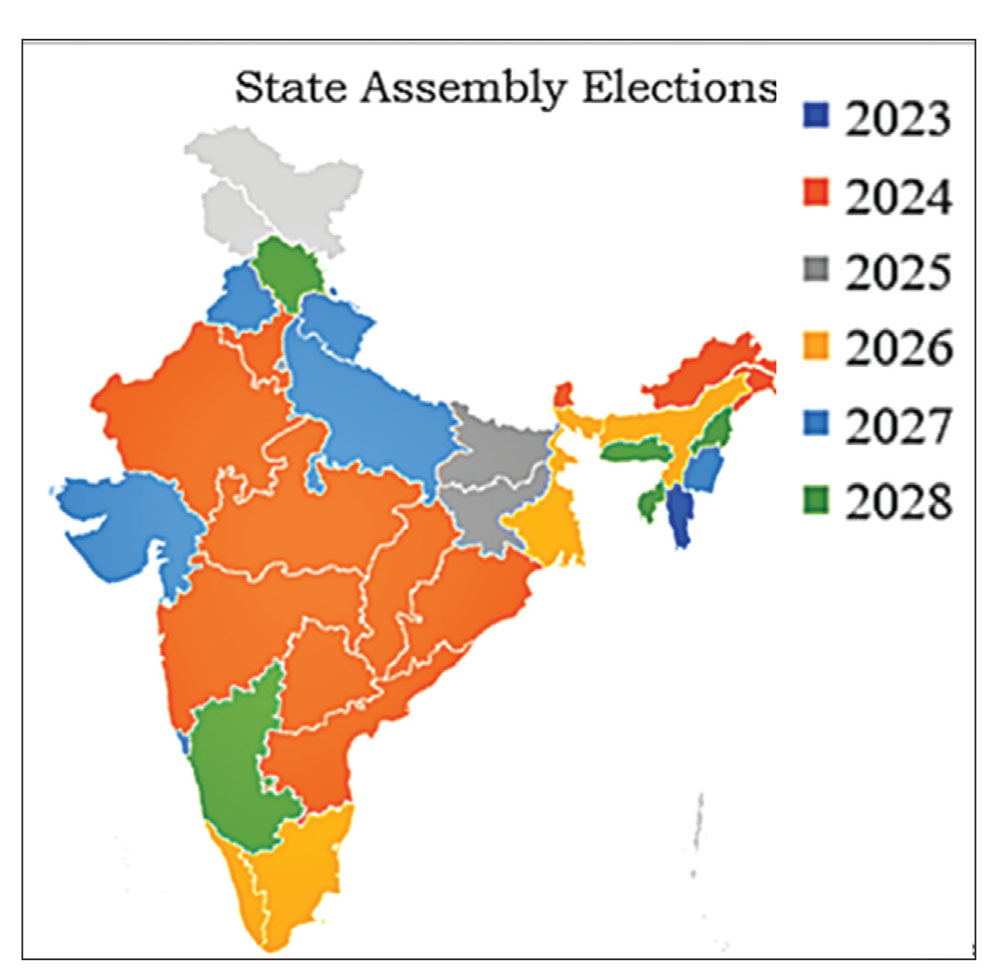
Ensuring simultaneous elections with minimum hiccups would require the selection of an appropriate year/time period for conducting of elections. Selection of a suitable year can be made with minimum extensions and curtailments of tenures. In line with the model as proposed, it is recommended that elections to 14 State Legislatures be conducted once in 2024 along with the Lok Sabha elections and for the rest 16 States/UT Legislatures be conducted next in 2027. As a one-time exercise, conducting elections to 14 State Legislatures in 2024 would require postponement of elections to 1 state (due in Nov-Dec 2023) and preponement of elections to 3 states (due in 2025). Similarly, conducting elections for 2027 would require postponement of elections to 5 states (due in 2026), and preponement of elections to 5 states (due in 2028).
Necessary Changes & Amendments
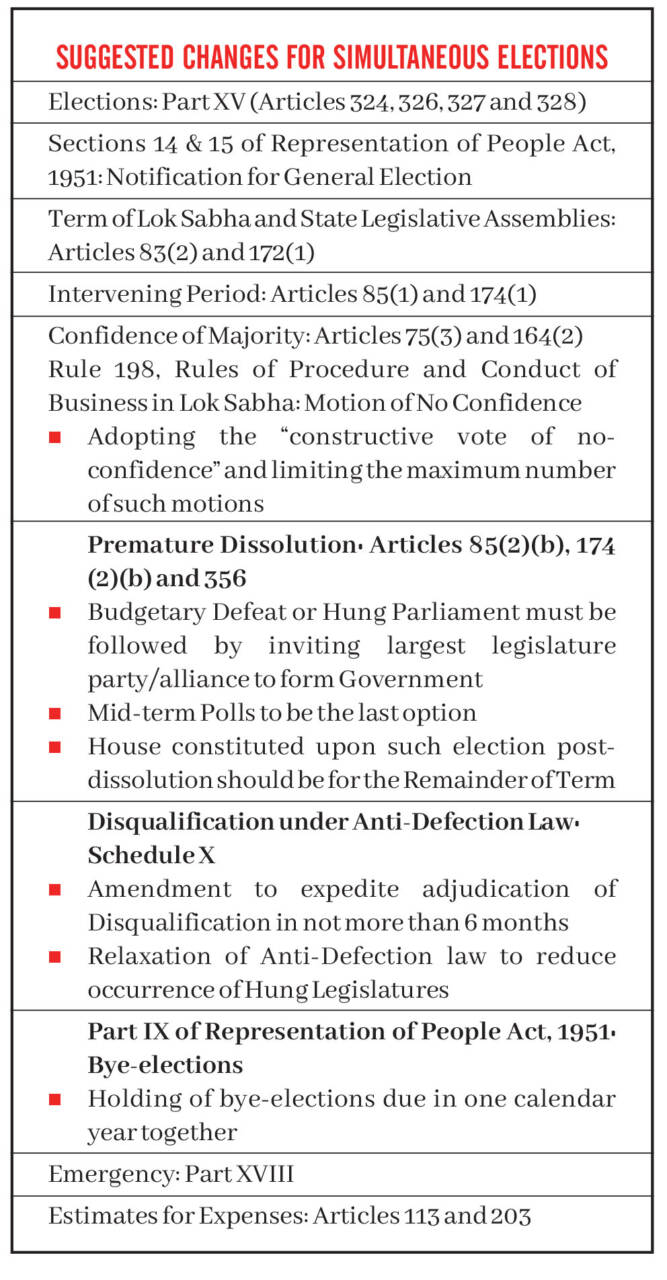
Votes of no-confidence are classified into two, a regular vote of no-confidence, and a constructive vote of no-confidence. In order to efficiently allow the constructive vote to work, it is necessary that there is no time elapsing between the vote and the election (by the House) of the new Government, i.e., simultaneity is maintained.
Dissolution could be envisioned in two ways, dissolution by President on the advice of the Prime Minister, and on the lapse of a money bill in the Parliament. It is proposed that power of Prime Minister to advise dissolution under Article 85 should be subject to the safeguards of floor test and other guidelines mentioned in Sarkaria and Puncchi Commission reports (discussed below) to prevent the possibility of unnecessary and mala fide dissolution of the house and mid-term elections. Similarly, when a money bill is rejected by the legislature, it implies a lack of majority enjoyed by the executive which means that the Lok Sabha must dissolve and fresh elections must be held. Therefore, to prevent early elections and maintain the simultaneous election cycle, as well as give true effect to the CVNC, this provision must be amended to prevent such a dissolution.
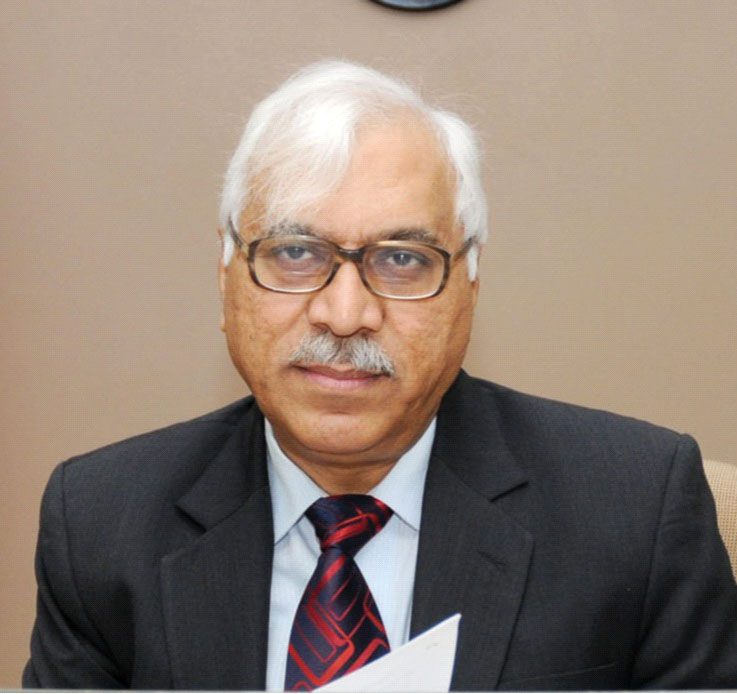
“Frequent elections mean that a huge chunk of public servants have to be present for election duty and are unable to carry out the responsibilities for which they have actually been appointed. Another argument in favour of simultaneous elections is that election is the time when communalism, casteism, corruption, crony capitalism are at their peak. Frequent elections mean that there is no respite from these evils at all” — SY Quraishi, former Chief Election Commissioner of Bharat in Organiser (July 2018)
However, the procedure for dissolution in case of a deadlock in House should be such that it cannot be manipulated by the government or the opposition to call for an early election by bypassing CVNC. In light of this, it is suggested that we implement the British model of dissolution of the house where the motion for dissolution is passed only when it is supported by a special majority of 2/3rd votes thus ensuring that dissolution takes place only when there is a broad cross-party consensus on its implementation.
The anti-defection law as it stands today poses an impediment to the formation of an alternate Government since it seeks to disqualify from membership any MP or MLA who acts against the party whip. Therefore, it is pertinent to carve out of an exception in the law for the purpose of allowing MPs to defy the party whip in exceptional circumstances of no-confidence motion in order to pass a confidence motion in favour of an alternate government potentially formed by factions of different political parties which together command a majority in the legislature.
All of this would require changes to be carried out an amendment to the provisions of the Constitution onamely, Articles 83 (2) and 172 (1) dealing with tenures of Lok Sabha and state assemblies. Further, the Representation of Peoples Act, 1951 will have to be amended to introduce provisions for fixed election cycles in pursuance of the implementation of CVNC. In addition, the money bill provision allowing for the premature dissolution of parliament would have to be similarly amended. Again, the Rules of Procedures of the Houses of Parliament as well as the State legislatures would require to be amended suitably.
Conclusion
As rightly put by Chanakya in Arthashastra, ´प्रजासुखे सुखं राज्ञ: प्रजानां तु हिते हितम’ meaning thereby that the happiness of the king vests in the happiness of his subjects, and he must see his interest in the interest of his subjects. Any policy decision by the Government must be for the benefit of the masses because after all, democracy is “of the people, for the people, by the people”. Keeping in view the Constitutional, legal and the prevailing political and social circumstances in the country, it is concluded that the time has come for India to revert to simultaneous elections in the greater national interest.
Conducting simultaneous polls would help in saving public money, help reducing the frequent cyclical burden on administrative set up and security forces, and will ensure better implementation of government policies on time and the administrative machinery of the country will be continuously engaged in developmental activities rather than in electioneering. The sustainability of the model suggested here is evidently in the maintenance of the scheduled timelines for holding simultaneous elections after the completion of the term of each of these bodies.
However, any major decision that has a direct impact on the polity of the country has to be taken after taking the stakeholders into confidence. A law that is not acceptable to the masses is not capable of being implemented. It is suggested that a group of stakeholders from all factions comprising constitution and subject matter experts, think tanks, government officials and representatives of various political parties must come together and work out appropriate implementation related details.
As is the case with long-term structural reforms, implementing this measure would also cause some short-term hassles. However, this should be a steppingstone towards improved governance and a larger initiation of “electoral reforms” – which is a desperately needed measure to re-boot the Bharatiya polity.











Comments