How ISRO outpaced Pakistan’s SUPARCO despite a late start
December 6, 2025
  • Read Ecopy
  • Circulation
  • Advertise
  • Careers
  • About Us
  • Contact Us
Android AppiPhone AppArattai
Organiser
  • ‌
  • Bharat
    • Assam
    • Bihar
    • Chhattisgarh
    • Jharkhand
    • Maharashtra
    • View All States
  • World
    • Asia
    • Europe
    • North America
    • South America
    • Africa
    • Australia
  • Editorial
  • International
  • Opinion
  • RSS @ 100
  • More
    • Op Sindoor
    • Analysis
    • Sports
    • Defence
    • Politics
    • Business
    • Economy
    • Culture
    • Special Report
    • Sci & Tech
    • Entertainment
    • G20
    • Azadi Ka Amrit Mahotsav
    • Vocal4Local
    • Web Stories
    • Education
    • Employment
    • Books
    • Interviews
    • Travel
    • Law
    • Health
    • Obituary
  • Subscribe
    • Subscribe Print Edition
    • Subscribe Ecopy
    • Read Ecopy
  • ‌
  • Bharat
    • Assam
    • Bihar
    • Chhattisgarh
    • Jharkhand
    • Maharashtra
    • View All States
  • World
    • Asia
    • Europe
    • North America
    • South America
    • Africa
    • Australia
  • Editorial
  • International
  • Opinion
  • RSS @ 100
  • More
    • Op Sindoor
    • Analysis
    • Sports
    • Defence
    • Politics
    • Business
    • Economy
    • Culture
    • Special Report
    • Sci & Tech
    • Entertainment
    • G20
    • Azadi Ka Amrit Mahotsav
    • Vocal4Local
    • Web Stories
    • Education
    • Employment
    • Books
    • Interviews
    • Travel
    • Law
    • Health
    • Obituary
  • Subscribe
    • Subscribe Print Edition
    • Subscribe Ecopy
    • Read Ecopy
Organiser
  • Home
  • Bharat
  • World
  • Operation Sindoor
  • Editorial
  • Analysis
  • Opinion
  • Culture
  • Defence
  • International Edition
  • RSS @ 100
  • Magazine
  • Read Ecopy
Home International Edition Asia South Asia

How ISRO outpaced Pakistan’s SUPARCO despite a late start

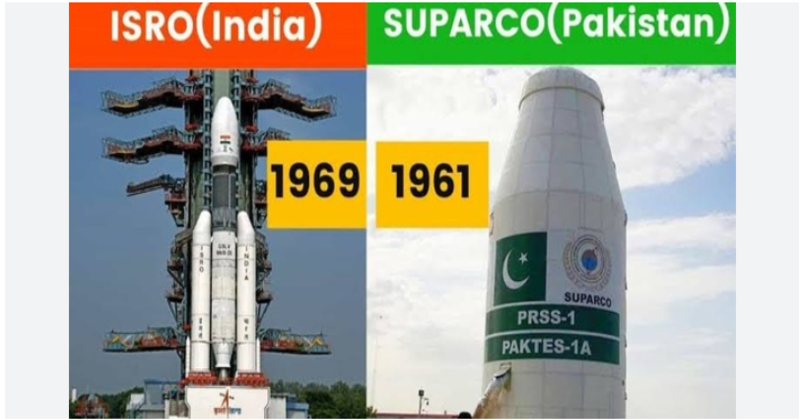
Despite starting earlier in 1961, Pakistan’s space programme, SUPARCO, has fallen far behind India's ISRO. Initial successes were overshadowed by political instability, lack of funding, and a focus on military rather than space technology. In contrast, ISRO, founded in 1969 and led by visionaries like Vikram Sarabhai, received strong governmental support, enabling significant achievements such as a successful Mars mission. Today, ISRO is a global leader in space exploration, while SUPARCO struggles with limited progress

WEBDESKWEBDESK
Aug 14, 2024, 11:54 pm IST
in South Asia, Bharat, Asia, Sci & Tech, International Edition
Follow on Google News
How ISRO outpaced Pakistan’s SUPARCO despite a late start

How ISRO outpaced Pakistan’s SUPARCO despite a late start

FacebookTwitterWhatsAppTelegramEmail

NEW DELHI: In the span of a few decades, the Indian Space Research Organisation (ISRO) has evolved from its modest beginnings to becoming one of the most prominent space agencies in the world. This transformation is marked by iconic milestones, such as transporting rocket cones on bicycles and satellites on bullock carts, and eventually launching a Mars orbiter on its very first attempt. However, ISRO’s meteoric rise is even more remarkable when contrasted with the fact that, at one point, India lagged behind Pakistan in space exploration.

Pakistan’s space journey began in the 1960s with the establishment of the Space and Upper Atmosphere Research Commission (SUPARCO) in 1961. This was eight years before ISRO came into existence, making Pakistan the fourth country in Asia, after the USSR, Japan, and Israel, to enter space. But while ISRO has achieved groundbreaking missions, Pakistan’s presence in the space race has faded over time.

As ISRO marks 55 years on August 15, 2024, a comparison between ISRO and SUPARCO’s trajectories highlights the vastly different outcomes of these two space agencies.

SUPARCO’s early years

The global space race between the US and the Soviet Union in the 1950s and 1960s played a significant role in SUPARCO’s early rise. On October 4, 1957, the USSR successfully launched Sputnik I, the world’s first artificial satellite, marking the dawn of the space age. This event ignited a fierce competition between the US and the USSR, leading to increased investments in space exploration. Pakistan seized this opportunity and established SUPARCO in 1961, with significant contributions from the country’s first Nobel laureate, Prof. Abdus Salam.

Under Salam’s guidance, SUPARCO achieved an early milestone by launching Rahbar-1 in June 1962, making Pakistan one of the first countries in Asia to venture into space. Despite these achievements, Salam faced significant opposition in Pakistan due to his affiliation with the Ahmadiyya sect, a religious minority in Pakistan. This opposition, coupled with the lack of political will and funding, hindered SUPARCO’s progress.

Political challenges and decline

The decline of SUPARCO can be traced back to a series of political decisions that diverted resources away from space exploration. Under the leadership of then-Prime Minister Zulfikar Ali Bhutto, Pakistan’s focus shifted towards the development of nuclear weapons. Bhutto’s famous declaration, “We will eat grass, even go hungry, but we will get our own (atom bomb),” underscored Pakistan’s prioritisation of military technology over space exploration.

The situation worsened in the 1980s under President Zia-ul-Haq, who further reduced funding for SUPARCO and replaced its scientists. As a result, the agency lost its momentum and fell behind ISRO, which was making significant strides in space technology during the same period.

The rise of ISRO: A visionary’s dream

While Pakistan’s space program struggled, India was laying the foundations for its own space agency under the leadership of Vikram Ambalal Sarabhai. Born into a wealthy industrialist family on August 12, 1919, Sarabhai was a prodigy with a degree from Cambridge, and his doctoral advisor was none other than India’s Nobel Prize Winner, C.V. Raman. Despite his privileged background, Sarabhai was committed to staying in India and working towards its development in space technology.

Sarabhai’s vision led to the establishment of the Indian National Committee for Space Research (INCOSPAR) in 1962, which later evolved into ISRO in 1969. His diplomatic skills and determination secured crucial international collaborations, enabling India to launch its first sounding rocket in 1963 from the Thumba Equatorial Rocket Launching Station. The now-iconic image of a bullock cart carrying equipment to the launch site is a testament to Sarabhai’s ambition and persistence.

ISRO’s journey: From bullock carts to mars

ISRO’s achievements over the past 55 years have been nothing short of extraordinary. From launching India’s first communication satellite, INSAT-1A, in 1982 to conducting the Satellite Instructional Television Experiment (SITE) in 1975, ISRO has consistently pushed the boundaries of space technology. Today, ISRO competes with NASA and the China National Space Administration (CNSA) in achieving significant milestones in space exploration.

ISRO’s success can be attributed to its innovative approach, often referred to as the “leapfrogging method.” Instead of reinventing the wheel, ISRO leveraged existing technologies while simultaneously developing new ones, allowing it to achieve remarkable progress in a relatively short period.

SUPARCO’s struggles: A story of lost potential

SUPARCO’s decline is a cautionary tale of how political decisions, lack of funding, and an absence of scientific culture can derail a promising space program. While ISRO flourished due to a strong educational base in physics and mathematics, Pakistan’s weak scientific infrastructure and focus on military technology hindered SUPARCO’s progress.

The contrast between how India and Pakistan treated their pioneering scientists, Vikram Sarabhai and Abdus Salam, respectively, also speaks volumes. While India celebrated and supported Sarabhai’s contributions, Salam was sidelined due to his religious identity. This disparity in recognition and support highlights the importance of valuing scientific talent, regardless of background.

Lessons for the future

As Pakistan looks to develop its indigenous satellite launching capabilities by 2040, the rise and fall of SUPARCO serve as a powerful reminder of the need to invest in research and development continually. By supporting its scientists and fostering a culture of innovation, Pakistan could have charted a different course in space exploration.

For India, ISRO’s success is a testament to the power of vision, persistence, and collaboration. As the agency continues to reach new heights, it remains a shining example of what can be achieved when a nation prioritizes scientific advancement and embraces the contributions of its brightest minds.

In conclusion, the stories of ISRO and SUPARCO offer valuable insights into the importance of political will, funding, and the recognition of scientific talent in shaping the future of space exploration. While ISRO’s journey has been marked by remarkable achievements, SUPARCO’s struggles serve as a reminder of the challenges that can arise when science and politics collide.



Topics: ISROSUPARCO
Share1TweetSendShareSend
✮ Subscribe Organiser YouTube Channel. ✮
✮ Join Organiser's WhatsApp channel for Nationalist views beyond the news. ✮
Previous News

Researchers reveals ways of preventing cancer cells from colonising liver

Next News

Reclaim the Night: Thousands of women hit the streets in Kolkata and across Bharat demanding Justice for Moumita

Related News

Representative Image

NISAR 12-Metre radar reflector will transform global climate, agriculture and forest monitoring

Uttarakhand: Former ISRO chief S Somanath to inaugurate 71st National Conference of ABVP in Dehradun

Pujya Dattopant Thengadi,

Birth Anniversary of Pujya Dattopant Thengadi: In search of the Indian soul amidst modernity

Launch Vehicle Mark-3 or LVM3-M5 on board with CMS-03 ready for launch

Aatmanirbhar Bharat in space technology: ISRO launches CMS-03, strengthening communications network

ISRO successfully launches GSAT 7R(CMS-03) satellite

ISRO successfully launches GSAT 7R(CMS-03) satellite; Big boost to maritime surveillance capabilities of Indian Navy

Veteran space scientist and Padma Bhushan awardee Professor Eknath Vasant Chitnis

ISRO Pioneer Eknath Chitnis Passes Away at 100: Scientist who shaped India’s space dream & mentored A P J Abdul Kalam

Load More

Comments

The comments posted here/below/in the given space are not on behalf of Organiser. The person posting the comment will be in sole ownership of its responsibility. According to the central government's IT rules, obscene or offensive statement made against a person, religion, community or nation is a punishable offense, and legal action would be taken against people who indulge in such activities.

Latest News

PM Modi presents Putin with Bhagavad Gita, chess set, and silver horse

Cultural ties strengthened: PM Modi presents Putin with Bhagavad Gita, chess set, and silver horse

Image for representational purpose only, Courtesy Vocal Media

Bihar to get ‘Special Economic Zones’ in Buxar and West Champaran

Thirupparankundram Karthigai Deepam utsav

Andhra Pradesh: AP Dy CM Pawan Kalyan reacts to Thirupparankundram row, flags concern over religious rights of Hindus

23rd India-Russia Annual Summit

India-Russia Summit heralds new chapter in time-tested ties: Inks MoUs in economic, defence, tourism & education

DGCA orders probe into IndiGo flight disruptions; Committee to report in 15 days

BJYM leader Shyamraj with Janaki

Kerala: Widow of BJP worker murdered in 1995 steps into electoral battle after three decades at Valancherry

Russian Sber bank has unveiled access to its retail investors to the Indian stock market by etching its mutual fund to Nifty50

Scripting economic bonhomie: Russian investors gain access to Indian stocks, Sber unveils Nifty50 pegged mutual funds

Petitioner S Vignesh Shishir speaking to the reporters about the Rahul Gandhi UK citizenship case outside the Raebareli court

Rahul Gandhi UK Citizenship Case: Congress supporters create ruckus in court; Foreign visit details shared with judge

(L) Kerala High Court (R) Bouncers in Trippoonithura temple

Kerala: HC slams CPM-controlled Kochi Devaswom Board for deploying bouncers for crowd management during festival

Fact Check: Rahul Gandhi false claim about govt blocking his meet with Russian President Putin exposed; MEA clears air

Load More
  • Privacy
  • Terms
  • Cookie Policy
  • Refund and Cancellation
  • Delivery and Shipping

© Bharat Prakashan (Delhi) Limited.
Tech-enabled by Ananthapuri Technologies

  • Home
  • Search Organiser
  • Bharat
    • Assam
    • Bihar
    • Chhattisgarh
    • Jharkhand
    • Maharashtra
    • View All States
  • World
    • Asia
    • Africa
    • North America
    • South America
    • Europe
    • Australia
  • Editorial
  • Operation Sindoor
  • Opinion
  • Analysis
  • Defence
  • Culture
  • Sports
  • Business
  • RSS @ 100
  • Entertainment
  • More ..
    • Sci & Tech
    • Vocal4Local
    • Special Report
    • Education
    • Employment
    • Books
    • Interviews
    • Travel
    • Health
    • Politics
    • Law
    • Economy
    • Obituary
  • Subscribe Magazine
  • Read Ecopy
  • Advertise
  • Circulation
  • Careers
  • About Us
  • Contact Us
  • Policies & Terms
    • Privacy Policy
    • Cookie Policy
    • Refund and Cancellation
    • Terms of Use

© Bharat Prakashan (Delhi) Limited.
Tech-enabled by Ananthapuri Technologies