





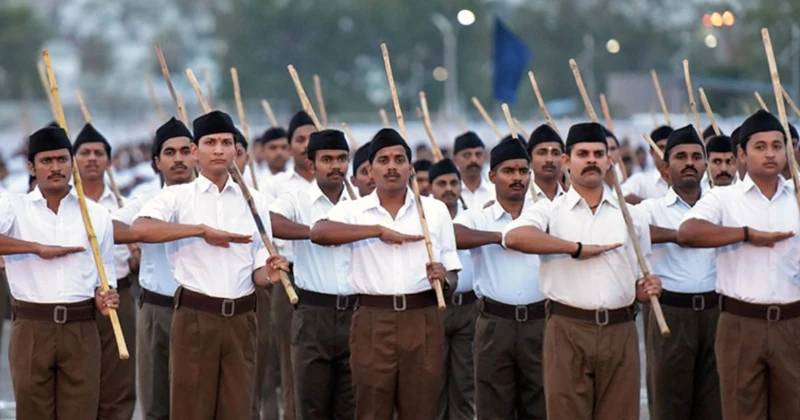
The Ministry of Home Affairs (MHA) has ordered the public display of a memorandum that lifts a decades-old ban on government employees’ participation in Rashtriya Swayamsevak Sangh (RSS) activities. This directive follows the issuance of an office memorandum by the Department of Personnel and Training (DoPT) on July 9, 2024, which officially revokes the longstanding restrictions.
The MHA’s office memorandum states: “The undersigned is directed to forward herewith the copy of the Ministry of Personnel, Public Grievances and Pension, Department of Personnel and Training’s (DoP&T’s) O.M No. 34013/1(S)/2016-Estt (B) dated 9th July, 2024 and to request that the same may kindly be displayed on the Home Page of the official website of the Ministry of Home Affairs for public knowledge please.” The decision underscores the Modi government’s commitment to transparency and public awareness of policy changes.
The Ministry of Home Affairs (MHA) issues an order, asking to display copy of the order on removal of #ban on the participation of government employees in the activities of the #RSS, on the Home Page of the official website of the Ministry for public knowledge pic.twitter.com/muflDxsTDX
— Organiser Weekly (@eOrganiser) July 31, 2024
The original ban on government employees participating in RSS activities dates back to a series of orders issued by Congress-led governments in 1966, 1970, and 1980. These orders were intended to maintain the political neutrality of government servants. The July 9, 2024, memorandum from the DoPT revokes these previous orders, marking a significant departure from past policy.
The memorandum reads: “The undersigned is directed to refer to the OM No.3/10(S)/66-Estt. (B) dated 30.11.1966, OM No. 7/4/70-Est. (B) dated 25.07.1970, and OM No. 15014/3(S)/80-Estt. (B) dated 28.10.1980 on the above subject. The aforesaid instructions have been reviewed, and it has been decided to remove the mention of Rashtriya Swayamsewak Sangh (RSS) from the impugned OMs dated 30.11.1966, 25.07.1970, and 28.10.1980.”
The lifting of the ban has elicited varied responses from political figures. BJP IT cell head Amit Malviya praised the move on social media, calling it a correction of an “unconstitutional” decision made 58 years ago. On the other hand, Congress leader Jairam Ramesh criticised the removal, emphasizing that the ban was upheld even during former Prime Minister Atal Bihari Vajpayee’s tenure and citing historical precedents for the RSS bans.
Interestingly, despite the current controversy, the Congress party had once recognised the contributions of RSS swayamsewaks during the 1962 war with China, inviting them to the 1963 Republic Day Parade.
The decision also follows advocacy from grassroots organizations. In 2018, Sadhu Singh of the Government Employees National Confederation (affiliated with Bharatiya Mazdoor Sangh) petitioned the Prime Minister to lift the ban, arguing that it prevented government employees from contributing to nation-building through social service.
Sunil Ambekar, Akhil Bhartiya Prachar Pramukh of RSS, welcomed the decision, highlighting the RSS’s longstanding role in national service and criticizing the previous ban as politically motivated.
Despite the current controversy, there are historical instances where the Congress party acknowledged the contributions of the RSS. During the 1962 war with China, RSS swayamsewaks were invited to the 1963 Republic Day Parade by then Prime Minister Pt. Nehru, in recognition of their services at the borders. Additionally, former Prime Minister Indira Gandhi inaugurated the Vivekananda Rock Memorial in 1970, an RSS-led initiative.
The removal of the ban is also seen as a response to longstanding advocacy efforts. In 2018, Sadhu Singh, Secretary-General of the Government Employees National Confederation (affiliated with the Bharatiya Mazdoor Sangh), wrote to the Prime Minister, urging the lifting of the ban. Singh argued that many government employees were interested in contributing to nation-building through social service but were deterred by the fear of disciplinary action.
Sunil Ambekar, Akhil Bhartiya Prachar Pramukh of RSS, welcomed the decision, highlighting the RSS’s contributions to national security, unity, integrity, and disaster response over the past 99 years. He criticized the previous ban as politically motivated and unjust, suggesting that the recent decision would strengthen the democratic fabric of India.











Comments