
“RSS is a revolutionary organisation. No other organisation in the country comes anywhere close to it. It alone has the capacity to transform society, end casteism and wipe the tears from the eyes of the poor. Its very name is ‘Rashtriya’ that is National. I am not saying this to flatter you. I believe you have historic role to play.” – Shri Jayaprakash Narayan , in his speech delivered at the RSS training in Patna on November 3, 1977, published in Organiser (weekly), November 14, 1977
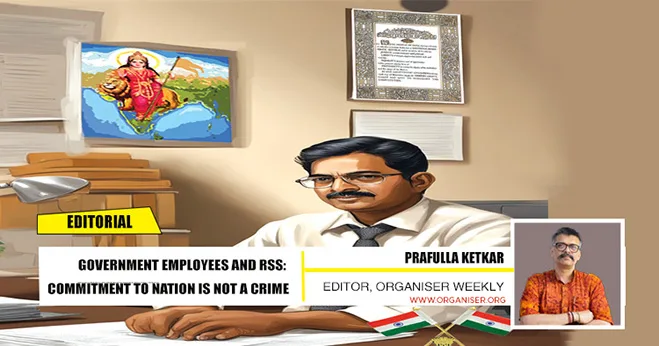
On July 9, 2024, the Union Government formally revoked a decades-old notification for Government Employees, a restriction that was unjust and undemocratic, preventing them from participating in any of Rashtriya Swayamsevak Sangh (RSS) activities. The uproar from the Congress-Communist camp is natural as they were responsible for this undemocratic gag order. Congress went on to say that the Government has done it to create a ‘committed bureaucracy’. Such unreasonable restraint has not stopped Government Employees from being RSS Swayamsevaks unless some politically motivated action was initiated based on a complaint. In a democratic set-up, clearing the air about such an uncivil rule of conduct for civil servants is necessary. Why such restriction was imposed and why it was necessary to remove it should be understood in the historical context.
When Islamic fundamentalism was growing, the conspiracy to divide the country on the religious line was taking shape, and finally, the ancient nation was partitioned on religious lines for the first time; it was the RSS and its Swayamsevaks who stood by the ordinary people and provided security, confidence and relief. The conspiracy hatched by the Nehru Government to target RSS under the garb of Gandhiji’s assassination without any connection was meant to halt the growing popularity and acceptance of the RSS thought process about Bharat being the ancient Rashtra based on civilisational values. Despite all efforts to finish the nationalist socio-cultural movement, Nehru’s aim could not be fulfilled thanks to the intervention by Sardar Vallabhbhai Patel and many Swayamsevaks present in the Congress party. In the next 16 years, RSS work did not just increase manifold; it was transmitted to many walks of national life through Swayamsevaks.
Only after Indira Gandhi took over the reins of Congress in 1966, when she side-lined the Congress organisation to sustain the dynastic rule and took support from the Communist against the deal of giving them a free hand to run the educational and cultural agenda of the nation, this old British game was revived. As per the Government Service rules, employees are not supposed to participate in political activities, which is understandable. However, the Government specifically restricted participation in RSS through an Office Memorandum (OM). Jammat-e-Islami, the fundamentalist Islamist organisation, was also included in this ban to balance things out. There was a background to this OM besides the growing Communist influence on the Indira Congress. There were two cases in which courts had given verdicts in favour of Government Employees to continue as RSS Swayamsevaks in 1965 and 1966. Punjab and Haryana High Court Chandigarh found the dismissal of one Ramphal, who was removed from service in 1965 because he participated in RSS’s activities. The court noted that there was no material before the Government to hold that RSS was a political party. While the Mysore High Court on July 6, 1966, ruled that a Government official’s membership in RSS cannot be a disqualification for promotion in the case related to Ranganatachar Agnihotri, an assistant Government pleader in Raichur district. Another immediate cause was the challenge posed by a massive anti-cow-slaughter protest at the Parliament on November 7, 1966, in which RSS and VHP could mobilise lakhs of people on the Boat Club near India Gate. Many died in the police firing. It had shaken the Indira Gandhi Government to the core, leading to this undemocratic order on November 30, 1966. So, it was a political decision of the executive without any sanctity in the service rules.
Though people continued to join the RSS Shakhas and training programmes, irrespective of their profession, it created a false impression in the society that Government Employees should be committed to the Congress party. During the Emergency, this myth was also busted to a large extent. This OM was the first attempt to create a ‘Committed Bureaucracy’. Indira Gandhi’s regime was not apologetic about this term; it also talked about the ‘Committed Judiciary’. The real question is a commitment to whom – a political party and ruling dispensation or to the Constitutional values and national ethos? Unfortunately, Congress and Communists both preferred the first. Communists completely politicised the State machinery, as witnessed in Kerala and West Bengal. Teachers, police personnel, and from class four employees to top-level bureaucrats, everyone is expected to be a communist cadre. If political affiliation was the concern, then in the 1970s and 1980s, no teaching faculty could have been appointed in top educational institutions like Jawaharlal Nehru University (JNU), where known Communist cadre were faculty members. Weren’t they Government employees? Wasn’t it a Redisation (attempt to infuse Red ideology – bloody revolutionary ideas through education)? Thanks to the ideological outsourcing project of Congress, no media house sitting in the ‘dynastic godi’ talked about this process as they now talk about ‘saffronisation’ (the term coined by Communist intellectuals to label any attempt of nationalising education).
The RSS is a national movement to decolonise the psyche and system. While keeping constitutional and democratic values in mind, the sole objective of RSS is to nationalise all walks of life and train individuals with national orientation. The cultural and social organisation accepts individuals from all castes, creeds, and sects and teaches them to worship Bharat Mata in national life, as Swami Vivekananda envisages. Self-discipline, voluntarism for social causes, national integration, a sense of pride in heritage and team spirit are the core values that RSS shakha and other activities inculcate among Swayamsevaks. Don’t Government Employees need these values while performing their service duties? Telling Government Employees not to be national in orientation and patriotic in civic life is against Constitutional values. Irrespective of who is in power, Swayamsevaks are known for commitment to the work assigned and performing it with a sense of duty. Even Congress leaders accept this in private conversations. Removing this redundant rule will further facilitate the process of Government Employees joining the large sets of RSS activities without fear or pressure.
In the 1990s, Keshubhai Patel led the Government in Gujarat had initiated the process to remove such restrictions. In 2006, Madhya Pradesh Government led by Shivraj Singh Chouhan removed a similar ban. On October 20, 2018, the Government Employees National Confederation wrote a letter to the Prime Minister requesting that the CCS (Conduct) Rules be amended to lift the ban on participation in the activities of RSS. The Haryana Government followed the process in 2021. The July 9th order is the culmination of this process.
Many court orders and stalwarts like Jayaprakash Narayan have recognised the national role of the RSS. On July 25, 2024, the Indore Bench of the Madhya Pradesh High Court made a significant observation while passing an order on the same issue. It said that because of this ban, “Aspirations of many central government employees of serving the countries in many ways therefore diminished in these five decades”. Do we want Government Employees with a sense of duty towards people as taught in the RSS training, or do we want them to carry the colonial, dynastic and anti-constitutional mindset as tried by the British, Congress and Communists? Commitment to a political party is problematic when performing a Government job, but commitment to national ethos cannot be. The removal of restrictions on Government Employees has removed the fundamental anomaly created by the Fascist-Communist regime of Indira Gandhi through an undemocratic Office Memorandum which did not have the sanction of either Parliament or the Constitutional interpretation by the judiciary. The RSS intends to organise the entire society with a clear national purpose that is complementary to the constitutional spirit and not contradictory to it. Let us allow all people to be part of this process.