





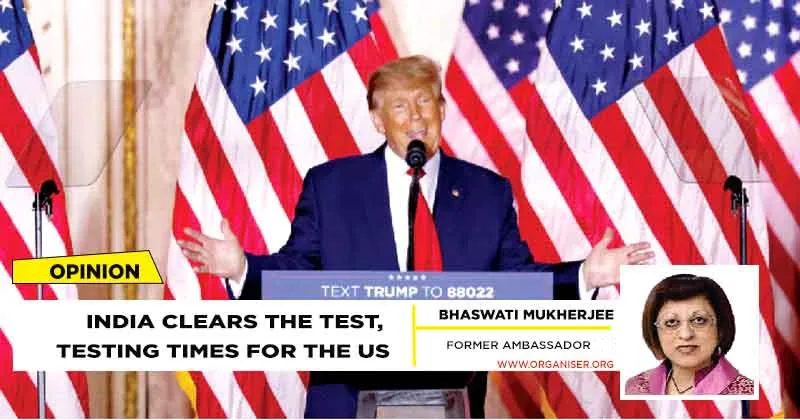
The Indian democracy has proved its mettle by emerging victorious in an election beset with negativity & false narratives. The US elections are also marred by extreme polarization, gun culture, vicious campaigns… will its democracy prevail?
The world’s largest democracy just concluded a free and fair election, leading to PM Modi’s third term, with a smaller number of seats and important regional coalition partners. Throughout the campaign, a distasteful and extremely negative narrative against the ruling party and the PM confused the voters occasionally, leading to some surprising results such as the loss of Ayodhya seat. As one who was privileged to be present at the ‘Pran Pratishtha’ ceremony at Ayodhya, the fact that BJP lost this seat demonstrates beyond doubt that we have a strong democracy and an excellent Election Commission that we can be proud of. Notwithstanding the challenges of the ‘Toolkit’ gang, both within and outside India, democracy prevailed and there was a smooth transition to Modi 3.0.
One of the greatest challenges facing us at that time was that the West, including the USA does not like strong governments in India, nor strong leaders, like PM Modi. Their preference is for a poor India, faltering under weak coalition governments. Throughout the campaign and till today, we are sermonized, scolded and accused of extra territorial killings of terrorists, without an iota of proof by the West, especially the USA. Nevertheless, Bharat that is India continues its inexorable march to emerging great power status.
The US meltdown
On the other side of the world, within the world’s oldest democracy, things are in a meltdown situation. With extreme polarization and a gun culture led by a powerful lobby, which funds both Republicans and Democrats, there are more guns than citizens in today’s America. There are no records of gun ownership and bullets can be purchased in some States from a vending machine. The US is no stranger to political assassinations. One would have imagined that with such a background, strict SOPs would be in place for protecting the presidential candidates.
As he survived assassination by a whisker in Pennsylvania, Republican Donald J. Trump’s image underwent an abrupt makeover. His defiant response in the face of death with his fist raised against the backdrop of an American flag made him a national icon, with the potential to ensure his election and blunt President Joe Biden’s strategy of a counter polarisation. The assessment is that the failed assassination has totally derailed the pathetic script that Biden struggled to put together after his meltdown in the presidential debate on June 27, 2024.
The more complex and troubling question is the extent to which both sides in their bid to capitalise on the near martyrdom of one candidate, will adopt the language of hate politics, building on vicious comments that have already been circulating on social media since the attack, deliberately conflating political opposition with personal animus. If both candidates and their campaign teams and their party leaders abandon common civility, in what should ideally be a structured partisan contest, and allow baser populist instincts to dominate their speeches in the months ahead, it will inevitably exacerbate the already bitter state of polarisation in the public discourse. Whoever wins on 5th November 2024 would then stand on the brink of a deeply troubled polity, hardly the ideal scenario to build bipartisan bridges, so essential to ensure that the U.S. can tackle the many challenges it faces, foreign and domestic.
The Indian Model
India would appear to be not only much better off but the greatest role model for a functional democracy. This is despite the fact that in the months leading up to the election campaign and during the campaign, India and its political order were deeply impacted by ‘fake news’ sometimes termed as ‘the alternative narrative’.
In his book, ‘Delusional Politics’ (2019) Minister Hardeep Singh Puri provided a fascinating insider account of the national and global impact of the rise of populism and an era of ‘alternative facts’ and ‘alternative narratives’ which exploits or distorts popular angst to capture political power. He points out that the assumption is clear: “We are in the dawn of a credibility crisis”. Data is distorted or manipulated to change a political narrative. It marks the rise of “post-truth politics” which feeds on the toxicity of a contrived and false narrative. It is further hyped by ‘polarised consumption’ led by the mainstream media and social media and many international media outlets with a total disdain for empirically verifiable data.
In India and in the West, the emergence of populism and populist politics poses a fundamental challenge to liberal democracies globally. In the West, as the reverse impact of globalisation coincided with shrinking markets resulting from the loss of empire and generous welfare policies, populist policies and politicians became a powerful threat to the status quo established post 1947. In addition, the rise of the era of ‘fake news’ and the manipulation of social media to develop popular angst is proving a grave challenge to free and fair democratic elections.
With four months to go and as presently poised after the near assassination of Trump, the US election seems to be poised for a Republican victory. However, if the unthinkable had happened last Saturday, USA could have been on the verge of a wide-spread civil unrest, violence and perhaps anarchy. Perhaps the time has come for the US to reflect on how much better is the Indian democratic system, which faced similar challenges and came out victorious. Never has the outcome of an American Presidential election seemed so uncertain or fraught with so many uncertainties, fears and anxieties. The world is watching for the outcome which could have profound implications for the West, for the outcome of the Russia Ukraine conflict and the difficult US China relationship, apart from the strategic partnership with India. The fact that Trump’s running mate’s spouse is a PIO is also reassuring to the huge Indian vote in US. Trump at the Republican Convention after the failed assassination bid sounded less combative, much more conciliatory, appealing for national unity and thereby much more reassuring and Presidential.
Costica Bradaton in his article in the NYT on July 5, 2019, noted presciently that there are so many challenges facing democracies that one could say that it is meant only for the Gods! He says: “History – the only true guide we have on this matter has shown us that democracy is rare and fleeting. Genuine democracy is difficult to achieve and once achieved, fragile. In the grand scheme of human events, it is the exception, not the rule”. He poses the question: “Why do democracies fail?” He responds: “Despite democracy’s elusive nature, its core idea is disarmingly simple: As members of a community, we should have an equal say in how we conduct our life together”.
“In democracy as it ought to be,” writes Paul Woodruff in his 2006 book ‘First Democracy: The Challenge of an Ancient Idea,’ “all adults are free to chime in, to join the conversation on how they should arrange their life together. And no one is left free to enjoy the unchecked power that leads to arrogance and abuse.”
In the forthcoming US elections, these challenges are becoming crystal clear. How the American system addresses them will determine fundamentally the course of human history in this century and impact international peace and security. The India US partnership would then come of age. Will the US under a Trump dispensation give a new dynamic to this relationship?
One could cite Victor Hugo who had said:
“You can resist an invading army,
But you cannot resist an idea whose time has come.” India’s time has come and this realization must dawn on the USA sooner rather than later.












Comments