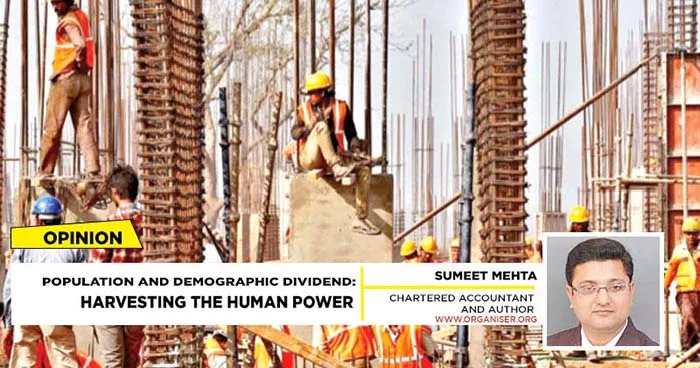
Population and Demographic dividend: Harvesting the human power
June 4, 2026
  • Read Ecopy
  • Circulation
  • Advertise
  • Careers
  • About Us
  • Contact Us
Android AppiPhone AppArattai
Organiser
  • ‌
  • Bharat
    • Assam
    • Bihar
    • Chhattisgarh
    • Jharkhand
    • Maharashtra
    • View All States
  • World
    • Asia
    • Europe
    • North America
    • South America
    • Africa
    • Australia
  • Editorial
  • International
  • Opinion
  • RSS @ 100
  • More
    • Op Sindoor
    • Analysis
    • Sports
    • Defence
    • Politics
    • Business
    • Economy
    • Culture
    • Special Report
    • Sci & Tech
    • Entertainment
    • G20
    • Azadi Ka Amrit Mahotsav
    • Vocal4Local
    • Web Stories
    • Education
    • Employment
    • Books
    • Interviews
    • Travel
    • Law
    • Health
    • Obituary
  • Subscribe
    • Subscribe Print Edition
    • Subscribe Ecopy
    • Read Ecopy
  • ‌
  • Bharat
    • Assam
    • Bihar
    • Chhattisgarh
    • Jharkhand
    • Maharashtra
    • View All States
  • World
    • Asia
    • Europe
    • North America
    • South America
    • Africa
    • Australia
  • Editorial
  • International
  • Opinion
  • RSS @ 100
  • More
    • Op Sindoor
    • Analysis
    • Sports
    • Defence
    • Politics
    • Business
    • Economy
    • Culture
    • Special Report
    • Sci & Tech
    • Entertainment
    • G20
    • Azadi Ka Amrit Mahotsav
    • Vocal4Local
    • Web Stories
    • Education
    • Employment
    • Books
    • Interviews
    • Travel
    • Law
    • Health
    • Obituary
  • Subscribe
    • Subscribe Print Edition
    • Subscribe Ecopy
    • Read Ecopy
Organiser
  • Home
  • Bharat
  • World
  • Operation Sindoor
  • Editorial
  • Analysis
  • Opinion
  • Culture
  • Defence
  • International Edition
  • RSS @ 100
  • Magazine
  • Read Ecopy
Home Bharat

Population and Demographic dividend: Harvesting the human power

Poised to gain significant demographic dividends from its large young population, India must address concerns relating to quality of education and skills training

Sumeet MehtaSumeet Mehta
Jul 11, 2024, 09:00 am IST
in Bharat, Opinion
Follow on Google News
FacebookTwitterWhatsAppTelegramEmail

On July 11, 1987, the world population touched the 5 billion mark. This inspired the Governing Council of the United Nations in 1989 to announce 11th July as World Population Day, to raise awareness on global population and related issues like family planning, gender equality, poverty, maternal and reproductive health, and human rights.

According to the United Nations Population Fund’s (UNFPA) State of World Population 2024 Report, India has become the most populous country in the world with a population of 1.44 bn. China which was once the most populous country now stands second at 1.42 bn population. According to this report, 24 per cent of India’s population is in the age range of 0-14 years and 17 per cent is in the 10-19 years age range. The segment in the range of 10-24 years is estimated to be 26 per cent, while the 15-64 years age makes up 68 per cent of the population of India.

This brings us to the most pertinent question – is India poised to harvest dividends arising from this demography?

To begin with, we need to understand what is demographic dividend. Demographic dividend means the growth in an economy resulting from a change in the age structure of a country’s population. The age structure is normally changed by a decline in fertility and mortality rates. Less developed countries that see a huge rise in population – as birth rates remain high while healthcare improves, thereby reducing mortality rate – fail to enjoy any economic benefit arising from change in age structure. Demographic dividend is driven by the increase in productivity of the working population. Demographic dividend is also a result of demographic transition from a predominantly rural agrarian economy to an urbanised industrialised society.

India is at the cusp of a massive demographic transition and hence is poised to significantly gain from opportunities that lie ahead, to develop and grow richer before the population starts aging. For India to grow, all segments of the society need to be able to contribute to enhancing the productivity of the country. It is especially for the working category – the youth, who must be provided with productive opportunities to achieve a high economic growth. To understand this phenomenon, let us take an example. With a rapid decline in fertility, the number of children in the total population is lower, which enables the state to invest a higher amount per child on education and skills training. This results in a more productive labour force that boosts industrial productivity and, in turn, wages and income of working populace.

This issue was discussed in the 2017 Economic Survey, wherein the Chief Economic Advisor to the Government of India noted that India needs to heavily invest in skilling rural populace involved in agriculture and enable their migration from agriculture to manufacturing and services sector. This will not only make agriculture economically viable but also enable India to trigger the golden period of its industrial boom. In the past, we have witnessed this economic boom in services when millions of educated youth opted for IT services to not only gain attractive income but became the integral part of the “IT boom” that helped India tremendously on all fronts – be it balance of payments or urban growth of cities like Bangalore, Hyderabad, Pune, Chennai, etc. India’s “IT Story” and making of Bangalore into the “Silicon Valley of India” is the story of India reaping benefits of demographic dividends.

Possibilities for India

Here the next question arises – What are the opportunities India has at this juncture and is India poised to gain benefits from the same? As per Ernst and Young, by 2026 about 64 per cent of India’s population is expected to be in the working age group of 15-59 years and the median age of India’s population is around 28 years, well below China’s and US’ median age of 37 years. Bloomberg had reported that around 30 per cent of India’s youth are neither employed nor in education or training. Till an overwhelming majority of youth are not gainfully employed, India’s “demographic dividend” faces the risk of turning out into a “socio-economic nightmare”. Just a decline in birth rates resulting in lesser number of young population cannot help the economy grow rapidly. India will have to invest in enhanced quality of young labour force that can repeat what the young engineers did in IT sector.

This will require dual reforms. India needs skilled youth in manufacturing sector in both white collared and blue collared jobs. The mindset of youth seeking cushy office jobs needs to be changed to encourage them to take up jobs in manufacturing sector. Along with this, the education system needs a major rehaul. The problem starts right from school education and continues till graduation level and even many post graduation courses.

As per United Nations Children’s Fund report of 2019, India produces around 13 million young job seekers every year and around one in four management professionals, one in five engineers, and one in ten graduates are considered fit for jobs. The balance large chunk of graduates is found unfit for any job. Outdated curriculum mixed with apathetic bureaucratic processes in updating curriculum and certifying new courses bundled with poor quality of teaching staff and inadequate infrastructure is the first challenge for the government to address. Second challenge is to bring in hands-on training and internships in education to make graduates work ready.

If these aforementioned areas are fixed using the NEP, and education institutions are revamped to create skilled manpower, then the first major challenge of achieving accelerated economic growth riding on demographic dividends will be achieved. India has the potential to convert the demographic baggage into demographic dividend and it has proved it in the IT and ITES Sector. Now it is imperative for India to repeat the same in the manufacturing sector.


Topics: NEPPopulationDemographic DividendUnited Nations Children's Fundskilled manpower
Share1TweetSendShareSend
✮ Subscribe Organiser YouTube Channel. ✮
✮ Join Organiser's WhatsApp channel for Nationalist views beyond the news. ✮
Previous News

Karnataka: Neha Murder case in spotlight again; 483 page chargesheet rules out love jihad angle 

Next News

Karnataka High Court halts trial against RSS karyakarta Prabhakar Bhatt Kalladka over his remarks on Muslim women

Related News

Representative Image

Hindus are the most educated religious community in US; Research reveals intellectual capabilities of Indian diaspora

External Affairs Minister Dr. S. Jaishankar

Global pecking order has changed: EAM Jaishankar highlights the rise of India and Western stagnation

Renaming reform, Rejecting Responsibility: DMK’s another double standard on NEP 2020

The SRS 2023 report is more than a statistical update – it is a warning. India’s future will be shaped less by how many people it adds today, and more by how few children are being born for tomorrow

When a young nation stops having children

New H-1B rules betrays carefully built India-US strategic relations

How the H-1B gambit of the United States betrays two decades of India-US cooperation

The Arthayam Conclave, jointly organised by Organiser Weekly and the National Stock Exchange (NSE)

Arthayam by Organiser-NSE: ‘Ekatma Manav Darshan in action’ brings ground realities and vision together

Load More

Latest News

PM Modi to Overtake Nehru as India's Longest-Serving Elected Prime Minister on June 10

PM Modi set to surpass Nehru’s record, become India’s longest-serving elected Prime Minister

A representative image

West Bengal Joins Ayushman Bharat: CM Suvendu Adhikari announces coverage for 1.36 crore families

Representatives of the Hindu Janajagruti Samiti, advocates associated with the case, and the complainant address a press conference in Pune regarding allegations of religious conversion pressure and workplace harassment at Wipro Technologies.

After TCS, another Corporate Jihad: Hindu employee alleges Shahina pressured to convert, HR Zeeshan forced resignation

(Left) Nivedita Menon (Right) Arfa Khanum

Podcast Storm: Nivedita Menon & Arfa Khanum slammed for remarks on ‘Love Jihad’ and Hindu women

Operation Delta Hunt: Gujarat Police arrests 362 illegal Bangladeshis, investigates wider network

Operation Delta Hunt: Gujarat Police arrest 362 illegal Bangladeshi nationals during thes crackdown 72-hour

Bangladesh’s reported JF-17 push has triggered fresh scrutiny after India’s Ops Sindoor exposed the vulnerabilities of Pakistani-Chinese defence systems and precision strike capabilities

Shadows of Operation Sindoor: Questions loom over Bangladesh’s JF-17 ambitions amid Sino-Pakistani tech vulnerabilities

B. Nagendra, Congress MLA and former minister in Karnataka

Karnataka: CBI files chargesheets against Nagendra, Congress leader, ex-minister, 29 others in Valmiki Corporation scam

Representative Image (This is an AI generated image)

From Class 10 to Ayurvedic Doctor: Central Sanskrit University unveils new pathway to BAMS

Heera Group founder Nowhera Shaik (File Photo)

Telangana: ED arrests Nowhera Shaik’s aide in Heera Group Sharia-compliant Rs 3000 Cr investment scam

Governor of Karnataka Thaawarchand Gehlot administered the Oath of Office and Secrecy to Chief Minister D.K. Shivakumar on June 3, 2026

DK Shivakumar takes oath as Karnataka CM, invokes Ajjayya in ceremony

Load More
  • Privacy
  • Terms
  • Cookie Policy
  • Refund and Cancellation
  • Delivery and Shipping

© Bharat Prakashan (Delhi) Limited.
Tech-enabled by Ananthapuri Technologies

  • Home
  • Search Organiser
  • Bharat
    • Assam
    • Bihar
    • Chhattisgarh
    • Jharkhand
    • Maharashtra
    • View All States
  • World
    • Asia
    • Africa
    • North America
    • South America
    • Europe
    • Australia
  • Editorial
  • Operation Sindoor
  • Opinion
  • Analysis
  • Defence
  • Culture
  • Sports
  • Business
  • RSS @ 100
  • Entertainment
  • More ..
    • Sci & Tech
    • Vocal4Local
    • Special Report
    • Education
    • Employment
    • Books
    • Interviews
    • Travel
    • Health
    • Politics
    • Law
    • Economy
    • Obituary
  • Subscribe Magazine
  • Read Ecopy
  • Advertise
  • Circulation
  • Careers
  • About Us
  • Contact Us
  • Policies & Terms
    • Privacy Policy
    • Cookie Policy
    • Refund and Cancellation
    • Terms of Use

© Bharat Prakashan (Delhi) Limited.
Tech-enabled by Ananthapuri Technologies