





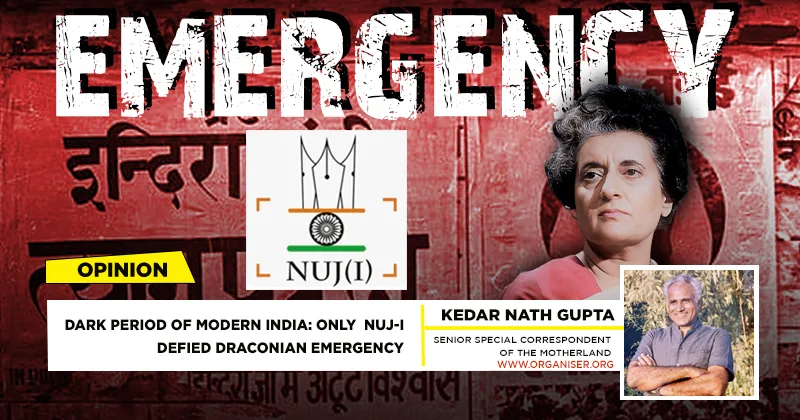
We are proud that the National Union of Journalists (India), an umbrella organisation comprising lakhs of journalists from across the country, rose to the occasion by not only criticising the Emergency but also resisting it, thereby contributing significantly to the ideals of democracy.
NUJ-I has been the national voice of media persons in India and celebrated its Golden Jubilee in 2022 as India celebrated 75 years of Independence. The NUJ-I has created a legacy of setting the highest professional standards for journalists, while simultaneously fighting to protect their rights and enhancing their role and contribution to society.
NUJ-I has stood by the commitment of its leaders to uphold the highest standards of professionalism. For this reason, the NUJ-I adopted a Code of Ethics as Agra Declaration, as early as February 1981.
Founded on January 23, 1972 in New Delhi by eminent journalists, the NUJ-I was set up in the backdrop of rapid growth in media on the one hand, and a growing threat to freedom of the Press on the other. A significant reason for the creation of NUJ-I was that the Indian Federation of Working Journalists (IFWJ) had been captured by cardholders of the Communist Party of India and followed its diktat. The IFWJ had deviated from the path laid down by its founders to serve the journalist community without following the diktat of any political party. This was proven during the infamous Emergency imposed on the country in June 1975, and also Censorship on news. At that time, I was working in the newspaper The Motherland as a Senior Special Correspondent. I witnessed the seizure by the authorities of our office and hundreds of journalists and newspaper employees becoming unemployed.
Commenting on the situation, veteran political and social leader Shri LK Advani rightly said that “When the media was asked to bend, it crawled”!
I had been a journalist since 1956, having worked at the Hindusthan Samachar, The Indian Express, and The Times of India, before joining The Motherland. After much humiliation and several attempts, I could get a job back in The Economic Times in a junior position. I was hurt. I had come into the profession of journalism after completing my education, declining my family business, and spurning lucrative jobs in the corporate world.
Detailing Opposition’s Ordeal
To assert Freedom of Speech and in defiance of the Emergency and Censorship, we produced a supplement of The Motherland that gave a detailed account of the country-wide arrests of Opposition leaders, including our respected Editor Shri KR Malkani. Malkaniji managed to inform us of his arrest and asked us to do our best under the prevailing circumstances. We followed in his footsteps by bringing out a supplement and circulating it throughout the country by distributing it at railway stations.
The National Broadcasting Corporation (NBC) of the USA approached me for an interview on the abuse of Emergency powers to curb Press Freedom. Having been an RSS worker since 1945 and having suffered in jail following the ban on it in 1948 following Mahatma Gandhiji’s killing, I readily agreed. The NBC interviewed me and my family for two days, and trailed my daily schedule from home to office to PIB and back, without doing any work. As soon as the interview was televised, the Indian Ambassador in the US brought it to the notice of New Delhi. The then I & B Minister VC Shukla directed foreign correspondents either to succumb to pre-censorship or leave the country. I was also put under great pressure and was threatened with arrest.
It was only NUJ-I as a media organisation that stood up and spoke boldly to take on the then Prime Minister Indira Gandhi against the imposition of press censorship. NUJ-I was led then by the great visionary journalist leader late Prithvish Chakravarty. The IFWJ had tacitly supported press censorship. Raising the voice through an organised forum like NUJ-I emboldened at least some journalists.
During my tenure as Secretary-General in 1988-1990, the NUJ-I got affiliated with the IFJ (International Federation of Journalists) based in Brussels. This was a landmark in our organisation’s history. Five of us – President Rajendra Prabhu, Treasurer Achutanand Mishra, PK Roy, Shyam Khosla, and I as Secretary-General – represented Indian media at the IFJ conference held at Maastricht in Holland. At the same time, the late Chaudhary Devi Lal, former Chief Minister of Haryana, and later deputy Prime Minister, donated a sum of Rs five lakhs (INR 500,000) to the NUJ-I at our biennial conference. We decided to keep it as a Fixed Deposit and run operations with the interest of the newly formed NUJ-I Institute of Journalism and Communications to upgrade the skills of existing journalists. Another significant feature was the holding of several workshops and seminars under the joint auspices of NUJ-I and IFJ, supported by Germany’s reputed Friedrich Ebert Foundation (FES). IFJ appointed me as its International Coordinator to organise South Asia Journalists Organisations’ conferences in South Asia. NUJ-I took the lead and organised four conferences at New Delhi, Dhaka, Kathmandu, and Colombo with India’s three journalists’ trade unions – NUJ-I, IFWJ, and IJU, along with South Asia’s journalists’ organisations. NUJ-I also recommended that IFJ affiliate the All-India Newspaper Employees Federation (AINEF) to strengthen the newspaper employees’ struggle to fight for the Freedom of the Press along with fair wages through the mechanism of Wage Board for newspaper employees. I was made the convener for organising the anti-Bihar Press Bill demonstration in New Delhi along with all media organisations and also newspaper owners. The movement succeeded and then Prime Minister Rajiv Gandhi’s Government withdrew the Bill. Our union took an all-India shape by having our affiliates almost in every corner of the country.
Another significant contribution of the NUJ-I is that it is the only trade union in India that has maintained the highest democratic traditions by allowing only one term to its main office-bearers. Besides, it is a trade union-cum-professional body that has no political affiliation. The NUJ-I has always been at the forefront of the struggle to maintain editorial freedom and keep it above business interests. At its founding conference in 1972, it had called for the diffusion of ownership to ensure editorial freedom, while simultaneously respecting the legitimate business interests of the newspaper barons.
Soon after the electronic media revolution in 1990, NUJ-I started demanding amendments to the Working Journalists Act to bring electronic media within the purview of the existing laws. Over the years, it has intensified its drive to transform the Press Council into a Media Council to end the dichotomy in which the Press is regulated by an independent statutory organisation. Apart from maintaining high standards of professionalism, it is far ahead of others in its trade union work also. Since the Emergency regime had suspended the Press Council of India, NUJ-I got the Council reinstated and functioning after the Janata Dal Government came to power. The NUJ-I also worked to get an Act of Parliament passed to constitute a Wage Tribunal for better remuneration for working journalists. NUJ-I provided massive evidence before it and its legendary leader, the late Shri L Meenakshi Sundaram, himself appeared before the Tribunal to argue the working journalists’ case. Later on, in the open court, even Justice Palekar acknowledged the contribution of the NUJ-I. Similarly, our veteran leader late Rajendra Prabhu presented the working journalists’ case before the Bachhawat Wage Board by using audio-visual techniques for the first time. We also presented a financial analysis of newspaper economics that stunned even newspaper management. The owners’ representatives applauded the work of our leader Rajendra Prabhu.
Again, it was the NUJ-I to initiate the demand for a pension scheme for working journalists. In 1980, Kapil Verma, one of its former Presidents, who was then a member of the Rajya Sabha, had lobbied vigorously and effectively for a pension for working journalists. Consequently, Finance Minister Shri Narayan Dutt Tiwari included a pension scheme for journalists as a Government initiative in his Budget speech in 1988. The report of a committee constituted for proposing the scheme with NUJ-I representation in it was adopted by the Labour Ministry to create a pension scheme for all employed newspaper/ news agency people. Yet another milestone achieved by NUJ-I was in 1998 when the then Prime Minister Late Atal Bihari Vajpayee launched NUJ-I’s Cyber Journalism Initiative mooted by Rajendra Prabhu. To familiarise journalists in remote places with new technologies and improve their professional caliber, it organised workshops, seminars, and classes to familiarise our fraternity with the new technology. This was followed by the NUJ-I School of Journalism and Communication which trained journalists in reporting on new areas like nuclear energy, developmental journalism, crime reporting, human rights, child rights, problems of gender equality, discrimination and empowerment, corporate reporting, public health awareness, environmental problems, etc. As said earlier, IFJ and FES assisted us in these ventures.
News Standard Deteriorates
In the present scenario, social media has become very popular, but it has led to a further decline in news standards. Major social media news platforms like Facebook and Google rake in billions in profits, but have caused the erosion of jobs in traditional media and have become platforms used to promote fake news and soft porn. Some of the television channels have lowered professional standards by hiring untrained fresh faces and denying them freedom and fair wages and working conditions. This has led to sensational items for TRPs and viral news.
NUJ (I) believes that media should foremost serve the public interest. So, in the interest of public good and democracy, there is no place for a monopoly. Presently, many business houses enjoy a monopoly in both print and electronic media. This is unfair, uncompetitive, and requires serious anti-trust laws. There is hardly a media house operated by media persons. This concentration of media in the hands of pure business persons leads to the erosion of Press freedom. The newspaper owners in India, who are interested parties in seeking to weaken editorial responsibility and independence and destroy working journalists’ unions, pose a direct grave danger to democracy itself. Therefore, in the national interest, there has to be a strong public demand for legislative and other steps to prevent this evil from raising its head in India.










Comments