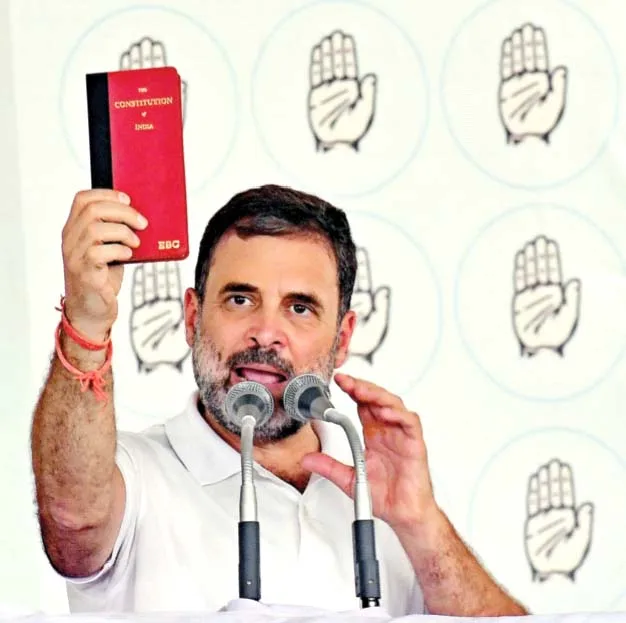
Recently, during the Lok Sabha elections, Rahul Gandhi and Congress party created significant propaganda claiming that Bharatiya Janata Party (BJP) would “change the Constitution” if re-elected to power. Gandhi was seen in his rallies, waving a copy of the Constitution to the crowd and making such allegations. There are multiple reasons why this allegation is not only a blatant lie but also a mockery of logic and historical truth. The first question that arises here is what exactly does “changing the Constitution” mean? Surely, he is not implying that the Constitution we have today is in its original, unchanged form without a word being altered.
There have been more than 100 amendments to the Constitution till date, mostly enacted by Congress Governments. Congress Government (or Congress-led Governments) amended or changed the Constitution 78 times of which 55 times it was amended under the Prime Ministership of Nehru-Gandhi family member only; 17 times during Jawaharlal Nehru’s tenure, 28 times during Indira Gandhi’s tenure and ten times during Rajiv Gandhi’s tenure.
Introducing First Amendment
Our Constitution came into force in 1950 and the First Amendment was made the very next year, in 1951, by Prime Minister Nehru. It is rather ironic that today Congress party and the entire Left-wing ecosystem accuse the BJP of curbing Freedom of Speech, when, in the first amendment, PM Nehru expanded the scope of “reasonable restrictions” on the Freedom of Speech and Expression guaranteed as a Fundamental Right in Article 19(1)(a) of the Constitution. This move was bitterly opposed by Dr Syama Prasad Mookerjee, who criticised Nehru, saying, “You are treating this Constitution as a scrap of paper.” However, with the numbers on his side, Nehru’s amendment was passed.
Emergency was Darkest Chapter
This was not the end of constitutional changes. The darkest chapter in the political history of independent India came during the internal Emergency imposed by Prime Minister Indira Gandhi, when Opposition leaders were jailed and the infamous 42nd Amendment was enacted. Many amendments were made before and after this period, but the 42nd Amendment stands out for its far-reaching effects and is often referred to as the “mini Constitution.” This amendment, among other things, added the words “secular” and “socialist” to the Preamble of the Constitution. These terms had been explicitly debated and rejected by several founding members, including Dr BR Ambedkar, who opposed the inclusion of “socialist” because he believed that adding would be “destroying democracy altogether.”
Both the First Amendment and the 42nd Amendment were made under unusual circumstances. The 1951 Amendment occurred hardly 16 months after the Constitution was enacted. It was brought before the first Lok Sabha elections, with a provisional Parliament in place, as if in a hurry. The 42nd Amendment was enacted during the internal Emergency when Opposition leaders were imprisoned. If one is truly searching for dictatorship in Indian politics, this is where his quest ends.
Congress Government under Indira Gandhi showed no bounds or ethics in changing the Constitution
In fact, Indira Gandhi’s Government’s dictatorial tendencies and desire for absolute power to amend the Constitution led to a prolonged conflict with the judiciary. In the Golaknath case (1967), the Supreme Court ruled that Parliament could not amend Fundamental Rights. In response, Indira Gandhi’s Government enacted the 24th Amendment in 1971, asserting Parliament’s unfettered power to amend any part of the Constitution, including Fundamental Rights. This led to the landmark Kesavananda Bharati case in 1973, where the Supreme Court ruled that while Parliament could amend the Constitution, it could not alter its basic structure. The 42nd Amendment brought by Indira Gandhi sought to curtail judicial review and reinforce Parliamentary supremacy, significantly altering the Constitution.
After the Emergency, the Janata Party Government reversed many changes made by the 42nd Amendment, restoring judicial review and Fundamental Rights. In the Minerva Mills case (1980), the Supreme Court reaffirmed the basic structure doctrine, ruling that amendments violating the Constitution’s basic structure were invalid.
On its own, the Congress Government under Indira Gandhi showed no bounds or ethics in changing the Constitution.
The Indian Constitution has provisions for amendments, and there is nothing “unconstitutional” about amending the Constitution. However, the political context in which these amendments were made raises questions about the ethics and motives of the Congress Government.
Eroding Electoral Integrity
Therefore, it is ironic when Congress and Rahul Gandhi propagate the idea that BJP will “change the Constitution.” This claim lacks logical sense and ignores Congress’s own history of constitutional amendments. In fact, 17 times the Constitution was amended or changed during the tenure of Prime Minister Manmohan Singh when Rahul Gandhi directly had a say in the affairs of the Government.
Election campaigning is a sacred process in a democracy, ensuring that the people can hear from every contender and make informed decisions. It is the ethical duty of every politician to base their criticisms on truth, with the ultimate aim of informing the public. Misinformation, or baseless allegations not only undermine the integrity of the electoral process but also erode public trust in democratic institutions. Maintaining this trust in the electoral process is our collective responsibility. And, this responsibility lies heavily on politicians. Therefore, questions that Rahul Gandhi and Congress are answerable to are:
- When did the BJP explicitly state that it would change the Constitution in a manner that discards it entirely
- What is their stance on all the amendments and changes that Congress and the Gandhi family enacted by brute force?
- Do they oppose the constitutional amendment provisions that have been part of the Constitution since its inception?
A copy of the Constitution which Rahul Gandhi was waving to the public, was it the “original unchanged copy” or did it have all these amendments brought by his party?
A responsible politician would address these questions maturely and engage in a constructive debate. However, what Congress and Rahul Gandhi did instead was create hysteria and an environment of panic. This is not the first time Rahul Gandhi has resorted to such a tactic. During the last Lok Sabha elections, in 2019, he wrongly said that the Supreme Court had said “Chowkidar Chor Hai”. For this, contempt of court proceedings were initiated against him and he had to tender an unconditional apology to the Supreme Court. It was the apex court; hence his tactic of making false and frivolous allegations didn’t work and he was made accountable for it. This time, too, he propagated blatant lies. In any responsible democracy, such actions should be held accountable to the people.