





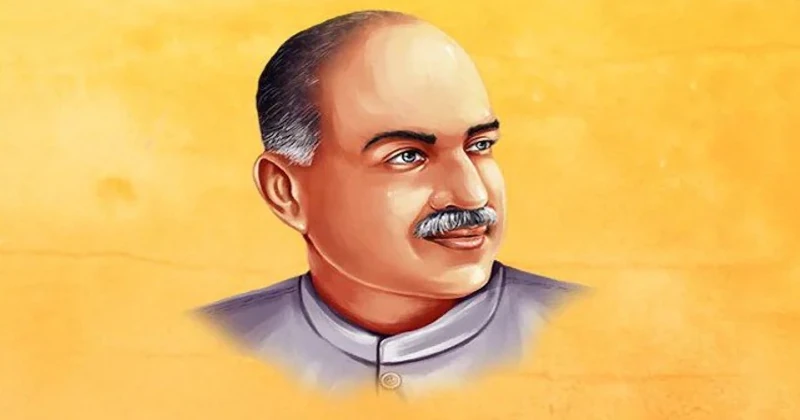
Many death anniversaries are celebrated in the country every year and will continue to be celebrated even further. However, those pious souls are very fortunate, whose supporters or ideals make their ‘sacrifice’ meaningful by their efforts, making history. Dr. Syama Prasad Mookerjee is one such supreme pious soul, who sacrificed his life on June 23, 1953 for the cause of a United Bharat, rejecting the decree of ‘Two Flags, Two Legislations and Two Heads’ (Do Nishan, Do Vidhan and Do Pradhan) in the country. Dr. Mookerjee, as Member Parliament and President of Bharatiya Jana Sangh told the then Prime Minister Jawaharlal Nehru in the Parliament that either I would protect the Constitution or else I would die. He went to Jammu and Kashmir without a permit. He was arrested by Sheikh Abdullah’s Government. He was pronounced dead a few days after his arrest. In fact, he became the first Indian to sacrifice his life for the unity and integrity of the country.
From Bharatiya Jana Sangh to Bharatiya Janata Party (BJP), June 23 has been celebrated not just as a death anniversary of Dr. Mookerjee, but as well a day of resolution to abrogate Article 370 from the Constitution. In every manifesto, the declaration of Dr. Mookerjee of abrogating the Constitution’s temporary Article 370’ was affirmed. The time came, under the leadership of Prime Minister Narendra Modi, who himself traveled to Bharat with Dr. Murali Manohar Joshi, hoisted the tricolor at the Lal Chowk of Srinagar, Article 370 was abrogated from the Constitution on August 5, 2019. Home Minister Amit Shah worked as a true flag-waver in passing the Bill from both the houses of parliament, and paid true tribute to Dr. Mookerjee. Today on June 23 and 67th death anniversary, we can proudly tell the people of our country and as well as the world that we did it for what the great nationalist Dr. Mookerjee sacrificed his life for.
Upbringing of a Nationalist in Patriot Family
Born on July 6, 1901, Dr. Syama Prasad Mookerjee was the child of a devout, just and patriotic Bengali family, renowned not only in Bengal, but all over the country. Respect for religion & culture and inspiration of nationalism came from his parents. While listening to religious and historical stories from his mother Yogamaya Devi, he got knowledge of great Indian tradition and culture, whereas sitting with his father Ashutosh Mookerjee , he imbibed the teachings of patriotism.
Moving steadfastly towards self-realisation, Dr. Mookerjee made his significant contribution in all fields of education, politics, society and culture. He became a member of the Bengal Legislative Council in 1929, and also the youngest Vice-Chancellor of the University of Calcutta from 1934 to 1938. Later, he became the Finance Minister of the Province of Bengal, and subsequently elected the National President of the All India Hindu Mahasabha, the Mahabodhi Society and the Royal Asiatic Society. Dr. Mookerjee was also named member of the Constituent Assembly. He got the opportunity to serve the country as a minister in the first cabinet of independent Bharat. In the first General Elections, he was elected for the Lok Sabha MP from the South Calcutta parliamentary constituency. However the nationalist and patriotic Dr. Syama Babu pledged that Bharat should become a strong united nation and he devoted his entire life to ensure this mission. He is a true icon to educate all of us as how Indian leaders used to be earlier.
Opposed the Partition as a True Son of Motherland
Dr. Syama Prasad Mookerjee did not want to allow the partition of Bharat. For this he also went to Mahatma Gandhi. But Gandhiji said that the Congress people did not listen to him. Jawaharlal Nehru was also in favor of partition. When it became inevitable, Dr. Mookerjee pledged to ensure that the interests of the Hindus of Bengal were not neglected. He tried vigorously for the partition of Bengal, so that the Muslim League’s plan to annex the entire province could not succeed. His efforts protected the interests of the Hindus, and also the Kolkata port survived being handed over to East Pakistan (present-day Bangladesh). He was distracted by the plight of Hindus coming to Bharat displaced from East Pakistan, and initiated schemes to benefit the displaced among them.
Due to Nehru’s disregard for the displaced and his own commitment to national interests, Dr. Mookerjee finally resigned from the Nehru Cabinet on 8 April 1950, which he had joined in 1947 at Gandhi’s invitation. He felt that Nehru had a very soft attitude towards the Government of Pakistan and he had no courage to ensure the protection of the interests of Hindus left in Western (present-day Pakistan) and East Pakistan. He clearly believed that the Nehru-Liaquat Agreement was meaningless as it entrusted the responsibility of protecting the interests of minorities on the Indian Government, but no such initiative was taken by Pakistan. After resigning, Dr. Mookerjee decided to play the role of opposition in the Parliament. For this purpose, he proceeded to explore the possibilities of formation of the opposition political platform.
Thus, the Bharatiya Jana Sangh was founded on October 21, 1951, and became its founding president. He said in his inauguration speech that ‘Today a new all Bharat political party is emerging as Bharatiya Jana Sangh , which will be the main opposition party of the country. Even though Bharat is a country of unique diversities, there is a need that the fraternity and wisdom that develop from the deep devotion to the motherland and the consciousness of loyalty bind all the countrymen in one thread.’ Dr. Mookerjee met with the second chief (Sarsanghchalak) of the Rashtriya Swayamsevak Sangh Madhav Sadashiv Golwalkar (Guruji) and urged him to establish the Bharatiya Jana Sangh. Guruji freed eight pracharaks , and this is where the work of Jana Sangh started with the mission of correcting the mistakes of Nehru hurting the unity and integrity of the country.
The first General Election was held from October 25, 1951 to 21 February 1952, and the Bharatiya Jana Sangh got three Lok Sabha seats. Dr. Mookerjee was one of the three, who won elections from the South Calcutta Parliamentary constituency. Although he did not have the status of Leader of the Opposition, he was the leader of the Democratic Alliance in the parliament. Nehru’s policies were strongly attacked in the House by the alliance and specifically by Dr. Mookerjee. During the debate in the House, Nehru once pointed to Dr. Mookerjee and said, ‘Jana Sangh is a communal party, I will crush Jana Sangh’. To this, Dr. Mookerjee replied, ‘My friend Pandit Jawaharlal Nehru says that he will crush Jana Sangh, I say I will crush this crushing mentality.”
Despite being small in number in the Parliament, he had so much influence that whether he discussed Kashmir or any other subject, everyone used to listen to his speech with full attention. It is the result of his perseverance and dedication that today the country has a majority government at the center under the leadership of his ideological instrumentalist Narendra Modi, who is correcting every mistake one by one, committed by the successive governments in independent Bharat. The abrogation of Article 370 is the ultimate, for the reason Dr. Mookerjee gave supreme sacrifice for this cause.
At the time when Article 370 was being discussed in the Constituent Assembly, Jawaharlal Nehru himself went abroad after listening to Sheikh Abdullah. This was done under a well thought out strategy. Gopalaswamy Iyengar, who was a minister without portfolio in the Nehru cabinet, and previously was the dewan of King Hari Singh of Jammu and Kashmir, had brought Nehru into the cabinet, especially for Jammu and Kashmir. Nehru gave this responsibility to Iyengar before going abroad. The provision of Article 370 came before the Congress Parliamentary Party but was protested. Scared, Iyengar reached Sardar Patel and he too rejected it. However temporary arrangements were made. Sardar Patel said that if Nehru had been there, he would have fixed it, but he would have to accept it. Thus, Article 370 became the part of the Constitution giving special status to the state of Jammu and Kashmir.
Even though the problem was visible to the people later, Dr. Mookerjee understood its seriousness in the beginning. If his speeches 1952 in the Lok Sabha are visited, then it will be clear that what happened later in Kashmir, terrorism and atrocities and escapes with Hindus, he had seen then. The separatist tendencies that emerged from Sheikh Abdullah’s separatist political activities in Jammu and Kashmir had begun to take hold by 1952. Due to this, the national mind was disturbed. Dr. Syama Prasad Mookerjee gave full support to the Satyagraha of Praja Parishad which was to make Jammu and Kashmir a full and integral part of Bharat. In support, he raised a strong slogan ‘Two flags in one country, two legislations in one country, two heads in one country, unacceptable, unacceptable’ (Yek desh men do nishan, yek desh mein do vidhan, yek desh men do pradhan, nahin chalenge, nahin chalenge).
At a massive rally in Jammu in August 1952, he expressed his resolve, ‘Either I will get you the Indian Constitution or I will sacrifice my life for the purpose.“’ In his historic speech in Parliament on 26 June 1952, Dr. Mookerjee strongly advocated the abrogation of Article 370 and fearlessly exposed the utterly wrong policies of the then Prime Minister Jawaharlal Nehru. He asked stalwartly, ‘Are the people of Jammu and Kashmir not entitled to the fundamental rights that we have given to the people of Bharat, except Jammu and Kashmir? Who has made Sheikh Abdullah the emperor of Kashmir, while the unification became possible only due to the entry of Indian forces into Kashmir? Was it done to create another sovereign republic under one sovereign republic? There is neither a need for separate constitutions for different organisational units, nor discrimination among these units.’
To fulfill his resolve, Dr. Mookerjee decided to challenge the Nehru Government in New Delhi and Sheikh Abdullah’s Government in Srinagar. In May 1953, he set out on a trip to Jammu and Kashmir. His aim was to go there and study the situation. In those days, permits had to be obtained for entry into Jammu and Kashmir. But he decided to enter the state of Jammu and Kashmir without a permit. He denied the existence of a second sovereign republic within the sovereign republic of Bharat. Before entering Kashmir without a permit, he had said ‘I will get the constitution or give my life’. When he was asked for a permit, he said, ‘I am a member of the Parliament of Bharat, I will not take a permit in Kashmir in my own country’. He was arrested and put under house arrest. For 40 days, neither medical care nor other basic facilities were provided to them. He died on 23 June 1953 under mysterious circumstances. To realise his resolve, Dr. Mookerjee sacrificed his life for the motherland.
Former Prime Minister Atal Bihari Vajpayee who went to Kashmir with him wrote, ‘When he died, I felt that Dr. Mookerjee was saying, His soul from the sky is saying – Look I have come out of the state of Jammu and Kashmir, though as a martyr, they could not keep me locked up.’ Atal ji vowed that he would dedicate his whole life to realise the dreams of Dr. Mookerjee. This sacrifice was the first sacrifice of independent Bharat that laid the foundation for the struggle for national unity and integrity. At his funeral in Kolkata, over 2 lakh people gathered to pay tribute. Young and old all took to the streets to be a part of their last journey. Dr. Mookerjee’s resolve became the resolution of the nation. His sacrifice became the vow to abolish Article 370 for the people of the nation.
There are rare moments in the history of the nation when a wonderful decision brings the stream of history and the nation’s journey inspired by a new energy and confidence. The moment of August 5, 2019 was similar when Article 370 of the Constitution, which drew a dividing line between Jammu and Kashmir and Bharat, was abrogated unanimously by both the Houses of the Parliament. The mission which was not achieved in the last 70 years was achieved by the Narendra Modi Government within 70 days of its second term. Under the leadership of Prime Minister Narendra Modi, the Government has proved that national unity and integrity is paramount. Bharat, along with Jammu and Kashmir and Ladakh, has laid the foundation of a golden future on the ground of national unity.
Dr Syama Prasad Mookerjee was the first Indian to sacrifice his life for Jammu and Kashmir. He made his supreme sacrifice on 23 June 1953, giving the slogan ‘One Flag, One Legislation, and One Head’ (Yek Nishan, Yek Vidhan, Yek Pradhan). 23 June, the day of supreme sacrifice by the first martyr of independent Bharat Dr. Mookerjee, should be observed in the country as ‘Yek Nishan, Yek Vidhan, Yek Pradhan’ day. With this, the nation will not only remember him on his day of supreme sacrifice every year, but also will strengthen the spirit of national unity and integrity in the country. There can be no better tribute.















Comments