Researchers discover major cause of inflammatory bowel disease
June 9, 2026
  • Read Ecopy
  • Circulation
  • Advertise
  • Careers
  • About Us
  • Contact Us
Android AppiPhone AppArattai
Organiser
  • ‌
  • Bharat
    • Assam
    • Bihar
    • Chhattisgarh
    • Jharkhand
    • Maharashtra
    • View All States
  • World
    • Asia
    • Europe
    • North America
    • South America
    • Africa
    • Australia
  • Editorial
  • International
  • Opinion
  • RSS @ 100
  • More
    • Op Sindoor
    • Analysis
    • Sports
    • Defence
    • Politics
    • Business
    • Economy
    • Culture
    • Special Report
    • Sci & Tech
    • Entertainment
    • G20
    • Azadi Ka Amrit Mahotsav
    • Vocal4Local
    • Web Stories
    • Education
    • Employment
    • Books
    • Interviews
    • Travel
    • Law
    • Health
    • Obituary
  • Subscribe
    • Subscribe Print Edition
    • Subscribe Ecopy
    • Read Ecopy
  • ‌
  • Bharat
    • Assam
    • Bihar
    • Chhattisgarh
    • Jharkhand
    • Maharashtra
    • View All States
  • World
    • Asia
    • Europe
    • North America
    • South America
    • Africa
    • Australia
  • Editorial
  • International
  • Opinion
  • RSS @ 100
  • More
    • Op Sindoor
    • Analysis
    • Sports
    • Defence
    • Politics
    • Business
    • Economy
    • Culture
    • Special Report
    • Sci & Tech
    • Entertainment
    • G20
    • Azadi Ka Amrit Mahotsav
    • Vocal4Local
    • Web Stories
    • Education
    • Employment
    • Books
    • Interviews
    • Travel
    • Law
    • Health
    • Obituary
  • Subscribe
    • Subscribe Print Edition
    • Subscribe Ecopy
    • Read Ecopy
Organiser
  • Home
  • Bharat
  • World
  • Operation Sindoor
  • Editorial
  • Analysis
  • Opinion
  • Culture
  • Defence
  • International Edition
  • RSS @ 100
  • Magazine
  • Read Ecopy
Home World

Researchers discover major cause of inflammatory bowel disease

In a significant breakthrough, researchers have pinpointed a major cause of inflammatory bowel disease (IBD). This discovery marks a pivotal moment in understanding and potentially treating this challenging condition

WEBDESKWEBDESK
Jun 10, 2024, 11:00 pm IST
in World, Health
Follow on Google News
Representative image

Representative image

FacebookTwitterWhatsAppTelegramEmail

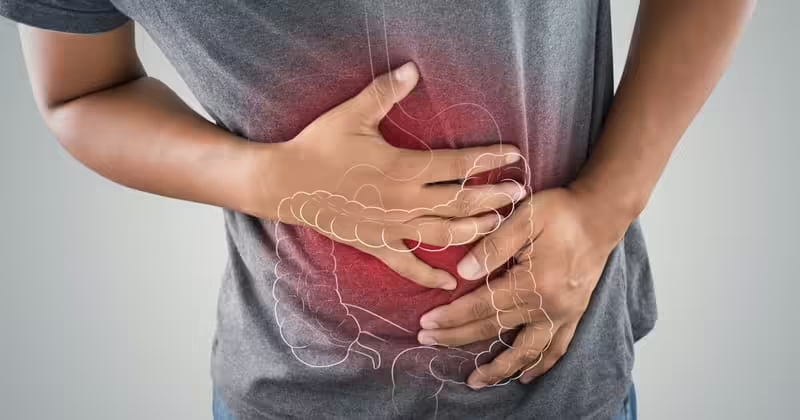
Researchers have identified a new biochemical pathway that is a major cause of inflammatory bowel disease (IBD) and related disorders that can be addressed with existing medications.

An autoimmune disease, such as IBD, which encompasses Crohn’s disease and ulcerative colitis, presently affects approximately 5 per cent of the world’s population and one in every 10 people in the United Kingdom. These diseases are also becoming increasingly widespread, with over half a million individuals in the UK living with IBD by 2022, nearly double the previous prediction of 300,000.

Despite increasing prevalence, current treatments do not work in every patient, and attempts to develop new drugs often fail due to our incomplete understanding of what causes IBD.

Researchers done by Francis Crick Institute, in collaboration with UCL and Imperial College London and their findings published in Nature, scientists at the Crick journeyed into a ‘gene desert’ – an area of DNA that doesn’t code for proteins – which has previously been linked to IBD and several other autoimmune diseases.

They found that this gene desert contains an ‘enhancer’, a section of DNA that is like a volume dial for nearby genes, able to crank up the amount of proteins they make. The team discovered that this particular enhancer was only active in macrophages, a type of immune cell known to be important in IBD, and boosted a gene called ETS2, with higher levels correlating with a higher risk of disease.

Using genetic editing, the scientists showed that ETS2 was essential for almost all inflammatory functions in macrophages, including several that directly contribute to tissue damage in IBD. Strikingly, simply increasing the amount of ETS2 in resting macrophages turned them into inflammatory cells that closely resembled those from IBD patients.

The team also discovered that many other genes previously linked to IBD are part of the ETS2 pathway, providing further evidence that it is a major cause of IBD.

Specific drugs that block ETS2 don’t exist, so the team searched for drugs that might indirectly reduce its activity. They found that MEK inhibitors, drugs already prescribed for other non-inflammatory conditions, were predicted to switch off the inflammatory effects of ETS2.

The researchers then put this to the test, and discovered that these drugs not only reduced inflammation in macrophages, but also in gut samples from patients with IBD.

As MEK inhibitors can have side effects in other organs, the researchers are now working with LifeArc to find ways to deliver MEK inhibitors directly to macrophages.

James Lee, Group Leader of the Genetic Mechanisms of Disease Laboratory at the Crick, and Consultant Gastroenterologist at the Royal Free Hospital and UCL, who led the research, said: “IBD usually develops in young people and can cause severe symptoms that disrupt education, relationships, family life and employment. Better treatments are urgently needed.

“Using genetics as a starting point, we’ve uncovered a pathway that appears to play a major role in IBD and other inflammatory diseases. Excitingly, we’ve shown that this can be targeted therapeutically, and we’re now working on how to ensure this approach is safe and effective for treating people in the future.”

Christina Stankey, PhD student at the Crick, and first author along with Christophe Bourges and Lea-Maxie Haag, said: “IBD and other autoimmune conditions are really complex, with multiple genetic and environmental risk factors, so to find one of the central pathways, and show how this can be switched off with an existing drug, is a massive step forwards.”

Volunteer participants from the NIHR BioResource, with and without IBD, provided blood samples that contributed to this research. The research was funded by Crohn’s and Colitis UK, the Wellcome Trust, MRC and Cancer Research UK, and the researchers worked with collaborators across the UK and Europe.

Ruth Wakeman, Director of Services, Advocacy and Evidence at Crohn’s & Colitis UK said: “Every year, more than 25,000 people are told that they have Inflammatory Bowel Disease. Crohn’s and Colitis are complex, lifelong conditions for which there is no cure, but research like this is helping us to answer some of the big questions about what causes them. The more we can understand about Inflammatory Bowel Disease, the more likely we are to be able to help patients live well with these conditions. This research is a really exciting step towards the possibility of a world free from Crohn’s and Colitis one day.”

Also Read: Naturally Effective: 7 Ayurvedic home remedies for cough and cold

Lauren Golightly is 27 years old and was diagnosed with Crohn’s Disease in 2018 after experiencing stomach cramps, blood in her poo and irregular bowel habits. She said: “Crohn’s has had a huge impact on my life. I’ve had a rocky road since diagnosis, with many hospital admissions, several different medications and even surgery to have a temporary stoma bag. One of the hardest things about having Inflammatory Bowel Disease is the uncertainty around it. I still experience flare-ups and can still spend quite a bit of time in hospital. Learning about this research is so exciting and encouraging. I am hopeful this could potentially make a difference for myself and so many other hundreds of thousands of people living with IBD.”

(with inputs from ANI)


Topics: IBDBowel diseaseInflammatory bowel disease
ShareTweetSendShareSend
✮ Subscribe Organiser YouTube Channel. ✮
✮ Join Organiser's WhatsApp channel for Nationalist views beyond the news. ✮
Previous News

Confident that New Delhi-Kathmandu ties will prosper under Narendra Modi’s leadership: Nepal PM ‘Prachanda’

Next News

Unfair to drag RSS in elections for spreading falsehood with the help of technology: Dr Mohan Bhagwat, RSS

Related News

Representative image

Study finds critical relationship between stem cells, mechanical signals

Representative image

Cancer risk linked to p53 in ulcerative colitis: Study

Representative image

Exposure to broccoli sprouts protects against colitis in bowel disease

Load More

Latest News

RSS centenary year is a time for renewed resolve and greater commitment to nation-building: Dr Mohan Bhagwat

Ex-DMK Minister Senthil Balaji (Right Side-File Photo)

Tamil Nadu: CBI books Rs 397 cr transformer tender scam from ex-DMK Minister Senthil Balaji’s tenure (2021-2023)

Border Security Force (BSF) officials inspect the Single Row Fencing (SRF) at a Border Out Post area (India-Bangladesh border)

Infiltration and Border Management: Saving the Siliguri corridor

External Affairs Ministry spokesperson Randhir Jaiswal, slams Pakistan over the recent killings in POJK

‘Hope Pakistan is held accountable’: India reacts after 20 killed in Pakistan Occupied Jammu & Kashmir

China’s anti-BLA offensive hits snag as UN members demand proof

UN Setback for China and Pakistan: US and allies stall move to ban Baloch Liberation Army

West Asia Conflict: Collective response to energy crisis

Atul Limaye Ji Sah Sarkaryavah, Rashtriya Swayamsevak Sangh while addressing a Pramukh Jan Gosthi Rashtriya at Raipur, Chhattisgarh

Chhattisgarh: Society must lead its own transformation through collective initiative: Atul Limaye

New York anti-Hindu Bill fails to advance: How the bill fueled bias & espoused caste discrimination

Beyond Alignment: How India is Carving Its Own Strategic Space Amid Global Power Play

Beyond Alignment: How India is Carving Its Own Strategic Space Amid Global Power Play

Chinese President Xi Jinping, Russian President Vladimir Putin and Prime Minister Narendra Modi

China’s New Tone Towards India: Tactical shift or strategic necessity? What Beijing’s push for RIC ties really signals

Load More
  • Privacy
  • Terms
  • Cookie Policy
  • Refund and Cancellation
  • Delivery and Shipping

© Bharat Prakashan (Delhi) Limited.
Tech-enabled by Ananthapuri Technologies

  • Home
  • Search Organiser
  • Bharat
    • Assam
    • Bihar
    • Chhattisgarh
    • Jharkhand
    • Maharashtra
    • View All States
  • World
    • Asia
    • Africa
    • North America
    • South America
    • Europe
    • Australia
  • Editorial
  • Operation Sindoor
  • Opinion
  • Analysis
  • Defence
  • Culture
  • Sports
  • Business
  • RSS @ 100
  • Entertainment
  • More ..
    • Sci & Tech
    • Vocal4Local
    • Special Report
    • Education
    • Employment
    • Books
    • Interviews
    • Travel
    • Health
    • Politics
    • Law
    • Economy
    • Obituary
  • Subscribe Magazine
  • Read Ecopy
  • Advertise
  • Circulation
  • Careers
  • About Us
  • Contact Us
  • Policies & Terms
    • Privacy Policy
    • Cookie Policy
    • Refund and Cancellation
    • Terms of Use

© Bharat Prakashan (Delhi) Limited.
Tech-enabled by Ananthapuri Technologies