





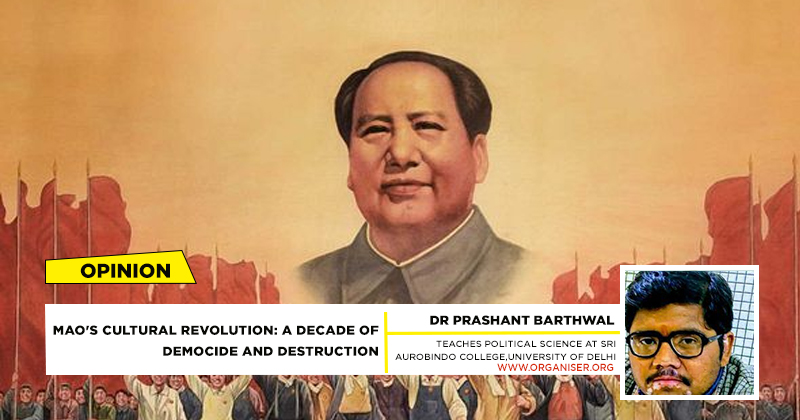
Mao Zedong’s Cultural Revolution, which ravaged China from 1966 to 1976, will forever be remembered as one of the darkest chapters in the nation’s long and storied history. What began as a movement ostensibly aimed at reviving revolutionary ideals and purging remnants of capitalist and traditional elements from Chinese society rapidly devolved into a nationwide reign of terror. It was a period defined by widespread violence, persecution, humiliation, and the systematic decimation of human capital that left an indelible scar on the Chinese psyche. At its core, the Cultural Revolution represented a campaign of democide – the intentional killing of any person or people by a Government, including genocide, policide, and mass murder. It stood fundamentally at odds with the notion of development, which implies progress, growth, and uplifting human conditions. Further, this analytical study will examine how Mao’s Cultural Revolution constituted a clear manifestation of democide through its methods of targeted killing, thought control, and the annihilation of the intellectual class while thoroughly disrupting China’s economic and social development.
The roots of the cultural revolution
The seeds of the Cultural Revolution were sown in the mid-1960s amidst growing tensions within the Chinese Communist Party (CCP). Having achieved victory in the civil war and consolidated power, Mao grew increasingly paranoid about the emergence of a new bourgeois class within the party ranks – officials and intellectuals whom he saw as straying from his vision of rigid Maoist orthodoxy. As his grip on power waned, Mao sought to re-ignite revolutionary zeal and cement his ideological dominance through a mass movement of youth known as the Red Guards. In 1966, Mao issued a clarion call to these student paramilitary groups, exhorting them to purge the capitalist roaders and revisionists within the CCP. What followed was a decade of chaos, violence, and democide as the Red Guards interpreted Mao’s words as a license for wide-ranging persecution.
The first and most glaring expression of democide during the Cultural Revolution was the targeted killing and persecution of perceived class enemies, dissidents, and any voices critical of Mao’s radical policies. The violence was instigated and condoned at the highest levels of leadership, with Mao himself exhorting the masses to “bombard the headquarters” and go after those he labelled as “capitalist roaders” working to restore the old order. In the summer of 1966, he unleashed the Red Guards – fanatical student paramilitary groups – to help spearhead the purges. What ensued was a horrific wave of beatings, humiliations, murders, and public executions that scarred the nation.
Specific targets included teachers, intellectuals, religious figures, managers, and administrators – essentially anyone associated with the “bourgeois” class or old traditional hierarchies. The scale of the killing was staggering, with some estimates indicating hundreds of thousands, or even millions, perished during the tumultuous decade. Many more were tortured, crippled, or endured psychological trauma. Families were torn apart, and entire communities were ripped asunder by the maniacal zealotry of the Red Guards and their war against the “Four Olds” – old customs, old culture, old habits, and old ideas.
In their radicalism, the revolutionaries attacked not just people but also ideology. Independent and critical thought outside the confines of Mao’s personality cult was deemed ideological pollution to be purged through thought reform and public humiliations like the struggle sessions. Untold numbers of Chinese were forced to engage in arduous self-criticism and rectification processes to realign their thinking with Mao’s vision. This represented not just the extinguishing of different viewpoints but an all-out assault on the individual autonomy and human dignity of those branded as ideological deviants. Perhaps the greatest toll exacted by the Cultural Revolution’s democide was on China’s intellectuals and educated class – the very people most crucial for steering the nation’s development and progress. The killings, persecutions, and purges targeted academics, artists, scientists, administrators, and other professionals in a systemic attack on human capital and expertise. Western-educated Chinese or those exposed to foreign ideas were attacked as stinking ninth purveyors of bourgeois liberal thinking. Many of China’s most brilliant minds were either murdered, endured torture and abuse, or saw their careers and lives derailed in this catastrophic era of anti-intellectualism.
Universities nationwide were shut down for years, books burned, and research initiatives halted. An entire generation had its education delayed or disrupted. Professors were paraded through the streets in grotesque streamer denunciations or sent for forced labour and indoctrination in the countryside. The systematic destruction of the educational system and denigration of scholarship kneecapped China’s ability to develop a modern economy, improve productivity, or stay technologically competitive. It decapitated the country’s intelligentsia and disconnected it from the global flows of knowledge, ideas, and skills crucial for development.
The enduring legacy and lessons learned
As the Cultural Revolution finally ground to a halt with Mao’s death in 1976, China was left to confront the staggering toll of a decade of democidal violence and societal upheaval. The scars ran deep, both physical and psychological, and the process of recovery and reconciliation would prove long and arduous. Yet, from the ashes of this tumultuous period, important lessons emerged that would inform China’s subsequent embrace of economic reform and cautious reintegration with the global community. The excesses of the Cultural Revolution served as a stark reminder of the dangers of unchecked ideological fervour and the perils of allowing a personality cult to supersede the rule of law and basic human rights. In the decades since, China has made concerted efforts to distance itself from the darkest chapters of the Mao era, acknowledging the immense suffering inflicted upon its people. While the Communist Party maintains its authoritarian grip on power, it has pragmatically embraced market-oriented reforms and cautiously opened itself to foreign investment and technological exchange. However, the spectre of the Cultural Revolution remains a potent cautionary tale, a reminder of the fragility of societal progress and the ever-present threat posed by the toxic convergence of ideology, demagoguery, and state-sanctioned violence.
The economic consequences of Mao’s Cultural Revolution, fuelled by this ideological onslaught against human capital, proved disastrous and compounded the suffering wrought by democide. Industry and manufacturing were severely hampered in the cities as workers, engineers, and managers fell victim. As China continues its ascent on the global stage, grappling with the complexities of balancing economic development, political stability, and individual freedoms, the lessons of the Cultural Revolution must never be forgotten. It was during that tumultuous decade that the human cost of democide and the corrosive effects of ideological extremism were laid bare, serving as a haunting testament to the imperative of upholding the inherent dignity and rights of all citizens – a prerequisite for any society’s true and lasting progress.















Comments