






“A political ideology is a very handy thing to have. It’s a real time-saver, because it tells you what you think about things you know nothing about.” – Hendrik Hertzberg
A mid differences, disquiet and one-upmanship, I.N.D.I. alliance is barely standing erect to face the 18th Lok Sabha polls. Among I.N.D.I. alliance constituents, Congress is facing an uncertain future and existential crisis. Prospects of a split, revolt, mutiny or disquiet are real and not without reasons. Mandate 2019 and subsequent defeats in the Assembly polls of Madhya Pradesh, Rajasthan and Chhattisgarh have shaken Congress’ self-belief and faith in ideology.
Bereft of Ideology
In terms of ‘science of ideas’ or ideology, the Congress’ strength had been the near absence of ideological clarity. From Jagjivan Ram’s description, ‘Modern man is the inheritor of all that is noble and good in human thought. And thus our democratic socialism is a synthesis of all that is best in the thinking of the East and the West and provides an ideology superior to other sectarian ideologies which are communalistic or communitarian,’ the Congress’ socio-economic thinking has been reduced to a near farcical sab chalta hai in Sonia-Rahul-Mallikarjun Kharge era.
In May 2022, the Congress was locked in an ideological debate at Udaipur, Rajasthan where the party’s inhouse ‘Chintan Shivir’ was held. A section of the party delegates had demanded an outreach programme leading to a sharp North-South divide among the delegates.
On the second day of the camp, that was May 14, 2022, discussions were held whether Congress, as part of its revival plan, should conduct a ‘religious outreach’ programme? Or, should the thrust be on socio-cultural and political issues? The delegates from States like Uttar Pradesh, Madhya Pradesh, Gujarat and Bihar were vocal that the primacy of negating religion should be replaced by ‘pro-active’ gestures. These delegates suggested that Congress leaders should conduct ‘Dahi Handi’ contests, place Ganesh idols at Pradesh (State) and district Congress committee offices and celebrate the Navadurga festival in their respective areas of influence.
In a letter to Kailash Nath Katju in 1953, Nehru had written, “The fate of India is largely tied up with the Hindu outlook. If the present Hindu outlook does not change radically, I am quite sure that India is doomed
But a section of leaders from Southern India, including a Congress Working Committee (CWC) member, Dr Chinta Mohan, Jairam Ramesh and other reportedly objected to it, pointing out that the party should stay away from mixing religion with politics. “Avoid getting into the BJP pitch,” a senior leader is said to have commented. But those from Uttar Pradesh seemed convinced that unless the Congress showed its ‘genuine’ Hindu credentials, the party’s electoral fortunes would continue to suffer. The prophecy came true when the Congress performed below par in MP, Rajasthan and Chhattisgarh.
These differences continue but the Congress leadership is reluctant to confront ideologically tricky situations it has found itself for the past ten years.
Since May 2014, the Congress’s ideological dilemmas have become more pronounced. But Sonia and Rahul, who have been representing the party’s political leadership since then, have been following the path of least resistance. Between December 2017 and May 2019, Rahul had tried everything from hopping temples to hosting Iftars.
Before we delve deeper into that, a look back at how the Congress has traditionally viewed religion and politics.
Cultivating the Majority
Historically, the Congress’s bid to mix religion and politics has remained problematic. There was a huge contradiction in the way Jawaharlal Nehru, independent India’s first Prime Minister, and Mahatma Gandhi viewed religion and politics. For Mahatma Gandhi, religion was integral to secularism. Gandhi, who otherwise agreed with his disciple Nehru on a range of issues, felt that the Nehruvian secular prescription would not work for India. “Politics bereft of religion” is “absolute dirt”, Gandhi would often say.
But Nehru, as I have mentioned in my book, 24, Akbar Road (Hachette), was firm in his definition of secularism that meant separation of religion from the political, economic, social and cultural aspects of life. Religion, in Nehru’s scheme of things, was a personal matter that the State should disassociate from at all costs. In a letter to his Home Minister Kailash Nath Katju in 1953, Nehru had written, “The fate of India is largely tied up with the Hindu outlook. If the present Hindu outlook does not change radically, I am quite sure that India is doomed.”
It was the observation of a man who had realised that the communalism of the majority community had the potential to resemble nationalism.
In September 1951, Nehru got all the CWC members of Purushottam Das Tandon’s team to resign, thus obliging Tandon, a right-wing Congress president, to resign. It may have been a mere coincidence that in the same month, the Bharatiya Jana Sangh, the BJP’s forerunner, was formally launched, with both Atal Bihari Vajpayee and LK Advani being present at the occasion.
Nehru, who had become the Congress president after Tandon’s resignation, pronounced the bottom line of the party’s secular creed at a meeting at the Ram Lila grounds on Gandhi Jayanti in 1951. “If any man raises his hand against another in the name of religion, I shall fight him till the last breath of my life, whether from within the government or outside,” he had said.
Contrary to popular perceptions, Congress fancies itself as a pro-Hindu party. When Indira Gandhi returned to power in 1980, she tried to cultivate the majority community and had accepted an invitation to launch the Vishva Hindu Parishad’s `Ekatmata Yatra’. The VHP was then a nascent outfit and such mass-contact programmes had the potential to tap into religious sentiments and mobilise favourable opinion.
According to bureaucrat and author SS Gill, Indira’s final stint as Prime Minister revealed a lack of social solicitude towards Muslims. A hint of that had come from CM Stephen, an Indira loyalist. In his book, The Dynasty — A political biography of the premier ruling family of modern India (1996), Gill quotes Stephen, who had declared in 1983, “The wave-length of Hindu culture and the Congress culture is the same.”
Earlier, Indira had bitterly opposed the creation of a separate Punjab State on linguistic lines as she closely identified with her minority Hindu supporters in the undivided State, which then included modern-day Haryana too. Indira had just taken over as Prime Minister for the first time in 1966 when a demand for the creation of a Punjabi Suba, or Punjabi-speaking State, was conceded. In her book, My Truth (Vision Books), Indira had recalled her concerns of 1965 when she was Minister for Information and Broadcasting in Lal Bahadur Shastri’s cabinet and a committee under the then Lok Sabha Speaker, Sardar Hukum Singh, had favoured the creation of a Punjabi Suba. Indira wrote that she was opposed to the formation of Punjab on the basis of language as it had let down the Congress’s Hindu supporters. “To concede the Akali demand would mean abandoning the position to which it (the Congress) was firmly committed and letting down its Hindu supporters in the projected Punjabi Suba… this startling reversal of Congress policy was totally unexpected.”
Barely six months before her assassination in October 1984, Indira had sought to assure the majority community that, “if there is injustice to them or if they did not get their rights, then it would be dangerous to the integrity of the country”.
Five years later, in 1989, her son Rajiv Gandhi, who was the Prime Minister then, would launch his Lok Sabha campaign on the banks of the river Saryu in Ayodhya, promising a Ram Rajya.
A clear articulation of where the party stood on secularism came from VN Gadgil, the late Congress ideologue who served as All India Congress Committee spokesperson during the regimes of Narasimha Rao and Sitaram Kesri. Gadgil had told Congress activists at a seven-day training camp in Kurla, Maharashtra, that he disapproved of the Congress leadership’s policy of appeasing Muslims. At the training camp in 2000 to select ‘future Congress leaders’, Gadgil had asked, “Do minorities mean only Muslims? What about Buddhists, Sikhs and others? When thirty-six Sikhs were killed in Kashmir, not a single Congressman condoled their deaths,” he said, referring to the March 2000 Chittisinghpora massacre.
The doctrine of necessity and compulsion have driven the Congress towards seat sharing on humiliating terms and unlikely to improve its prospects
When Gadgil was asked why he was saying all this, he had replied, “I have said this earlier. Muslims constitute only 18 per cent of the vote share. Even if all of them vote for the Congress, the party will not return to power. We cannot go on ignoring the sentiments of the other 82 per cent.”
At a theoretical level and historically too, the Grand Old Party had always taken upon itself the ‘duty’ of leading the nation, with successive AICC political resolutions.
The Congress’s ‘duty’ to lead the nation was tweaked a bit in 1998 when the party under Sonia’s leadership officially opened its doors to forming coalitions. Still, in successive political resolutions, it would rebut the claim that the days of single-party rule were over and that a conglomeration of regional parties at the Centre hoped to thrash out a seat sharing formula. But the prospects of a one-on-one contest against Narendra Modi-led BJP-NDA is not liked by a section of Congress, particularly its in-house veterans. The reason being, for the first time in post-Independence India, the grand old Congress would be contesting less than 320 Lok Sabha seats for 18th Lok Sabha in 2024.
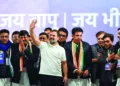
Faced with bleak prospects and near existential crisis due to a series of electoral defeats and crisis of confidence, Congress under the combined leadership of Mallikarjun Kharge and three Gandhis – Sonia , Rahul and Priyanka – are trying to team up with regional parties such as the AAP, TMC, NCP [Sharad Pawar], DMK, Shiv Sena [Udhav Thackeray] and 22 others to beat the BJP.
The doctrine of necessity and compulsion have driven the Congress towards seat sharing on humiliating terms and unlikely to improve its prospects. The I.N.D.I. allies fancy themselves as co-equals and unwilling to make any concessions. Congress leaders, oblivious of realities, live in the past and nostalgia thinking, hamare baap dada ne ghee khaya tha, hamari hatheli soongh lo are bound to be in for a rude shock. The fragile alliance is already breaking into chaos.


Comments