Book Review: Fallacy of Nehru’s Policy
December 5, 2025
  • Read Ecopy
  • Circulation
  • Advertise
  • Careers
  • About Us
  • Contact Us
Android AppiPhone AppArattai
Organiser
  • ‌
  • Bharat
    • Assam
    • Bihar
    • Chhattisgarh
    • Jharkhand
    • Maharashtra
    • View All States
  • World
    • Asia
    • Europe
    • North America
    • South America
    • Africa
    • Australia
  • Editorial
  • International
  • Opinion
  • RSS @ 100
  • More
    • Op Sindoor
    • Analysis
    • Sports
    • Defence
    • Politics
    • Business
    • Economy
    • Culture
    • Special Report
    • Sci & Tech
    • Entertainment
    • G20
    • Azadi Ka Amrit Mahotsav
    • Vocal4Local
    • Web Stories
    • Education
    • Employment
    • Books
    • Interviews
    • Travel
    • Law
    • Health
    • Obituary
  • Subscribe
    • Subscribe Print Edition
    • Subscribe Ecopy
    • Read Ecopy
  • ‌
  • Bharat
    • Assam
    • Bihar
    • Chhattisgarh
    • Jharkhand
    • Maharashtra
    • View All States
  • World
    • Asia
    • Europe
    • North America
    • South America
    • Africa
    • Australia
  • Editorial
  • International
  • Opinion
  • RSS @ 100
  • More
    • Op Sindoor
    • Analysis
    • Sports
    • Defence
    • Politics
    • Business
    • Economy
    • Culture
    • Special Report
    • Sci & Tech
    • Entertainment
    • G20
    • Azadi Ka Amrit Mahotsav
    • Vocal4Local
    • Web Stories
    • Education
    • Employment
    • Books
    • Interviews
    • Travel
    • Law
    • Health
    • Obituary
  • Subscribe
    • Subscribe Print Edition
    • Subscribe Ecopy
    • Read Ecopy
Organiser
  • Home
  • Bharat
  • World
  • Operation Sindoor
  • Editorial
  • Analysis
  • Opinion
  • Culture
  • Defence
  • International Edition
  • RSS @ 100
  • Magazine
  • Read Ecopy
Home Bharat

Book Review: Fallacy of Nehru’s Policy

Vijay Gokhale assesses that Bharat is an important global player today than it was in the 1950s in his book which highlights the damage done to Bharat’s external relations when Nehru, who was pro-China, was the PM

Ameya KulkarniAmeya Kulkarni
Mar 20, 2024, 08:00 pm IST
in Bharat, Books
Follow on Google News
FacebookTwitterWhatsAppTelegramEmail
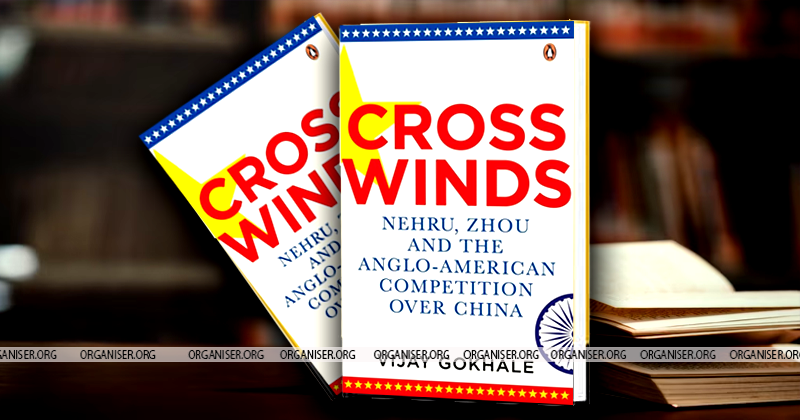
Title: Crosswinds: Nehru, Zhou and the Anglo-American Competition Over China , Author: Vijay Gokhale , Publisher: Penguin Viking , Pp 256, ” 470.00

What differentiates Vijay Gokhale’s writings – be it his op-eds, research papers or his three previous books, all are rigorous documentary research, wide reading of existing literature and offering valuable insights, using as a lens – is his mastery over the Chinese language and rich experience serving in China as an Ambassador and negotiating with the Chinese.

India’s former Foreign Secretary and Ambassador to China, Vijay Gokhale, in his fourth book Crosswinds: Nehru, Zhou and the Anglo-American Competition over China offers a fascinating account of India’s diplomacy in four specific events during 1949 through 1959: the formal recognition of the People’s Republic of China (PRC), the Indochina War and the two Taiwan Strait crises. India’s diplomatic role was encouraged by the British and the Chinese but mostly disdained by the Americans, who came to view India as too partial to China and unappreciative of the US goal of containing Communism in Asia. Gokhale believes that the events of that decade can shed some light on the current US-China confrontation in the South China Sea, and India’s role in today’s geopolitics of the Indo-Pacific.

Gokhale writes that India’s foreign policy in this era was shaped by a complex dynamic involving Britain, the United States, China, and the Cold War. India had achieved its Independence from Britain in 1947, while China was in the midst of its civil war between Chiang Kai-shek’s Nationalists and Mao Zedong’s Communists, and the United States was implementing, albeit unevenly, the policy of containment in both Europe and Asia. Both Indian and British leaders viewed a Communist victory in China as likely but viewed China’s Communist leaders as being motivated more by nationalism than by ideology. And when the Communists came to power on the mainland in October 1949, both India and Britain attempted to persuade US leaders to recognise the new Government, believing that it was the best way to counter Soviet influence in China. The United States refused.

Gokhale writes: The anti-Cold War mentality was deeply embedded in Nehru’s thinking, and the conviction that China would play a positive and beneficial role in Asia had also set in with the concluding of the agreement between India and China on trade

India’s perspective was shaped by its colonial past and its geographical proximity to China. India’s Prime Minister Jawaharlal Nehru hoped to develop a partnership with China that would transcend the emerging Cold War bipolarity and develop into a “third force” in global politics. Britain, led by Prime Ministers Clement Attlee, Winston Churchill, Anthony Eden, and Harold Macmillan, looked to its imperial interests in Hong Kong and South Asia—its empire was fading but its leaders clung to the belief that they could still play a significant role in global politics. The Truman and Eisenhower administrations in America continued to side with Chiang Kai-shek’s Nationalist regime (which had fled to Formosa, ie

Taiwan, after the Communists’ victory), and US policy reflected the fear of an ostensible world-wide communist enterprise headquartered in Moscow that sought world domination.

Gokhale uses the Taiwan issue as the pivot for his story of the drama unfolding in the Indo-Pacific and explores, with extensive archival evidence, the trajectory that shaped the

Asian order, which eventually succumbed to the dynamics of the Cold War despite a different vision that animated India’s foreign policy in these formative years. Nehru was sound in assessing that post-war Asia was driven by the forces of nationalism rather than an ideological attachment to Communism, that the cause of regional peace would be advanced by acknowledging and accommodating rather than confronting, even subverting, the upsurge of nationalism.

Although Britain feigned a “special relationship” with the US, Gokhale points out that on the issue of formal recognition of the PRC, the resolution of the Indochina War between France and Ho Chi Minh’s Communist forces, and during the two Taiwan Strait crisis, Britain and the United States were rarely in agreement. And British leaders and diplomats frequently used India and its leaders’ perspectives to explain, and in some cases as an excuse for, their differences with the Americans.

Gokhale gives high marks to India’s leaders for their “strategic clarity”, their readiness to mediate the US-China disputes, and their refusal to take sides in the intensifying Cold War, at least during this first decade. And despite, or perhaps because of, the colonial history, India and Britain usually saw eye-to-eye in Far Eastern geopolitics. Indian leaders and diplomats believed they understood Asia better than the Americans or the British—and they were probably right. Britain, though it often opposed US policies in the Indo-Pacific, was always mindful of the importance of Anglo-American cooperation.

India, Gokhale writes, “contributed to the final outcome of the Geneva Conference” that ended the Indochina War, and “Nehru’s personal stature also helped India secure a post-conference role in Indochina,” but despite Nehru’s claims it was not Indian leaders but Eden, Zhou, Russian Foreign Minister Molotov, North Vietnamese leader Pham Van Dong and French Prime Minister Pierre Mendes-France who were mostly responsible for the Geneva accords. US leaders had contemplated military intervention on France’s side in the war, and after Geneva, both Eisenhower and his Secretary of State John Foster Dulles promoted the formation of the Southeast Asia Treaty Organisation (SEATO) as a bulwark against Communism in the region. The US sought India’s membership, but Nehru refused. The Geneva accords did not bring lasting peace to Indochina, and meanwhile the US and China faced-off with each other twice in the mid- and late-1950s in the Taiwan Strait.

The early recognition of the People’s Republic of China (PRC) was based on this perspective. Nehru believed that a partnership between India and China as the two largest emerging states in Asia was indispensable to preventing the Cold War from locking the region in an ideological and military confrontation that would limit India’s diplomatic space and threaten its vital interests.


Topics: Fallacy of Nehru’s PolicyUS policyanti-Cold WarCrosswinds: NehruZhouUS- China
Share1TweetSendShareSend
✮ Subscribe Organiser YouTube Channel. ✮
✮ Join Organiser's WhatsApp channel for Nationalist views beyond the news. ✮
Previous News

Supreme Court to hear PIL against political parties offering freebies during elections on March 21

Next News

Badaun Double Murder: Sajid and Javed’s grandmother defends butchering of Ahan & Ayush referring ‘Upari hawa’

Related News

US President Donald Trump 2.0 spurs global shift to strategic autonomy

OpenAI VS DeepSeek : Illusion of supremacy

US President Donald Trump along with Israeli Prime Minister Benjamin Netanyahu

Trump declares US takeover of Gaza strip; unveils bold plans for more occupation promises security & economic growth

US President Donald Trump

Trump’s Stance on Gender: US will now recognise only two genders, male and female

Trump Triumphs but Towering Task Ahead

Representative Image

US condemns China’s death penalty threats over Taiwan independence advocacy

Load More

Comments

The comments posted here/below/in the given space are not on behalf of Organiser. The person posting the comment will be in sole ownership of its responsibility. According to the central government's IT rules, obscene or offensive statement made against a person, religion, community or nation is a punishable offense, and legal action would be taken against people who indulge in such activities.

Latest News

Thirupparankundram Karthigai Deepam utsav

Andhra Pradesh: AP Dy CM Pawan Kalyan reacts to Thirupparankundram row, flags concern over religious rights of Hindus

23rd India-Russia Annual Summit

India-Russia Summit heralds new chapter in time-tested ties: Inks MoUs in economic, defence, tourism & education

DGCA orders probe into IndiGo flight disruptions; Committee to report in 15 days

BJYM leader Shyamraj with Janaki

Kerala: Widow of BJP worker murdered in 1995 steps into electoral battle after three decades at Valancherry

Russian Sber bank has unveiled access to its retail investors to the Indian stock market by etching its mutual fund to Nifty50

Scripting economic bonhomie: Russian investors gain access to Indian stocks, Sber unveils Nifty50 pegged mutual funds

Petitioner S Vignesh Shishir speaking to the reporters about the Rahul Gandhi UK citizenship case outside the Raebareli court

Rahul Gandhi UK Citizenship Case: Congress supporters create ruckus in court; Foreign visit details shared with judge

(L) Kerala High Court (R) Bouncers in Trippoonithura temple

Kerala: HC slams CPM-controlled Kochi Devaswom Board for deploying bouncers for crowd management during festival

Fact Check: Rahul Gandhi false claim about govt blocking his meet with Russian President Putin exposed; MEA clears air

Union Minister for Road Transport and Highways Nitin Gadkari (Right)

India set for highway overhaul as Union Minister Nitin Gadkari unveils nationwide shift to MLFF electronic tolling

RSS Akhil Bharatiya Prachar Pramukh Shri Sunil Ambekar

When Narrative Wars result in bloodshed, countering them becomes imperative: Sunil Ambekar

Load More
  • Privacy
  • Terms
  • Cookie Policy
  • Refund and Cancellation
  • Delivery and Shipping

© Bharat Prakashan (Delhi) Limited.
Tech-enabled by Ananthapuri Technologies

  • Home
  • Search Organiser
  • Bharat
    • Assam
    • Bihar
    • Chhattisgarh
    • Jharkhand
    • Maharashtra
    • View All States
  • World
    • Asia
    • Africa
    • North America
    • South America
    • Europe
    • Australia
  • Editorial
  • Operation Sindoor
  • Opinion
  • Analysis
  • Defence
  • Culture
  • Sports
  • Business
  • RSS @ 100
  • Entertainment
  • More ..
    • Sci & Tech
    • Vocal4Local
    • Special Report
    • Education
    • Employment
    • Books
    • Interviews
    • Travel
    • Health
    • Politics
    • Law
    • Economy
    • Obituary
  • Subscribe Magazine
  • Read Ecopy
  • Advertise
  • Circulation
  • Careers
  • About Us
  • Contact Us
  • Policies & Terms
    • Privacy Policy
    • Cookie Policy
    • Refund and Cancellation
    • Terms of Use

© Bharat Prakashan (Delhi) Limited.
Tech-enabled by Ananthapuri Technologies