
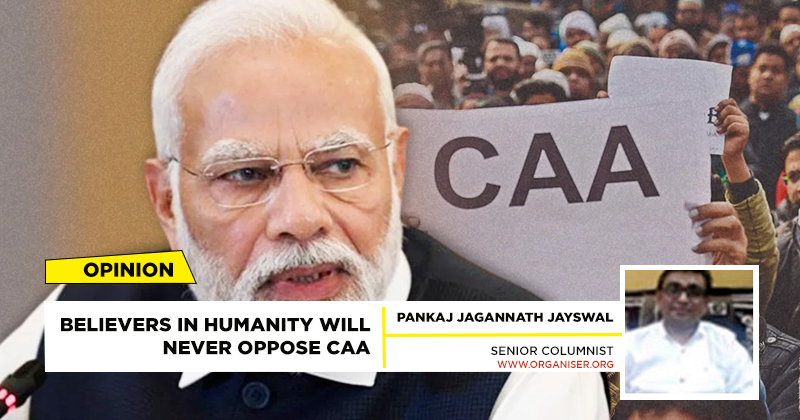
The Citizenship (Amendment) Act of 2019 (CAA) allows migrants/foreigners from six minority communities in three specified countries who have come to Bharat due to religious persecution to petition for Bharatiya citizenship. It makes no changes to the existing legal provisions that allow foreigners of any class, creed, religion, or group to apply for Bharatiya citizenship by registration or naturalisation. Such a foreigner must meet the minimum legal requirements before applying for citizenship.
Why was it crucial to bring CAA?
Let us begin with Dr Baba Saheb’s words and the Constitution that he and his team wrote. The Constitution’s first words, ‘India that is Bharat…’ acknowledge the Indian Republic as a nation-state. The nation-state notion holds that the State is the successor of a historical civilisation and cultural identity and is responsible for preserving that identity. As part of this commitment, the Indian Union has a moral and constitutional obligation to provide relief to Hindus, Sikhs, Buddhists, Jains, Parsis, and Christians who are persecuted in their neighbourhoods through the Citizenship Bill. In his book Pakistan and the Partition of India, Dr Baba Saheb Ambedkar addresses several previously unanswered topics about partition. According to Dr Ambedkar, the partition process will most likely continue until every Hindu in Pakistan returns to India. So, did Ambedkar foresee that the poor backward, Scheduled Caste Hindus we left behind in Pakistan would undoubtedly seek safety in India one day from Islamic Pakistan. Dr Baba Saheb was undoubtedly aware that when India and Pakistan were partitioned, Jinnah stated that Pakistan would be a secular country rather than an Islamic one. But a handful of individuals believed him, and Baba Saheb’s apprehension underscores this.
The Citizenship Bill is a belated atonement for this error.
When Hindus, concerned about the impunity granted to Islamic extremism in Pakistan and Bangladesh, came to secular India to save their lives, they were met with disdain and scorn. On one side, there would be the threat of murder, rape, kidnapping, and forced conversion, while on the other, there would be the worry of a lengthy legal process in India or confinement in camps. Hindus, Buddhists, and Sikhs under oppression in these countries did not desire partition. Partition was imposed on them. The genocide that has been taking place in Pakistan since 1947 and in Bangladesh since 1971 exemplifies the tragedy of partition. The Citizenship Bill is a belated atonement for this error. Although lakhs of Hindus were massacred during the partition, many Hindus remained in Pakistan. Among this Hindu group were many Dalits from modern-day India who had travelled to Pakistan with Jogindernath Mandal; everyone is aware of their current situation. National Citizenship Registration began in India in 1951. After Bangladesh was established in 1971, all those who arrived in India and settled there before March 24, 1971, were enrolled as Indian citizens. However, those who arrived after that were labelled infiltrators. Another significant distinction is that they are refugees rather than an intruder. Due to religious persecution, some people have fled their own country and sought asylum in India. In such a case, what is the problem with India granting Indian citizenship to their followers? If Hindus do not travel to India, where will they go? India is the country where Hindus are the majority. As a result, Hindus from other countries or individuals of different religions feel safer in India. If you think this is anti-Muslim, think again. Pakistan, Afghanistan, and Bangladesh are three nations near India’s border, with a Muslim majority. The Hindus, Jains, Buddhists, Parsis, and Christians who live here are all minorities. If they are persecuted in these nations, where will they flee? They have only Indian roots, no matter where they are.
Is there religious exploitation of minorities in these three Islamic nations?
At the time of partition, Hindu, Sikh, Buddhist, and Jain communities in Pakistan accounted for 15.16 per cent of the entire population, which has since decreased to 1.5-2 per cent after 75 years. According to research, there were 40,000 Sikhs in Pakistan in 2002; today, there are fewer than 8000. Similarly, in 1947, Hindu and Buddhist adherents made up about 30 per cent of the overall population of Bangladesh (East Pakistan prior to 1971), while today, they make up less than 8 per cent. The number of Afghan Hindus and Sikhs in Afghanistan was over 7 lakh in the 1970s but has steadily dropped since the civil war in 1990, reaching barely 3000 persons presently.
How lethal is minority percussion in these three countries? Here are a few occurrences
In 2019, on the evening of Holi, a similarly tragic occurrence occurred in Pakistan. On this day, two Hindu minor girls were kidnapped in Dharki, Ghotki district, Sindh province, and forced to convert to Islam. Both were forced to marry. These girls, Reena Meghwar (12) and Raveena Meghwar (14) are members of the Meghwar community, which is large in southern Sindh. They were abducted from their home.
It is worth pointing out that another Hindu girl, Sonia Bhil, was kidnapped from the Mirpur Khas district on the same day. Sadaf Khan (converted name), a Christian girl, was kidnapped and forced to switch her religion just a few days prior. These episodes demonstrate that extreme religious criminals have no fear of Pakistan’s law and justice system, as evidenced by the Sindh Police’s response to the incident.
According to a local human rights activist in Pakistan’s English daily ‘Dawn’, “About 25 incidents of forced religious conversion occur every month in Umerkot district of Sindh in Pakistan.” The place is rather backward. The minorities who live here are Scheduled Castes, and the police do not respond to their complaints about forced religious conversion. This predicament is only in one district, so the magnitude of the calamity can be approximated across Pakistan.
In 2007, the US Department of State published the International Religious Freedom Report on Afghanistan. The ongoing displacement of ethnic communities was examined. According to the article, “Approximately 3,000 Hindus and Sikhs reside here. People of Hindu, Sikh, Jewish, and Christian faiths were living here until a few years ago, but following Taliban control and civil war, the majority of the population departed. They now account for fewer than 1 per cent of the total population. During years of strife, around 50,000 Hindus and Sikhs have been displaced to other nations in search of refuge.
If six communities from these three Islamic nations can obtain citizenship in India, why can’t the Muslims of those countries?
India, in keeping with its long-standing tradition, granted entire freedom to its minorities as well as equal opportunity to advance. In contrast, Pakistan failed to do so, and the minority became extinct as a result.
According to the amendment, minorities such as Hindus, Sikhs, Buddhists, Christians, Parsis, and Jains who came to India after being persecuted for their religion in Pakistan, Afghanistan, or Bangladesh will be able to gain Indian citizenship.
What harm does it do anyone if India shelters the aforementioned victims of religious persecution? How can providing sanctuary for defenceless Hindus affect Indian Muslims or anyone else? The question also arises: if six communities from these three Islamic nations can obtain citizenship in India, why can’t the Muslims of those countries? The direct answer is that these three countries are recognised Islamic nations, thus any suggestion of Muslim domination there on religious grounds is absurd.
Humanists should investigate these facts rather than disseminating false information to poison the minds of Muslims in India. People should be aware that several political parties and their leaders are acting irresponsibly in light of India’s forthcoming election. Such anti-humanitarians must learn their lesson in future elections.