Uttarakhand Civil Code: Common Spirit of Constitution
July 17, 2026
  • Read Ecopy
  • Circulation
  • Advertise
  • Careers
  • About Us
  • Contact Us
Android AppiPhone AppArattai
Organiser
  • ‌
  • Bharat
    • Assam
    • Bihar
    • Chhattisgarh
    • Jharkhand
    • Maharashtra
    • View All States
  • World
    • Asia
    • Europe
    • North America
    • South America
    • Africa
    • Australia
  • Editorial
  • International
  • Opinion
  • RSS @ 100
  • More
    • Op Sindoor
    • Analysis
    • Sports
    • Defence
    • Politics
    • Business
    • Economy
    • Culture
    • Special Report
    • Sci & Tech
    • Entertainment
    • G20
    • Azadi Ka Amrit Mahotsav
    • Vocal4Local
    • Web Stories
    • Education
    • Employment
    • Books
    • Interviews
    • Travel
    • Law
    • Health
    • Obituary
  • Subscribe
    • Subscribe Print Edition
    • Subscribe Ecopy
    • Read Ecopy
  • ‌
  • Bharat
    • Assam
    • Bihar
    • Chhattisgarh
    • Jharkhand
    • Maharashtra
    • View All States
  • World
    • Asia
    • Europe
    • North America
    • South America
    • Africa
    • Australia
  • Editorial
  • International
  • Opinion
  • RSS @ 100
  • More
    • Op Sindoor
    • Analysis
    • Sports
    • Defence
    • Politics
    • Business
    • Economy
    • Culture
    • Special Report
    • Sci & Tech
    • Entertainment
    • G20
    • Azadi Ka Amrit Mahotsav
    • Vocal4Local
    • Web Stories
    • Education
    • Employment
    • Books
    • Interviews
    • Travel
    • Law
    • Health
    • Obituary
  • Subscribe
    • Subscribe Print Edition
    • Subscribe Ecopy
    • Read Ecopy
Organiser
  • Home
  • Bharat
  • World
  • Operation Sindoor
  • Editorial
  • Analysis
  • Opinion
  • Culture
  • Defence
  • International Edition
  • RSS @ 100
  • Magazine
  • Read Ecopy
Home Bharat

Uttarakhand Civil Code: Common Spirit of Constitution

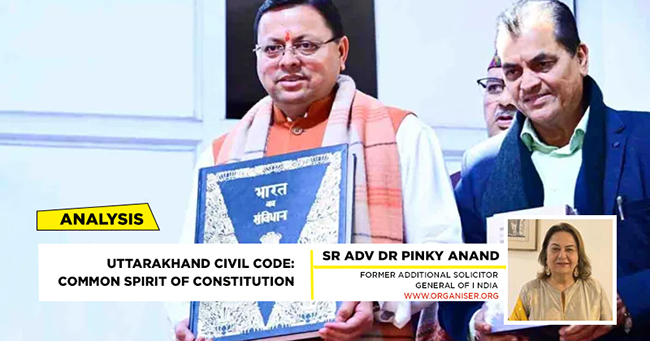
By introducing Common Civil Code Bill, Uttarakhand has become the first State in Bharat to have a uniform civil law. This watershed moment, realised on February 6, will usher in an era of human development, rights-based society and dignity

Dr Pinky AnandDr Pinky Anand
Feb 13, 2024, 07:00 pm IST
in Bharat, Analysis
Follow on Google News
FacebookTwitterWhatsAppTelegramEmail

Implementing a Common Civil Code is a quandary that has confronted our Constitutional Courts and Legislative bodies since the very inception of Bharat. The storied sojourn of the Indian Constitution and its Fundamental Rights jurisprudence have seen a plethora of cases that have sought to usher in a rights-based personal law. Still, the goals of complete justice and equal protection of law remained elusive. The current system is complex, inaccessible and guarantees different notions of justice. On November 26, 1949, “We the People” of India gave to ourselves a Constitution that guaranteed equality, justice, liberty and fraternity. Still, as the Indian legal history would attest for some sections of our citizens, these remained lofty words to be sacrificed at the altar of political convenience. The promise of Article 14, which guaranteed equal protection of the law, was never realised in spirit. For the law did not protect us all equally. On February 6, 2024, the State of Uttarakhand introduced its Common Civil Code Bill, which shall remain etched into the annals of Indian law. This watershed moment has seen 76 years in the making and shall deliver on the promise of the Indian Constitution irrespective of religion to all its people.

The Uniform Civil Code found its existence not in the Fundamental Rights Part III of the Constitution but in Directive Principles of State Policy wherein, under Article 44 “The State shall endeavour to secure for the citizens a Uniform Civil Code throughout the territory of India”. The Bill introduced in the Special Assembly Session of Uttarakhand answers this Constitutional expectation.

“I personally do not understand why religion should be given this vast, expansive jurisdiction so as to cover the whole of life and to prevent the legislature from encroaching upon that field. After all, what are we having this liberty for?”-Dr BR Ambedkar

Over the years, the Courts have expressed in several landmark judgements the need for a Common Civil Code. In the case of Shah Bano, the Supreme Court deemed it a matter of regret that a Common Civil Code had not been introduced in India. Dr BR Ambedkar had been a proponent of CCC as has been expressed when he stated, “I personally do not understand why religion should be given this vast, expansive jurisdiction so as to cover the whole of life and to prevent the legislature from encroaching upon that field. After all, what are we having this liberty for? We have the liberty to reform our social system, which is full of insecurities, discrimination, and other things that conflict with our Fundamental Rights. It is therefore quite impossible for anybody to conceive that personal law shall be excluded from the jurisdiction of the state.”

Upon a cursory glance at the tabled Bill, the one thing that stands out is its unabashed approach to ensuring that civil law does away with dogmas and prejudices codified in religious law that somehow still found its existence in the Indian polity of the 21st Century. The new Bill has taken a purposive approach to guarantee women’s and children’s welfare, flourishing and dignity. Whether this is in the form of banning the practice of polygamy, rampant in certain minority communities, that contributes towards excesses of domestic violence, poverty, negligent and abusive parenting, and broken homes or in the form of practices of Muta and Halala. The laws are used by clerics and patriarchs to strip women of their dignity and agency. The practice of Halala requires women to engage in sexual relations with another man to simply be able to enter into a second marriage. The practice of Muta is used to push young children, orphans and vulnerable women into the trade of trafficking and prostitution. Custom and religion cannot be used to create legal immunity against abhorrent crimes like prostitution, in the same grain as using a custom to carry out heinous crimes with impunity. The Supreme Court is currently faced with a legal petition to apply penal laws irrespective of rights granted under personal laws. The current provisions of statutory rape under POCSO and of child marriage are abused with impunity by benefactors of a medieval, patriarchal, discriminatory and violent law regime. There exists a need to simplify the laws so as to create a democratic and accessible justice system that serves to protect the sacrosanct Fundamental Rights enshrined in our Constitution. The current system creates an inequality of right-holders. A class of citizens that has honed its socio-economic status, individual autonomy and dignity by constituting itself with natural law rights. Another class is stuck in interpretations of holy books that are not in tandem with the notions of constitutional morality and principles of natural justice.

It’s imperative to note that the Bill has been judiciously crafted and does not homogenise a nation as diverse as ours. The Bill ensures that it does not abrogate the Constitutional rights of Scheduled tribes that have earned a customary right to carry out their culture and way of life.

At the heart of the CCC Bill is an attempt to ensure gender and child justice wherein lies the provision that guarantees a uniform age of consent for marriage, a complete ban on child marriage and a ban on polygamy and bigamy. The Bill has legislated that a divorce of a marriage can be granted exclusively by a Court of Law. Thereby ensuring that dogmatic, patriarchal, and unfair customs are written out and women get their fair share. This includes making religious conversions a ground for divorce, which will ensure that marriage undertaken that eventually seeps into a person’s personal agency can be voided by law. The proposed CCC goes further in requiring the registration and recognition of live-in relationships or cohabiting unions for maintenance and in recognising children born from such unions. The law holds that all children are legitimate and shall be entitled to inheritance from both of their parents.

The CCC Bill proposes to simplify and uniformly apply laws of marriage, divorce, inheritance and tax across communities, ensuring that the protection of law in India is granted equally and the promise of the Indian social contract is attained. The Indian struggle for CCC has been long documented, from Shah Bano to Shayara Bano, from Sarla Mudgal to Danial Latifi to John Vallamattom. With the present Bill, Uttarakhand will become the first State since Goa to have a uniform civil law and usher in an era of human development, dignity, flourishing and a rights-based society.


Topics: UttarakhandUniform Civil CodeCommon Civil CodeCCC Bill proposes
ShareTweetSendShareSend
✮ Subscribe Organiser YouTube Channel. ✮
✮ Join Organiser's WhatsApp channel for Nationalist views beyond the news. ✮
Previous News

Anti-Indian terrorists dying in their own dens 

Next News

Sandeshkhali: West Bengal police lathi-charged BJP workers protesting against sexual assault by TMC goons in Basirhat

Related News

Madhya Pradesh's Uniform Civil Code draft proposes mandatory registration of live-in relationships

Madhya Pradesh: UCC draft proposes mandatory registration of live-in relationships, divorce & inheritance laws

Uttarakhand govt ends grants for 456 madrasas after abolishing Madrasa board

Uttarakhand govt ends grants to 456 Madrasas after abolishing Madrasa board; U-DISE benefits stay

Dhami Govt rolls out Minority Education reforms, scraps Madrasa Board

Uttarakhand launches ‘Minority Education Authority’ on principle of One Nation-One Education, Madrasa Board abolished

West Bengal Govt set to table UCC Bill on Monday

West Bengal UCC Bill Explained: What Uniform Civil Code covers, Why Govt is bringing it, What it means for state

Tension escalated in Uttarakhand after a group of Nihang Sikhs allegedly breached police barricades at state border

Uttarakhand: Nihang Sikhs breach police barricades, trigger massive security alert across the state

The Uniform Civil Code debate in Assam has reignited questions around equality, cultural identity and constitutional reform in India

Equality Without Assimilation: Why Assam’s UCC debate goes beyond legal uniformity

Load More

Latest News

West Bengal: ED unearths Rs 40 lakh cash, 180g gold at Al-Jamiatul Islamia Darul Uloom Madrasa

The 5th Meeting of the BIMSTEC National Security Chiefs was held in New Delhi on 16 July 2026

India leads BIMSTEC security push as member states unite against terrorism, maritime and emerging threats

Train collides with school van at railway crossing, three students killed

Murshidabad Train Accident: Three students killed, several injured after train hits school van at railway crossing

More than 1,800 RSS swayamsevaks carried out large-scale seva operations during the 2026 Puri Rath Yatra, ensuring devotee safety through medical aid

Puri Jagannath Rath Yatra 2026: RSS swayamsevaks lead massive seva drive, form human chains to protect devotees

Jharkhand: NIA cracks down on RSS office petrol bomb attack case, raids multiple locations in Lohardaga

Maharashtra FDA cracks down on food adulteration, suspends Parsi Dairy Farm's licence

Mumbai’s iconic Parsi Dairy Farm loses license in Maharashtra FDA crackdown; Rs 1.9 crore worth adulterated food seized

A representative image

ED probe uncovers FCRA fund diversion network linked to Rohingya, Bangladeshi infiltration across Bengal, UP, Haryana

The secret Kalat offer that could have redrawn the map of South Asia, and the decision that changed its course

What if India’s western frontier had reached Balochistan? The secret 1948 offer that could have changed history

Former US Navy personnel Jordan Brown under investigation after attempting to enter Nepal illegally.

Former US Navy officer arrested at Nepal Border visited Mysuru, Bengaluru; Probe uncovers suspicious India trail

India's first privately developed orbital rocket, Vikram-1, built by Skyroot Aerospace, is set for its historic maiden launch from Sriharikota on July 18

Vikram-1 Mission Aagaman: India’s first private orbital rocket to attempt historic satellite launch on July 18

Load More
  • Privacy
  • Terms
  • Cookie Policy
  • Refund and Cancellation
  • Delivery and Shipping

© Bharat Prakashan (Delhi) Limited.
Tech-enabled by Ananthapuri Technologies

  • Home
  • Search Organiser
  • Bharat
    • Assam
    • Bihar
    • Chhattisgarh
    • Jharkhand
    • Maharashtra
    • View All States
  • World
    • Asia
    • Africa
    • North America
    • South America
    • Europe
    • Australia
  • Editorial
  • Operation Sindoor
  • Opinion
  • Analysis
  • Defence
  • Culture
  • Sports
  • Business
  • RSS @ 100
  • Entertainment
  • More ..
    • Sci & Tech
    • Vocal4Local
    • Special Report
    • Education
    • Employment
    • Books
    • Interviews
    • Travel
    • Health
    • Politics
    • Law
    • Economy
    • Obituary
  • Subscribe Magazine
  • Read Ecopy
  • Advertise
  • Circulation
  • Careers
  • About Us
  • Contact Us
  • Policies & Terms
    • Privacy Policy
    • Cookie Policy
    • Refund and Cancellation
    • Terms of Use

© Bharat Prakashan (Delhi) Limited.
Tech-enabled by Ananthapuri Technologies