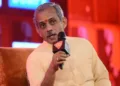

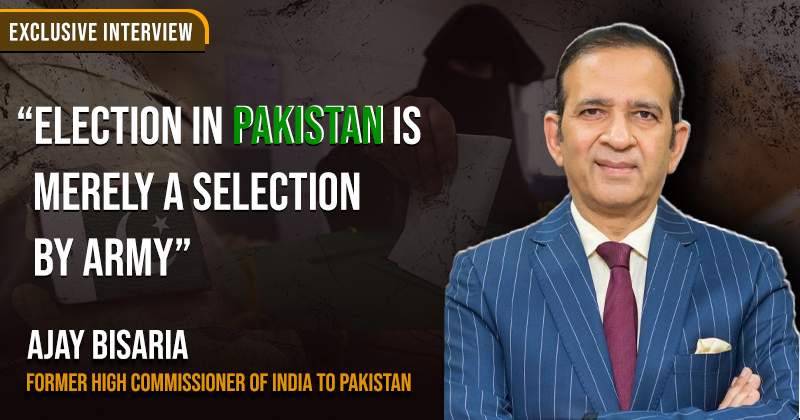
As elections in Pakistan is scheduled to take place on February 8, Ajay Bisaria, former High Commissioner of India to Pakistan, who has recently written a book titled ‘Anger Management’, shared his experience with Organiser Assistant Editor Ravi Mishra when Pakistan Government knocked on his door at midnight of February 27 when Bharat threatened to attack Pakistan if it didn’t release its Pilot Abhinandan. He said that the time between Pulwama and Balakot and its aftermath five years ago, was certainly a challenging time for India, for the Indian mission in Pakistan and for him personally. Excerpts
Elections will be held in Pakistan on February 8. Should Bharat expect anything positive from this electoral?
Pakistan’s General Elections, scheduled for 8 February 8, are possibly the most predictable ones in its history. They are rightly being called a ‘selection’. They come at a chaotic time of polycrisis for that country, with security, economic and political challenges. Still, fresh elections and fresh mandates, however flawed, can lead to fresh thinking in both the Army and civilian setups in Pakistan. The arrival of Nawaz Sharif and a fresh look at Pakistan’s problems may make for a better India policy.
Since his return to Pakistan, Nawaz Sharif has been talking a lot of positive things like improving relations with Bharat. Do you think Pakistan military will let him do anything positive?
If Nawaz Sharif, on his arrival, gets on the same page with the Army to cobble together a Government with some coherence, we could expect some steps forward in the relationship. This may be expressed in concrete steps in the second half of the year, when India will also have a new exercise Government in place, in all likelihood a Modi 3.0, that might review its approach towards Pakistan.
In recent months, people in POJK and Balochistan have been raising their voices against Pakistan Army for human rights violations. Do you think that Pakistan is heading towards civil unrest?
Pakistan’s many faultlines are opening up. The country can hardly afford opening another front to the West with an aggressive Iran, while it is engaged with containing brutal attacks by the militant Tehrik-e-Taliban Pakistan (TTP) on the Afghan border. The TTP problem itself is coalescing with the larger Pashtun and Baloch movements against the Army establishment. Add to that the problem in POJK, particularly the so-called Gilgit Baltistan region where people are protesting both against economic management and their political neglect. This internal dissension spells a distracting security nightmare for an Army that needs all its bandwidth to engineer elections and to put a favoured candidate on the saddle in a new hybrid regime.
What is the future of Imran Khan and his party PTI?
Cricket analogies are legion in Pakistan currently. The level playing field in Pakistan now implies levelling Imran and his PTI to the ground, to allow the favoured Nawaz an easy glidepath to being the Army’s junior partner in governance. The former cricket hero has been deprived of his bat his party’s election symbol and now has been ’clean bowled’ twice in succession on January 29-30, with hastily assembled courts sentencing him to ten years for leaking secrets and fourteen for accepting illegal gifts. The PTI has also been dismantled and splintered with several reprogrammed ‘electables’ propped up as independent candidates. The Army’s message to the voters, who appeared to overwhelmingly favour Imran, is clearly that they should only choose from options available. Imran Khan is not on the menu for the people of Pakistan in this election.
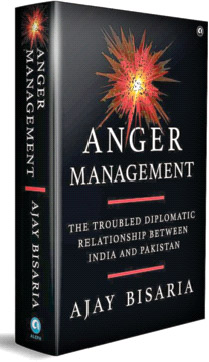
You have written a book “Anger Management” on Pakistan. What provoked you to write this book?
The book is a 560-page long answer to the short question: what do Indian diplomats do in Pakistan? It is essentially a practitioner’s account of the troubled history of the relationship, keeping a focus on the diplomacy that we have attempted for decades. Even though this is a crowded space, and a lot of good scholarship has appeared on this relationship, I thought it is much too important not to present another perspective. I think practitioners who have seen critical moments in history owe it to their successors to record their experiences and assessments which could also benefit the larger public, which often does not get nuanced views on critical policy challenges.
You were the Indian High Commissioner to Pakistan when Bharat launched an Air Strike in Pakistan after the Pulwama attack by Pakistani terrorists. What was the situation in Pakistan then?
The Balakot airstrikes, together with the surgical strikes in Uri in 2016, not only represented a paradigm shift in India’s approach to ‘active defence’ in tackling cross-border terrorism but also triggered a rethink in Pakistan about the cost of deploying militant groups against its neighbours. Both these processes- India’s lowered threshold of tolerance of terrorism and Pakistan’s reconsideration- are positive trends that must be watched carefully by analysts.
Was this the most challenging time of your career?
I was fortunate in my 35 years in Government, to have a ringside view of many exciting moments, both within India and outside.
The time between Pulwama and Balakot and its aftermath five years ago, was certainly a challenging time for India, for the Indian mission in Pakistan and for me personally. We had to react to developments on an hourly basis. But the good news is that Indian policy and diplomacy acquitted itself well both in successfully achieving short-term goals and setting newer long-term objectives.
In your book, you have written that the Pakistan Government knocked on your door at midnight of February 27 when Bharat threatened to attack Pakistan if it didn’t release Abhinandan.
It was an interesting phone call that I received on behalf of Pakistan’s PM Imran Khan on the night of February 27. We can only speculate on what that call was about since it never materialised. Imran Khan himself mentioned it in his Parliament the next day, that he had tried to make that call to India. What the entire episode demonstrated is that India’s message was loud and clear: that the conflict would escalate if the Indian pilot was not quickly returned unharmed. That objective was achieved and it should be counted as a success of confident and decisive policy.
How do you see Bharat’s foreign policy under the Narendra Modi Government?
In my assessment, India, that is Bharat, has a more confident foreign policy. Our country is now willing to take risks in navigating the complexity of changing geopolitics, with a proactive approach towards both partners and adversaries. For Indian diplomats, we have the outstanding political leadership, not just of PM Narendra Modi but also of External Affairs Minister Jaishankar, who is an out-of-the-box thinker. The clearly laid out policy guidelines and leadership make Indian diplomats on the ground more confident and, when necessary, assertive, in outlining India’s positions.