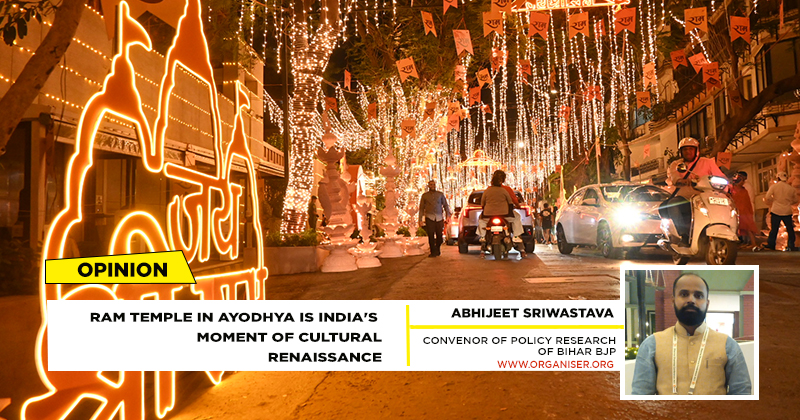
Ram Temple in Ayodhya is India's moment of cultural renaissance
September 14, 2026
  • Read Ecopy
  • Circulation
  • Advertise
  • Careers
  • About Us
  • Contact Us
Android AppiPhone AppArattai
Organiser
  • ‌
  • Bharat
    • Assam
    • Bihar
    • Chhattisgarh
    • Jharkhand
    • Maharashtra
    • View All States
  • World
    • Asia
    • Europe
    • North America
    • South America
    • Africa
    • Australia
  • Editorial
  • International
  • Opinion
  • RSS @ 100
  • More
    • World Hindu Congress 2026
    • Op Sindoor
    • Analysis
    • Sports
    • Defence
    • Politics
    • Business
    • Economy
    • Culture
    • Special Report
    • Sci & Tech
    • Entertainment
    • G20
    • Azadi Ka Amrit Mahotsav
    • Vocal4Local
    • Web Stories
    • Education
    • Employment
    • Books
    • Interviews
    • Travel
    • Law
    • Health
    • Obituary
  • Subscribe
    • Subscribe Print Edition
    • Subscribe Ecopy
    • Read Ecopy
  • ‌
  • Bharat
    • Assam
    • Bihar
    • Chhattisgarh
    • Jharkhand
    • Maharashtra
    • View All States
  • World
    • Asia
    • Europe
    • North America
    • South America
    • Africa
    • Australia
  • Editorial
  • International
  • Opinion
  • RSS @ 100
  • More
    • World Hindu Congress 2026
    • Op Sindoor
    • Analysis
    • Sports
    • Defence
    • Politics
    • Business
    • Economy
    • Culture
    • Special Report
    • Sci & Tech
    • Entertainment
    • G20
    • Azadi Ka Amrit Mahotsav
    • Vocal4Local
    • Web Stories
    • Education
    • Employment
    • Books
    • Interviews
    • Travel
    • Law
    • Health
    • Obituary
  • Subscribe
    • Subscribe Print Edition
    • Subscribe Ecopy
    • Read Ecopy
Organiser
  • Home
  • Bharat
  • World
  • Operation Sindoor
  • Editorial
  • Analysis
  • Opinion
  • Culture
  • Defence
  • International Edition
  • RSS @ 100
  • Magazine
  • Read Ecopy
Home Bharat

Ram Temple in Ayodhya is India’s moment of cultural renaissance

After enduring a relentless five-century struggle marked by countless sacrifices, Bhagwan Ram has finally returned to his 'Janmsthan.' This momentous occasion unfolds as a source of unspeakable joy and satisfaction for over a billion Hindus worldwide

Abhijeet SrivastavaAbhijeet Srivastava
Jan 22, 2024, 09:00 am IST
inBharat, Culture
Follow on Google News
Facebook
Twitter
WhatsAppTelegramEmail

After an arduous struggle spanning five centuries marked by countless sacrifices, finally Bhagwan Ram has returned to his ‘Janm Sthan’. This is a momentous occasion, a moment of unspeakable joy and satisfaction for over a billion Hindus across the world. Bharatvarsha had to wait for several generations to see this long-cherished dream turn into a reality. The magnificent Ram temple at Ayodhya is a testament to the unwavering faith and perseverance of Ram Bhakts, who steadfastly fought for it through ages. It is the culmination of those numerous battles that generations of Hindus fought to preserve their civilizational identity.

As many commentators have suggested that Ram Mandir movement was not just a religious endeavor but also one of the most consequential chapters in the ongoing civilizational battle of Bharatvarsha. Detractors who opposed the idea of a Ram Mandir being constructed at Bhagwan Ram’s birth place failed to understand the civilisational significance of this struggle. Here was a grassroots movement predominantly led by ordinary Hindus, seers, and saints who could not withstand the site of a mosque standing where the temple dedicated to their revered god once stood. The fact that the larger Hindu community kept the embers of ‘Dharma Yudh’ alive for five hundred years and never really stopped to struggle for the temple to come at its pre-existing place narrates a compelling tale of unyielding faith and devotion.

Numerous historical texts and memoirs document the atrocities committed by Islamic invaders and rulers in India. The eight- hundred-year-long Islamic reign in India was marked by extreme brutality against the Hindu population. Iconoclasm, inherent in Islamic practices, manifested through the desecration of a significant number of Hindu temples by Islamic marauders upon their arrival in India. Historian Sita Ram Goel in his  two-volume book named ‘Hindu Temples: What Happened To Them’ has mentioned over 1,800 Muslim structures that were constructed over existing temples and/or using materials from destroyed temples.

American historian Will Durant in his famous book ‘The Story of Civilisation: Our Oriental Heritage’  argued- “The Mohammedan conquest of India is probably the bloodiest story in history. The Islamic historians and scholars have recorded with great glee and pride the slaughters of Hindus, forced conversions, abduction of Hindu women and children to slave markets and the destruction of temples carried out by the warriors of Islam during 800 AD to 1700 AD. Millions of Hindus were converted to Islam by sword during this period.”

Nobel laureate VS Naipaul wrote in his book ‘India: A Wounded Civilization’- “India has been a wounded civilization because of Islamic violence: Pakistanis know this; indeed they revel in it. It is only Indian Nehruvians like Romila Thapar who pretend that Islamic rule was benevolent. We should face facts: Islamic rule in India was at least as catastrophic as the later Christian rule. The Christians created massive poverty in what was a most prosperous country; the Muslims created a terrorised civilization out of what was the most creative culture that ever existed. India was wrecked and looted, not once but repeatedly by invaders with strong religious ideas, with a hatred of the religion of the people they were conquering. People read these accounts but they do not imaginatively understand the effects of conquest by an iconoclastic religion.”

Hindu temples were often targeted by Islamic invaders and rulers, recognizing them as not only centers of worship but also as foundational pillars of Sanatan Dharma. These temples stood as enduring symbols of the eternal nature of Sanatan Dharma, serving as monuments that, despite facing repeated plunder and destruction, remained steadfast as the focal points of dharmic tradition and witnessed “repeated endeavours to reconstruct them.” It is this enduring essence of Sanatan Dharma that has kept us alive as a civilisation.

Notably, of all the temples destroyed, the Somnath Temple in Gujarat, the Ram Temple in Ayodhya, the Gyanvapi Temple in Varanasi, and the Krishna Temple in Mathura have historically been integral to the collective struggle of the Hindu community in reclaiming its past civilizational glory. In the years after independence, these sacred sites, holding immense religious significance, not only became pivotal in the rediscovery of Hindu identity but also played a crucial role in fostering decoloniality of the Hindu mind and ushering in a resurgent cultural ethos.  Therefore, the construction of Ram Mandir in Ayodhya should be viewed not as an expression of Hindu chauvinism, but as the dawn of a cultural renaissance crucial for this ancient civilization to redefine its place in the modern world.

Ram, since ages, has been viewed as the most perfect embodiment of dharma and justice. India’s national character finds its essence in the divine persona of Bhagwan Ram, and his ideals- ‘Ram Rajya’ – serve as our guiding light.  With our revered Prabhu Shri Ram’s long-awaited return to his ‘Janm Sthan’, one can hope that his ideas will find resonance in the modern strife-torn world, propelling us towards a society that is more just and equitable.

It is crucial to bear in mind that India is a deeply religious country which finds its unity and strength from its unique tradition of ‘bhakti’ and ‘tyag’. We can successfully overcome all our challenges and meet our aspirations as a modern nation-state so long as we preserve these values.

Topics: bhagwan ramSomnath MandirAyodhyaRam Mandir
Share1
Tweet
SendShareSend
✮ Subscribe Organiser YouTube Channel. ✮
✮ Join Organiser's WhatsApp channel for Nationalist views beyond the news. ✮
Previous News

How Ayodhya is rejuvenating & becoming a focal point of spirituality & prosperity, in PM Modi’s words

Next News

Grand ‘Pran Pratishtha’ for Bhagwan Ram Lalla in Ayodhya today; city decked up, security tightened

Related News

Ram Mandir CEO Air Marshal (Retd.) Jitendra Mishra (left), Another Fake person (Right) (Image Source: X)

Fact Check: Pakistan-originated fake video on Ram Mandir CEO Jitendra Mishra amplified by Congress & CJP debunked

CEO of Ayodhya Ram Mandir: A warrior administrator at the helm

Air Marshal Jeetendra Mishra (Retd): 45,000 Air warriors once took his orders. Now he will take orders from Ramlala

August 5 Milestones: Article 370 revocation and Ram Mandir Bhoomi Pujan

Paramedical student Sarfaraz detained after bomb-making information found in notebook at Rajarshi Dashrath Medical College

Ayodhya Shocker: Paramedical student Sarfaraz detained after bomb-making notes found at Rajarshi Medical College

Jagdish Aphale takes charge as first secretary of Ram Janmabhoomi Trust

From Architect of Ram Mandir to its Sentinel: Jagdish Aphale takes charge as first secretary of Ram Janmabhoomi Trust

Load More

Latest News

RSS Akhil Bharatiya Sah-Bauddhik Shikshan Pramukh Deepak Vispute addressing the gathering

‘Nation First’ should be the guiding principle for every individual, regardless of their Field: Deepak Vispute

‘India was not poor; it was made poor’: The truth re-emerges through Jema Ferrer’s perspective

Six years after talent manager Disha Salian was found dead, her father Satish Salian on September 11 recorded a detailed statement with the Central Bureau of Investigation (CBI), naming Shiv Sena (UBT) leader Aaditya Thackeray, actors Dino Morea and Sooraj Pancholi, and others.

Disha Salian Murder Case: Father names Aaditya Thackeray in CBI statement; Lawyer claims gang rape, murder cover-up

Release of a book at Vishwa Bandhutva Diwas programme that was organised in Ujjain

Bharat’s youth rooted in sacrifice, service & discipline can give new direction to World: Parag Abhyankar

AI Generated Representative Image

“Let Go” — But only when it suits you? Exposing the double standards of Kashmir’s political leadership

Bharatiya Kisan Sangh distributed free school uniforms, notebooks, pen bundles, bags to 7,000 students in flood-affected areas of Assam

Assam: Bharatiya Kisan Sangh distributes free school uniforms, notebooks & bags to 7,000 flood-affected students

Chinmoy Prabhu

When a Bengali Hindu suffers in Bangladesh, where does ‘Bangali-Prem’ go?

AI Generated Representative Image

BRICS Summit: Not de-dollarisation, but derisking from dollar; India scripts pragmatic shield against external shocks

RSS Sarsanghchalak Dr Mohan Bhagwat, attended the 37th annual prize distribution ceremony ‘Swaraj’ at L.K. Singhania Education Centre

Education must go beyond livelihood and focus on holistic human development: Dr Mohan Bhagwat

(Left) Prime Minister Narendra Modi and Russian President Vladimir Putin (Right) Prime Minister Narendra Modi and Chinese President Xi Jinping in the backdrop of the Rameshwaram temple corridor in the backdrop of the BRICS 2026 summit

Bharat’s civilisational pride at BRICS 2026: Rameswaram temple corridor frames world leaders

Load More
  • Privacy
  • Terms
  • Cookie Policy
  • Refund and Cancellation
  • Delivery and Shipping

© Bharat Prakashan (Delhi) Limited.
Tech-enabled by Ananthapuri Technologies

  • Home
  • Search Organiser
  • Bharat
    • Assam
    • Bihar
    • Chhattisgarh
    • Jharkhand
    • Maharashtra
    • View All States
  • World
    • Asia
    • Africa
    • North America
    • South America
    • Europe
    • Australia
  • Editorial
  • Operation Sindoor
  • Opinion
  • Analysis
  • Defence
  • Culture
  • Sports
  • Business
  • RSS @ 100
  • Entertainment
  • More ..
    • Sci & Tech
    • Vocal4Local
    • Special Report
    • Education
    • Employment
    • Books
    • Interviews
    • Travel
    • Health
    • Politics
    • Law
    • Economy
    • Obituary
  • Subscribe Magazine
  • Read Ecopy
  • Advertise
  • Circulation
  • Careers
  • About Us
  • Contact Us
  • Policies & Terms
    • Privacy Policy
    • Cookie Policy
    • Refund and Cancellation
    • Terms of Use

© Bharat Prakashan (Delhi) Limited.
Tech-enabled by Ananthapuri Technologies