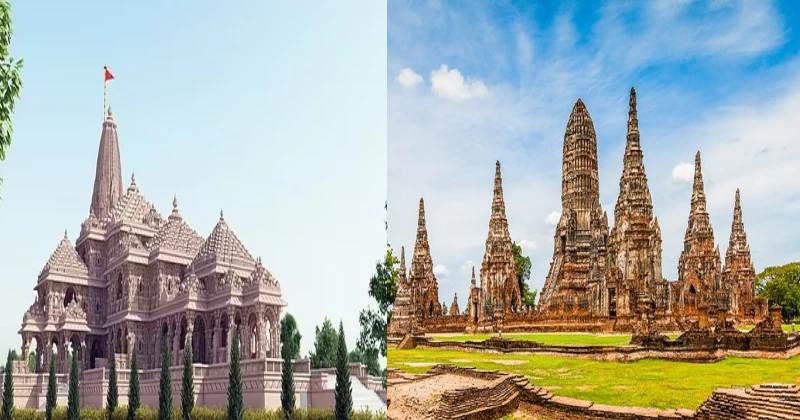
Ayodhya in India and Ayutthaya in Thailand are separated by about 3,500 kilometres in two different countries, but it is Bhagwan Ram which binds these two nations and its people together. Bhagwan Ram is central to the people of both the countries.
The kingdom of Siam (Thailand) was established in the first half of the 13th century. Ayutthaya, around 70 kilometres north of Bangkok, became the most important city and capital of the kingdom of Siam.
The word Ayutthaya has its roots in Ayodhya, the birthplace of Bhagwan Ram. Ayutthaya indicates the influence of Hinduism in the region and is associated with ‘Ramakien’, the Thai version of The Ramayana.
King Ramathibodi is said to be the first king of the kingdom of Ayutthaya and had named this city. The name of King Ramathibodi also shows the influence of the Ramayana. It is said that Royal rituals were based on Hindu Vedic scriptures and the Royal household adopted the religious-political ideology that had been embodied by Bhagwan Ram as mentioned in the Ramayana.
King Rama I the founder of the reigning Chakri dynasty of Siam, when he ascended to the throne in 1782, he took the name of Ramathibodi just like the founder of the Ayutthaya Kingdom. Since then, all the Kings of Thailand carry the name Rama.
The Ramayana was brought to Southeast Asia by the Buddhist missionaries. A Thai version is said to have been written during the Ayutthaya Kingdom. Later King Rama I compiled the first version of the Ramakien that is recognised today.
In fact, Bhagwan Ram is so entrenched in Thai culture they are even sending soil from Ayutthaya to Ram Janmabhoomi in Ayodhya, where the Mandir complex will be inaugurated in January 2024. The initiative was taken by the Vishva Hindu Parishad and the World Hindu Foundation.
“We have identified 51 countries that will witness Bhagwan Ram ‘s consecration at Ayodhya. Susheelkumar Saraf and I will be also be present in Ayodhya” says Swami Vigyananda of the World Hindu Foundation.
This act of sending soil followed the earlier gesture of sending water from two rivers in Thailand to Bhagwan Ram’s Mandir in Ayodhya. These are yet again clear signs how close these two countries are as far as their cultural heritage is concerned. The similarities do not stop here. As India celebrates Kartik Poornima and Dev Deepawali, Thailand also marks Loy Krathong, known as Thailand’s festival of lights. In prominent places, idols of Shiva, Parvati, Ganesha, and Indra, among others, are installed, where people pay their devotion.
The historic city of Ayutthaya flourished from the 14th to the 18th centuries, during which time it grew to be one of the world’s largest urban areas and a centre of global diplomacy and commerce. The city was attacked and razed by the Burmese army in 1767 who burned the city to the ground and forced the inhabitants to abandon the city. The city was never rebuilt, and remains known today as an extensive archaeological site.
The Ayutthaya school of art showcases the creativity of the Ayutthaya civilization as well as its ability to assimilate a multitude of several foreign influences. All buildings were elegantly decorated which consisted of an eclectic mixture of traditional styles surviving from Sukhothai, inherited from Angkor, and borrowed from the art styles of Japan, China, and India among others.
Dr Suresh Pal Giri, and Indian who has been residing in Thailand for 22 years and teaches at a Religious University says “The land on which you are standing is a part of the missing link of India. For some years, it was called Thailand, it is genetically Hindu and later with time, elements of Buddhism kept coming into Hinduism and it got mixed. There is a Brahma Vishu and Shankar Mandir 35 kilometres from this place which is about 1,000 years old. Another Mandir, some 300 kilometres from this place, there is a 3,000 years old Hindu Mandir, which was believed to be built by then Indian kings. You feel like being in your country when you are here in Thailand. But with times, things are changing. It is well documented, the King of Thailand is called Ram – Ram I, Ram II, Ram III and now Ram X, who is ruling the country. Ram Rajya is what both the countries want.”
Priyanka Shenoy, an Indian origin Singapore resident, says coming to Ayutthaya made her feel closer to her religion and culture.
“Honestly, it feels very nice how the culture has spread so far, and I think the most important part is no one forced them to adopt this culture. It was kind of soft power, and they made it part of the life. If you see normal Thai life, so many similarities with the Hindu way of living…no one put a gun to their head and say do this,” Chenoy says. “This place is very serene; I think this makes you feel closer to your dharma (religion).”
Sanjay Kumar Arya, originally from Delhi but staying in Singapore for 25 years and was in Thailand as a tourist says, “I have been to Ayodhya and I proudly say I am a Karsevak. I have come here to check out what are the differences or similarities between both the places. The Ayutthaya has become developed for 200 years now. But the Ayodhya in India is thousands of years old. I have learnt that King of Thailand has been a devout follower of Bhagwan Ram.”
Urmila Sharma, another Indian origin Myanmar resident, who was visiting Ayutthaya, says, “The biggest similarity between our Bhagwan Ram and the kings of Thailand is that both sacrificed a lot. They even sacrificed their kingdom for their brother. So many of our Karsevaks have laid down lives to bring back the glory of Bhagwan Ram in Ayodhya, and now it should be our endeavour to bring back Ram Rajya in India and bring to light a new Ayodhya,” she adds, hailing Bhagwan Ram with ‘Jai Shri Ram’ chant.
When the Burmese army burned the city of Ayutthaya to the ground, many of its stone Mandir and Buddhist monasteries survived. The structural design of the Mandir and monuments in Ayutthaya are a mesmerizing mixture of Hindu influenced and the Sukhothai style, that closely resemble the ruins of Angkor Wat.
Paresh Sharma, a tourist visiting Ayutthaya, feels it is important to preserve your history, “My experience is mostly about conservation and I feel really upset about what happened in its history. This place really highlights what is important to you must be preserved and there should be a sense of security in what matters to you.”
Bajrang Sharma, an Indian origin person but born in Myanmar, says “I am closely connected with the Hindu faith and culture. Every individual staying in Ayutthaya has Bhagwan Ram in her heart. People here in Thailand worship their King like Bhagwan Ram, and kept the Bhagwan Ram deeply etched in their hearts. There are those who have faith in Bhagwan Ram and those not do not. But in the case of Thailand, there is not a single individual who oppose the idea of Bhagwan Ram. It is my dream that India should also follow the model of Thailand and bring Ram Rajya in the country.”
Vivek Tiwari, a Bhopal resident who was in Thailand as a tourist says that Bhagwan Ram is central to faith and heritage in both countries. “Taking the name of Bhagwan Ram is equal to taking names of thousand other gods or goddesses. When we come to Thailand and visit this place called Ayutthaya and see the Mandir, we get to know how vast the geographical limit of Hindu kingdom. People having faith in Ram, and who worship him live both in India and Thailand. India has always followed the path of Vasudev Kutumbakam (the world is one family). Bhagwan Ram is above politics, and Bhagwan Ram is central to our faith and our heritage.”
The two cities of Ayodhya and Ayutthaya are once again poised to re-kindle the centuries old bond when soil from Ayutthaya reaches Ayodhya Janmabhoomi Mandir.
Swami Vigyananda of the World Hindu Foundation says “India and Thailand have a strong cultural and historical bond. Kings belong to Bhagwan Ram’s descendants. Every king here too has the title of Ram in their name which is an old tradition here, he said. Bangkok in Thailand is part of the Asian southeast country where rich Hindu cultural heritage exists.”
The holy ceremony for the consecration of the Ram Mandir in Ayodhya on January 22, 2024 is also expected to be broadcast live in Bangkok and Hindus from across the globe will converge at the event, engaging in kirtans, bhajans, puja, and recitation.
“We have ordered prasad from Ayodhya. A replica of the Ayodhya Mandir has been built here. We have also brought an image of the birthplace of Ram Lalla from Ayodhya. Copies of the image will be shared with all the delegates (attending the conference). The festive ambience in Ayodhya ahead of the consecration of the Ram Mandir should be spread across the world,” says Swami Vigyananda.
As the world awaits the consecration of the Holy Mandir at the birthplace of Bhagwan Ram, Ayutthaya is a reminder of the glory of the kingdom of Bhagwan Ram and his teachings. The teachings and traditions that travelled far to reach Ayutthaya and left a deep imprint on Thai society forever.
(with inputs from ANI)