





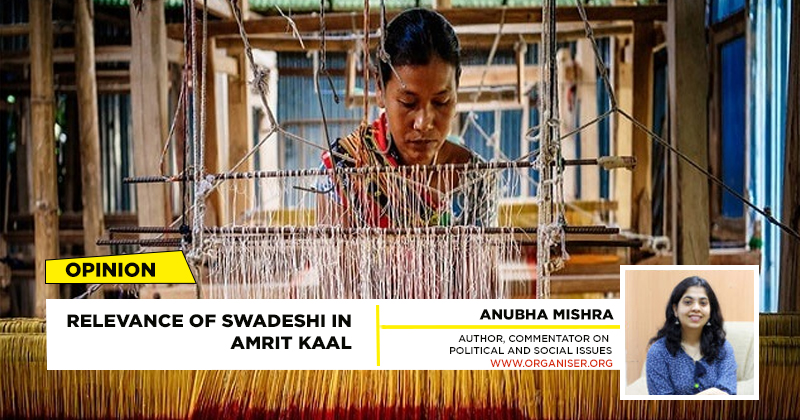
It is important to understand how we view this great movement that started in the early 20th century in its 75th year and what role it can play in making the 100th year of independence a golden age for India.
The History of handloom in India dates back to the Indus Valley Civilization; the Indus Valley farmers were the first civilisation to spin and weave cotton. In 1929, archaeologists found pieces of cotton cloth in Mohenjo-Daro (Pakistan), which were dated between 3250 and 2750 BC. Apart from this, cotton spinning and weaving are also mentioned in Vedic texts written between 1500 and 1200 BC. India’s handloom industry is extremely huge and is also thousands of years old. Evidence of this claim is found from Ramayana to Mahabharata.
Some evidence also suggests that the Indian handloom industry is approximately 5,000 years old; that is, handlooms have been in use in the country for the last 5000 years. India also has a history of exporting handloom clothes to some big countries, evidence of which is found in the Weaving technique of Ikat patterns of Odisha and the Southeast Asian country Indonesia. Similarly, the nearly 2000-year-old paintings from Ajanta (in Maharashtra) demonstrate weaving, fabric embellishment techniques and motifs that are still in use in India today, such as the Kantha in Bengal and the Bandhani of Gujarat and Rajasthan.
Weaving survived in India despite so many foreign invasions, brutal colonial rules and economic oppression. Under Hindu rulers, weavers had the status of an artist. According to the Arthashastra they had their own guilds or categories and even the king had to treat the weavers’ guilds with due respect. Islamic invasions destroyed the autonomy of the weavers. The weavers remained mere daily wage labourers, but the Muslim rulers also encouraged new textiles like ‘Mulmul’, ‘Banarasi Brocade’ and ‘Jamavar’. By the 17th century, India produced 25% of the world’s textiles, with Bengal accounting for more than 50% of the textiles and 80% of the silk imported by the Dutch from Asia.
The decline of India’s handloom industry began in the 19th century when it was systematically exploited by the British. The British rule left no stone unturned to destroy the handloom sector of the country. Britain imported cotton from India at cheap rates and dumped machine-made clothes from Manchester mills into India. The British authorities brought machine-made cotton into the country and forced the weavers to stop their production. Due to this reason, the source of income of many weavers of the country had stopped. Gradually the handloom industry was replaced by synthetic clothes.
In India, there has always been a tradition of making one’s own cloth and this skill has been passed down from generation to generation, from mother to daughter and from father to son. People used to make cloth from cotton using the charkha. In every village of India, weavers used to make sarees, dhoti etc. by hand for the people living in the village using small equipment like charkha, which was abolished by the British with their colonial policy.
The Swadeshi movement, started in the early 20th century, was a direct result of the British Indian government’s decision to partition Bengal and the use of indigenous goods and boycott of foreign-made goods were the two main objectives of this movement. Swadeshi was the first 20th century movement in India that encouraged widespread participation of a large section of the society in modern nationalist politics, and for the first time, women also came out of their homes and became part of a mass movement on such a large scale, which encouraged every Indian to use the charkha and spin his/her own yarn and this one step made a huge impact on the economy of that time and shook the foundation of the British rule.
In 1918, Mahatma Gandhi introduced Khadi for the people of undivided India with the aim of achieving self-reliance and becoming free from British textiles. Originating from the word khaddar, khadi refers to hand-woven cotton fabric, which emerged as a powerful symbol during India’s struggle for independence. The Khadi movement was a socio-cultural initiative coupled with nation’s collective call for economic independence, a means of providing livelihood to rural communities and a medium to preserve our craftsmanship. Even nowadays the dominance of power-loom sector has adversely affected the handloom sectors due to many reasons. Due to shortage of high quality cotton and along with this the rise of the mill also gave a big blow to the handloom sector in independent India.
Another reason would be due to the rising prices of natural fibres, the common man is less interested in purchasing it. With the speed with which synthetic fibres started making their place in the Indian market, weavers also started adopting synthetic fibres like polyester with time. Polyester is known to create water waste, leading to water pollution and it is a well-known fact that the global fashion industry contributes about 10% to global greenhouse gas emissions due to its supply chains and energy intensive production. Henceforth, Prime Minister’s clarion call of mission LiFe (lifestyle for environment) should reach the common people as it has become need of the hour.
In Present time, when we talk about vocal for local and self-reliance, we should know that the handloom industry has economic, social and cultural significance. Handloom is one of the largest employment providers after agriculture in India. This sector in the country provides employment to 43.31 lakh persons associated with about 23.77 lakh handlooms of which more than 70% of handloom weavers and allied workers are women. It is no exaggeration that the handloom sector is the key to the economic and social empowerment of women, which will not only provide economic progress to them and the country but will also give impetus to the development of the country’s glorious cultural heritage.
The element of arts and crafts present in Indian handloom makes it a potential sector for the upper fashion consumer of domestic and global market. However, the sector is beset by many problems like obsolete technologies, unorganized production system, low productivity, inadequate working capital, traditional product range, weak marketing links, overall stagnation in production and sales and above all, competition from power loom and mill sector. It is also imperative to understand that the post-Covid situation has put us at a crossroads where the world powers are moving towards de-globalization, so it is important for India to protect its interests and not only remain a consumer market for the world powers but also reserve its chair in the global politics. As a result, of effective government intervention through financial assistance and the implementation of various developmental and welfare schemes, the handloom sector has, to some extent, been able to overcome these losses but much remains to be done.
Weaving cloth is so embedded in our culture that many of the terms associated with this craft, such as sutra (thread), tantra (weaving), guna (individual thread), are still used to explain esoteric philosophical and spiritual concepts. In the Gita, Lord Krishna explains the concept of rebirth using the metaphor of the soul discarding an old body in the same way one discards old, worn-out clothes. Handloom weaving is a noble craft and essential for the future of the planet. Despite so much political turmoil, despite so many attempts to destroy it, handloom weaving has survived in India for thousands of years it is our responsibility not to let it die. Handloom weavers need respect and prestige from the countrymen more than they need proper salary and the kind of encouragement from government institutions which they enjoyed in ancient India.
In the end, when we enter 100th year of independence 25 years from now, let us do it with the mantra that handloom/Khadi should not be limited to a particular class but should be weaving a new story of the country’s glory in the world. Just as the Swadeshi movement in the last century had taught us to be self-reliant, now it is necessary to once again make Swadeshi a movement and keep it alive in our conscious minds and become self-reliant by taking pride in what is rightfully ours.





![A Representative image [ANI Photo]](https://organiser.org/wp-content/uploads/2025/12/representative-image-e1765612818961-120x70.webp)





Comments