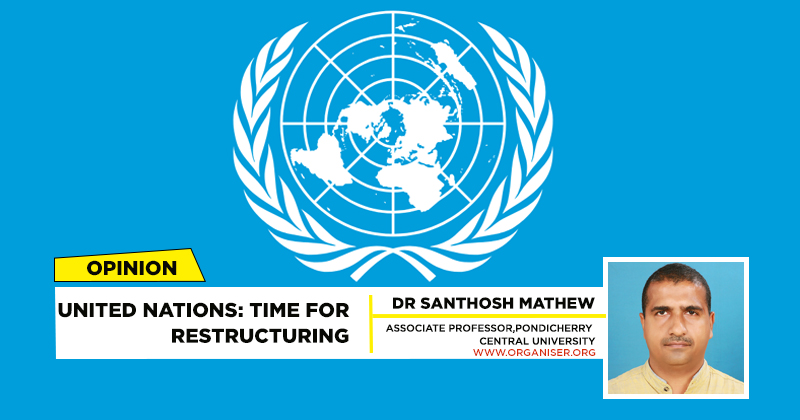
Dag Hammarskjold, the illustrious second Secretary-General of the United Nations , once profoundly articulated that the UN’s raison d’être was not merely to usher us into heaven, but rather to serve as humanity’s guardian against the abyss of hell. As the United Nations proudly celebrates its remarkable 75-year journey, it stands on the precipice of yet another year teeming with complex challenges and international disputes, demanding unwavering mediation and an indomitable will to stave off catastrophic calamities.
The lofty idealism that ignited the hearts of the League of Nations’ founding fathers, driven by an unswerving commitment to preventing large-scale warfare, tragically crumbled amidst the horrors of the Second World War. In the wake of this cataclysmic conflict, where pain and loss knew no borders, world leaders were resolute in their determination to forge a new order. They envisioned a fortified international organisation, empowered to vigilantly curtail belligerent behaviors and steadfastly safeguard global peace and security. Today, history echoes with an eerie resonance, for once again, a geopolitical landscape akin to yesteryear’s has taken shape. As the world grapples with prevailing power dynamics, reminiscent of the past, the imperative to prevent history’s grim repetition is both compelling and urgent.
The appellation ‘United Nations’ was born from the visionary mind of the 32nd President of the United States, Mr. Franklin Roosevelt, on that fateful day of October 21, 1942. Ironically, today, it is his successor who has cast a shadow of uncertainty over the United Nations standing by slashing its funding by a staggering 30 percent. This revision in financial support marks the latest in a series of blows dealt by the Trump administration to this revered international institution. In retrospect, over the past 75 years, the United Nations has weathered the tempestuous tides of global geopolitics, yet its resilience is now tested as the specter of financial crisis looms large.
The recently published Hunger Index paints a disquieting picture, further underscoring the challenges faced by the UN. The very essence of its mission—to alleviate poverty and provide sustenance and shelter—now stands in question, as the numbers starkly reveal a disheartening surge in deprivation. When President Trump assumed office, his paramount priority was to disentangle the United States from international agreements and organisations that he believed were siphoning away critical resources from his nation. The United States, a financial bulwark of the United Nations, contributes a substantial 27.8 per cent of the United Nations budget, and the subsequent 30 per cent funding cut has exacerbated an already fragile global landscape. In a move that reverberated across the world, President Trump announced in May his intent to sever all ties with the World Health Organisation (WHO), making it a convenient scapegoat for the Coronavirus pandemic. Meanwhile, a sweeping set of proposed regulations governing the use of elevators, vehicles, and electricity has cast a pall of uncertainty over the morale of the nearly 37,000-strong United Nations workforce, leaving them apprehensive about the future of their motivational incentives.
It is noteworthy that a staggering 85 per cent of the total United Nations budget is bankrolled by seven nations: the United States (27.89 per cent), China (15.21 per cent), Japan (8.56 per cent), Germany (6.09 per cent), Britain(5.78 per cent), France (5.61 per cent), and Italy (3.01 per cent). A sobering statistic considering the UN’s membership comprises a total of 193 countries, highlighting the precarious nature of its financial stability.
Since its inception, the composition of the United Nations Security Council (UNSC), has been a source of unease among member countries, particularly the developing Nations of the third world, often relegated to the sidelines or ignored altogether. The lexicon of power within the organization has crystallized around the concept of ‘permanent seats’ and the accompanying privilege of wielding the veto. This inherent flaw casts a long shadow, where the Security Council dictates terms and veto power wields disproportionate influence over decisions made by the General Assembly. A promising remedy to the United Nations challenges lies in a fundamental restructuring of the Security Council, one that acknowledges the burgeoning internationalism exhibited by regional organizations. In my perspective, it will be these dynamic coalitions or smaller groups of Nations that can champion transformation and secure peace and stability. A stable environment is the cornerstone upon which enduring peace is built, and it is incumbent upon the UN to provide this conducive atmosphere for peace to flourish.
Enter the G4 coalition, composed of India, Japan, Germany, and Brazil, all fervently advocating for an expanded Security Council. These Nations unite, not only in their pursuit of greater influence but in their collective aspiration for a more robust and responsive Security Council. As it stands, the UNSC, the linchpin in international peace and security, remains in the tight grip of five permanent members — the US, UK, France, China, and Russia— each armed with the formidable veto power to thwart any Council decision. Reforms have been initiated to render the Council more representative, yet a deadlock persists. The crux of the matter is that four major powers — Germany, Japan, India, and Brazil — seem more vested in securing permanent seats than in addressing the overarching imperative of making the Council genuinely effective and pertinent in our contemporary world. Peace mediation, the very essence of the United Nations mission, has proven to be a formidable challenge throughout its history, despite its emergence as a global powerhouse. While financial and decision-making powers are often rooted in Western-led alliances, it’s intriguing that the United Nations most substantial peacekeeping force draws strength from contributions by Nations in the third world. The linchpin enabling the United Nation to simultaneously engage in peace operations and act as a mediator lies in the might of its peacekeeping forces. Remarkably, the UN possesses no standing army, and questions loom large when it seeks to resolve and mediate issues involving major powers who are also significant patrons of this global institution.
Among the leading contributors to the United Nation peacekeeping force are India, Pakistan, and Bangladesh, yet ironically, these Nations find themselves frequently overlooked and underserved. This paradox underscores a fundamental tenet of the United Nation’s existence: the principle of ‘Collective Security.’ Regrettably, this principle is often abandoned by many states and their leaders, transforming the ethos of ‘One for all and all for one’ into a more somber ‘For one, and if one so decides, then for all. A poignant example is the Afghanistan mission, United Nations Assistance Mission in Afghanistan (UNAMA) , in operation since 2002. Despite the tireless efforts of the UN, peace remains an elusive dream for the region and its beleaguered people. Lessons gleaned from the League of Nations’ failures, etched into the annals of history through watershed moments like the Washington, Yalta, Tehran, and San Francisco summits, underscore the steep price of peace and the imperative for global harmony. The United Nations, born from this crucible of experience, emerged as a beacon of hope, conceived to usher in an era of mutual and sustainable development for all its member states.
However, one must candidly admit that the idealistic notion that the shortcomings of the ‘Covenant’ could be rectified through a universally embraced ‘Charter’ has proven to be a disillusion. The United Nations, once envisioned as a paragon of international cooperation, now stands in chains, beset by lackluster performance and bereft of the requisite potency to defuse global conflicts. This glaring reality has not escaped the discerning eye of member states, leaving many to question the very essence of this grand international institution. The crux of the matter lies in the United Nations limited direct control over the very issues for which it was established. This sobering truth has spurred a growing chorus of voices, casting doubt upon the continued relevance and necessity of this venerable organisation on the world stage.
Lessons gleaned from the League of Nations’ failures, etched into the annals of history through watershed moments like the Washington, Yalta, Tehran, and San Francisco summits, underscore the steep price of peace and the imperative for global harmony. The United Nations, born from this crucible of experience, emerged as a beacon of hope, conceived to usher in an era of mutual and sustainable development for all its member states. However, one must candidly admit that the idealistic notion that the shortcomings of the ‘Covenant’ could be rectified through a universally embraced ‘Charter’ has proven to be a disillusion. The United Nations, once envisioned as a paragon of international cooperation, now stands in chains, beset by lackluster performance and bereft of the requisite potency to defuse global conflicts. This glaring reality has not escaped the discerning eye of member states, leaving many to question the very essence of this grand international institution. The crux of the matter lies in the United Nations limited direct control over the very issues for which it was established. This sobering truth has spurred a growing chorus of voices, casting doubt upon the continued relevance and necessity of this venerable organisation on the world stage.
The United Nations relevance today is beyond question, as the need for an international mediator and peace regulator remains indisputable. As the United Nations approaches its 77th anniversary, it’s crucial to reflect and learn. Our world grapples with multifaceted challenges, from poverty and terrorism to human trafficking and climate change. These issues transcend borders, demanding the collective cooperation of all Nations. The United Nations, with its 193 member states, representing the majority of sovereign states globally, serves as the pivotal platform to unite Nations, pooling their resources to address these pressing concerns. However, the UN’s current power dynamics, especially within the Security Council, continue to raise concerns. This permanent body holds sway over peace and security matters, with five Nations – China, France, the United States, the United Kingdom, and Russia – enjoying veto powers that can either advance or hinder progress, depending on their interests. Whether the UN remains true to its mission and its call for the betterment of humanity may ultimately hinge on a structural shift that accommodates the evolving demands of the third world.
The relentless spread of COVID-19 compelled millions into lockdown, wreaking havoc on economies worldwide. Now, as some countries confront a second wave, the 193-member United Nations faces its own set of challenges, grappling with a distrustful United States, an assertive China, and an escalating rivalry between the two. COVID-19 serves as a stark reminder of the imperative for cooperation that transcends borders, sectors, and generations. The United Nations response holds the key to the world’s recovery pace, the achievement of Sustainable Development Goals, and the effective management of pressing issues like climate change, inequalities, emerging forms of violence, and rapidly evolving technology and demographics.
Yet, at a time when collective action is paramount, global cooperation has waned. Trust in traditional institutions dwindles in many Nations, and international relations strain under pressure. The pivotal question arises: Will this pandemic unite the world or deepen mistrust? The need for global dialogue and action has never been more pressing. The United Nations, however, remains resoundingly relevant. It stands as a platform where Nations converge to address and resolve their shared challenges. It is not a World Government, nor a global police force. Instead, it serves as a valuable arena for forging consensus on preserving and fostering peace, tackling common concerns such as environmental degradation and pandemics, and offering advocacy and expertise in pursuit of development goals like the MDGs and SDGs.
Ultimately, the United Nations is a microcosm of our world. When we speak of the United Nations being “broken,” it’s not about the physical structure or its inner workings—it’s a reflection of the global landscape. Credit is due to India for consistently shaping its foreign policy around the principles enshrined in the United Nations Charter. India’s approach has been characterised by non-interference and a commitment to non-aggression against any state. In these turbulent times, a coalition of like-minded Nations, sharing faith in the UN Charter, can play a pivotal role in safeguarding the world from a potentially perilous future, one marked by unchecked major power rivalries. The United Nations Secretary-General Antonio Guterres underscores that the United Nations 75th anniversary presents a unique opportunity to actualise long-held aspirations, including accelerating the transition to a carbon-neutral world, ensuring universal access to healthcare, and addressing the scourge of racial injustice. As Guterres aptly puts it, we confront a pivotal moment akin to the world’s challenges in 1945. Unity, like never before, is the need of the hour—a collective resolve to surmount today’s emergencies, set the world in motion again, and hart a course toward shared prosperity and progress.