
‘One Nation, One Election’: Is India ready?
December 6, 2025
  • Read Ecopy
  • Circulation
  • Advertise
  • Careers
  • About Us
  • Contact Us
Android AppiPhone AppArattai
Organiser
  • ‌
  • Bharat
    • Assam
    • Bihar
    • Chhattisgarh
    • Jharkhand
    • Maharashtra
    • View All States
  • World
    • Asia
    • Europe
    • North America
    • South America
    • Africa
    • Australia
  • Editorial
  • International
  • Opinion
  • RSS @ 100
  • More
    • Op Sindoor
    • Analysis
    • Sports
    • Defence
    • Politics
    • Business
    • Economy
    • Culture
    • Special Report
    • Sci & Tech
    • Entertainment
    • G20
    • Azadi Ka Amrit Mahotsav
    • Vocal4Local
    • Web Stories
    • Education
    • Employment
    • Books
    • Interviews
    • Travel
    • Law
    • Health
    • Obituary
  • Subscribe
    • Subscribe Print Edition
    • Subscribe Ecopy
    • Read Ecopy
  • ‌
  • Bharat
    • Assam
    • Bihar
    • Chhattisgarh
    • Jharkhand
    • Maharashtra
    • View All States
  • World
    • Asia
    • Europe
    • North America
    • South America
    • Africa
    • Australia
  • Editorial
  • International
  • Opinion
  • RSS @ 100
  • More
    • Op Sindoor
    • Analysis
    • Sports
    • Defence
    • Politics
    • Business
    • Economy
    • Culture
    • Special Report
    • Sci & Tech
    • Entertainment
    • G20
    • Azadi Ka Amrit Mahotsav
    • Vocal4Local
    • Web Stories
    • Education
    • Employment
    • Books
    • Interviews
    • Travel
    • Law
    • Health
    • Obituary
  • Subscribe
    • Subscribe Print Edition
    • Subscribe Ecopy
    • Read Ecopy
Organiser
  • Home
  • Bharat
  • World
  • Operation Sindoor
  • Editorial
  • Analysis
  • Opinion
  • Culture
  • Defence
  • International Edition
  • RSS @ 100
  • Magazine
  • Read Ecopy
Home Bharat

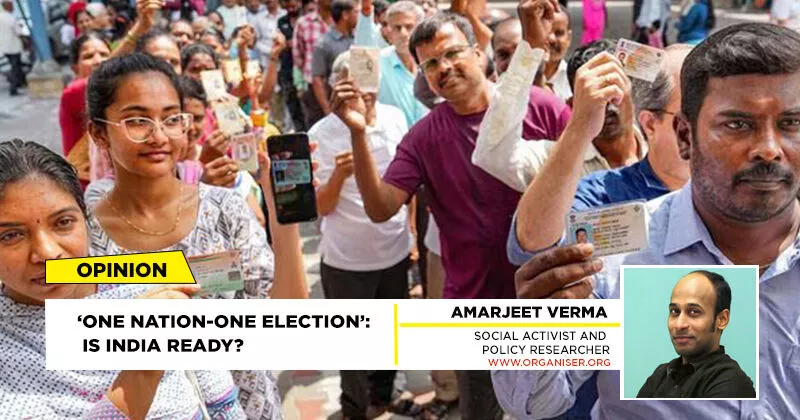
‘One Nation, One Election’: Is India ready?

The ‘One Nation - One Election’ initiative seeks to harmonise elections at the national and state levels, limiting the frequency of referendums and allowing central and state governments to focus on sustainable governance initiatives

Amarjeet VermaAmarjeet Verma
Sep 4, 2023, 08:15 pm IST
in Bharat, Opinion
Follow on Google News
Amarjeet Verma, One Nation One Election

"The concept of ‘One Nation - One Election’ in a diverse nation like India is both promising and challenging. It offers a myriad of benefits, including cost savings, better governance and greater voter engagement," writes Amarjeet Verma

FacebookTwitterWhatsAppTelegramEmail

Elections are the lifeblood of a democracy, and the manner in which they are conducted serves as a profound reflection of a nation’s democratic values. The recent formation of a Union Government panel to examine the feasibility of ‘One Nation – One Election’ has once again sparked a nationwide discourse in India. Although not entirely new, India had previously held both central and state elections simultaneously from 1951 to 1967. However, due to premature state assembly dissolutions, this practice lapsed and was gradually forgotten.

Presently, the Modi Government’s renewed support for ‘One Nation – One Election’ seeks to revive the historic electoral system. This report explores its historical context, potential benefits, challenges and impacts and highlights the need for a thoughtful and constructive debate on this major electoral reform.

A deeply diverse nation comprising 28 states and eight union territories, India remains constantly immersed in election campaigns. Every election, including those in union territories like Puducherry, is often seen as a verdict on the Government of India. This perpetual election cycle can prevent the government from addressing long-term challenges and development goals. The ‘One Nation – One Election’ initiative seeks to address this problem by harmonising elections at the national and state levels, limiting the frequency of referendums and allowing central and state governments to focus on sustainable governance initiatives.

Pros of ‘One Nation-One Election’

  • Cost savings: One of the most significant benefits of this system is the significant cost savings. Conducting elections is a costly affair, and synchronising them would result in significant savings. The 2019 general election cost India approximately 60,000 crores rupees. These funds could be redirected to essential development projects and initiatives.
  • Efficient use of resources: The system would ensure proper deployment of security forces during elections and reduce the burden on these vital resources. It would also allow for better disaster management planning as election-related disruptions would be minimised. For example, in 2019, India alone experienced seven elections in a year, which put a strain on officials.
  • Long-term governance: With synchronised elections, governments would have longer terms of office, allowing for better planning and implementation of long-term projects. Frequent elections often lead to a focus on short-term populist measures to secure votes.
  • Productivity and stability: Government employees would benefit from fewer election holidays, leading to increased productivity. Moreover, a stable government resulting from simultaneous elections would instil investor confidence and promote economic stability.
  • Better Administration: Senior Government officers would have more time to formulate policy and implement projects, leading to more efficient administration. Continuity of leadership would reduce political upheavals associated with elections driven by leadership changes.
  • Increased voter engagement: A single-election event would make it easier for citizens to exercise their right to vote, which could increase voter turnout and political participation.
  • Reduction of electoral malpractices: Simultaneous elections could help reduce the number of fraudulent voters and electoral malpractices as there would be a more efficient & strengthened process.

Cons of ‘One Nation – One Election’

  • Anti-Incumbency: ‘One Nation – One Election’ can lead to a high anti-incumbency factor, especially when both the central and state governments are from the same party or alliance. Voters may be inclined to vote against the incumbent in either election, which could lead to significant policy changes.
  • Hung Parliament/ Legislature: India’s parliamentary setup often results in hung parliaments or legislatures where no party can form a government. In such cases, frequent elections may be necessary, disrupting the ‘One Nation – One Election’ cycle.
  • Complexity of Transition: Transitioning to ‘One Nation – One Election’ would be a complex process involving legal, logistical and administrative issues. Constitutional amendments may be needed, and state governments may be reluctant to give up their power to set election schedules.
  • Political opposition: The opposition parties have not shown a unanimous willingness to discuss and implement this reform. Their concerns and reservations need to be addressed through constructive dialogue.

Challenges Ahead

The concept of ‘One Nation – One Election’ in a diverse nation like India is both promising and challenging. It offers a myriad of benefits, including cost savings, better governance and greater voter engagement. However, challenges such as transition complexity and political opposition need to be carefully considered. As India grapples with a perpetual electoral cycle, it is essential to engage in a rational and open debate on this electoral reform.

The Modi Government should not only support this initiative but also engage in constructive discussions with the opposition parties and related stakeholders. In addition, the government should take this message to the grassroots level, explaining the benefits and addressing the concerns of every citizen. This participatory approach can help bridge the gap and pave the way for meaningful electoral reforms.

Ultimately, the question remains: Can India, with its vast diversity and complex political landscape, successfully implement ‘One Nation – One Election’? While it represents a promising solution to many of the challenges associated with frequent elections, the road to achieving it will undoubtedly be fraught with obstacles. Nevertheless, it is a conversation worth having for the sake of the nation’s progress and democratic vitality.
Topics: Narendra ModiGovernment of IndiaOne Nation One Election
Amarjeet Verma
Amarjeet Verma
Amarjeet Verma is a remarkable, differently-abled, passionate social activist, policy researcher and thinker who exudes resilience and determination. With a distinguished background as a management graduate and corporate professional, he gracefully intertwines his expertise with his passion. Through his regular contributions to various digital news and magazine platforms, he amplifies voices that deserve to be heard, captivating hearts and minds along the way! [Read more]
Share1TweetSendShareSend
✮ Subscribe Organiser YouTube Channel. ✮
✮ Join Organiser's WhatsApp channel for Nationalist views beyond the news. ✮
Previous News

India’s G20 Presidency: A Voice of the Global South

Next News

Uttar Pradesh: Minor killed self after Shavez Rizvi shared nude clip on social media; Case registered, accused arrested

Related News

“Inspiration for millions”: PM Modi gifts Russian edition of Bhagvad Gita to Putin

A representative image

‘One Nation, One Election’ gets constitutional green signal from law commission

Representative image

India to conduct Census 2027 in two phases, marking first digital survey with caste enumeration after 70 years

From Power to Service: PMO becomes ‘Seva Teerth’ as India shifts focus on governance with citizen-first vision

Indian Prime Minister Narendra Modi and Russian President Vladimir Putin attend a ceremony in Moscow on July 9, 2024 (Representative image)

Putin-Modi summit to focus on trade, manpower pacts; MEA rules out Russia-India-China talks

PM Modi hails global acceptance of Gita Mahotsav in Mann ki Baat; 70 lakh devotees take part in celebrations

Load More

Comments

The comments posted here/below/in the given space are not on behalf of Organiser. The person posting the comment will be in sole ownership of its responsibility. According to the central government's IT rules, obscene or offensive statement made against a person, religion, community or nation is a punishable offense, and legal action would be taken against people who indulge in such activities.

Latest News

PM Modi presents Putin with Bhagavad Gita, chess set, and silver horse

Cultural ties strengthened: PM Modi presents Putin with Bhagavad Gita, chess set, and silver horse

Image for representational purpose only, Courtesy Vocal Media

Bihar to get ‘Special Economic Zones’ in Buxar and West Champaran

Thirupparankundram Karthigai Deepam utsav

Andhra Pradesh: AP Dy CM Pawan Kalyan reacts to Thirupparankundram row, flags concern over religious rights of Hindus

23rd India-Russia Annual Summit

India-Russia Summit heralds new chapter in time-tested ties: Inks MoUs in economic, defence, tourism & education

DGCA orders probe into IndiGo flight disruptions; Committee to report in 15 days

BJYM leader Shyamraj with Janaki

Kerala: Widow of BJP worker murdered in 1995 steps into electoral battle after three decades at Valancherry

Russian Sber bank has unveiled access to its retail investors to the Indian stock market by etching its mutual fund to Nifty50

Scripting economic bonhomie: Russian investors gain access to Indian stocks, Sber unveils Nifty50 pegged mutual funds

Petitioner S Vignesh Shishir speaking to the reporters about the Rahul Gandhi UK citizenship case outside the Raebareli court

Rahul Gandhi UK Citizenship Case: Congress supporters create ruckus in court; Foreign visit details shared with judge

(L) Kerala High Court (R) Bouncers in Trippoonithura temple

Kerala: HC slams CPM-controlled Kochi Devaswom Board for deploying bouncers for crowd management during festival

Fact Check: Rahul Gandhi false claim about govt blocking his meet with Russian President Putin exposed; MEA clears air

Load More
  • Privacy
  • Terms
  • Cookie Policy
  • Refund and Cancellation
  • Delivery and Shipping

© Bharat Prakashan (Delhi) Limited.
Tech-enabled by Ananthapuri Technologies

  • Home
  • Search Organiser
  • Bharat
    • Assam
    • Bihar
    • Chhattisgarh
    • Jharkhand
    • Maharashtra
    • View All States
  • World
    • Asia
    • Africa
    • North America
    • South America
    • Europe
    • Australia
  • Editorial
  • Operation Sindoor
  • Opinion
  • Analysis
  • Defence
  • Culture
  • Sports
  • Business
  • RSS @ 100
  • Entertainment
  • More ..
    • Sci & Tech
    • Vocal4Local
    • Special Report
    • Education
    • Employment
    • Books
    • Interviews
    • Travel
    • Health
    • Politics
    • Law
    • Economy
    • Obituary
  • Subscribe Magazine
  • Read Ecopy
  • Advertise
  • Circulation
  • Careers
  • About Us
  • Contact Us
  • Policies & Terms
    • Privacy Policy
    • Cookie Policy
    • Refund and Cancellation
    • Terms of Use

© Bharat Prakashan (Delhi) Limited.
Tech-enabled by Ananthapuri Technologies