





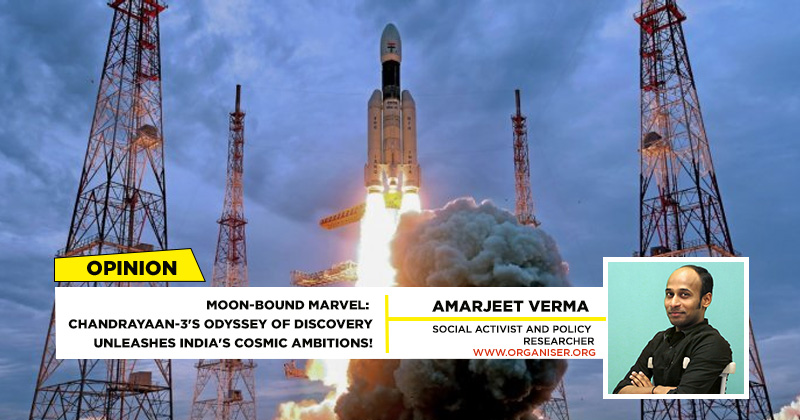
The Countries that ventured into the vast seas and explored in the Middle Ages held a dominant position on the world stage for a long time. Driven by curiosity and ambition, these nations expanded their territories, established trade networks, and amassed great wealth and power. Today, their enduring legacy is evident in their advanced civilizations and thriving economies. However, as we look ahead into the future, it is increasingly clear that the next frontier of exploration lies in ‘Space’. The Earth leading the way in space exploration will undoubtedly have a significant impact not only on Planet Earth but also on celestial bodies such as the Moon and Mars. India’s recent successful launch of the ambitious space program “Chandrayaan-3” is a remarkable testament to our future-readiness and a source of immense pride. We are ready to shape the destiny of humanity as we venture beyond our home planet, the Earth.
On 14 July 2023, the Indian Space Research Organization (ISRO) achieved a major & most anticipated milestone with the successful launch of Chandrayaan-3, the follow-up mission to Chandrayaan-2. The purpose of this mission is to demonstrate India’s end-to-end capabilities in safely landing and roaming on the lunar surface.
Chandrayaan-3 consists of a Lander and Rover configuration and its launch from the Satish Dhawan Space Center at Sriharikota captivated not only India but the entire world. The primary objectives of the Chandrayaan-3 mission, as outlined by ISRO, are threefold. First, it aims to demonstrate the capability of a safe and soft landing on the lunar surface and learn from the lessons of the partial failures of Chandrayaan-2. This goal is of immense importance as it aims to establish India’s expertise in precision landings on the moon. Second, Chandrayaan-3 seeks to demonstrate the rover’s capabilities for lunar roaming. The mission will test the rover’s mobility and functionality on the lunar surface, paving the way for future exploration and resource exploitation. Finally, Chandrayaan-3 aims to conduct in-situ science experiments. By analyzing the lunar environment, studying the composition of the Moon, and collecting valuable data, this mission will contribute to expanding our knowledge of the Moon and its resources. Scientific discoveries made during this mission have the huge potential to influence future lunar exploration efforts.
The launch of Chandrayaan-3 builds on the success and experience of its predecessor, Chandrayaan-2. In 2019, Chandrayaan-2 grabbed global attention when it successfully placed the Vikram lander and the Pragyan rover near the Moon’s South Pole. This achievement marked a significant milestone in India’s space history and highlighted the country’s capabilities in space exploration. However, Chandrayaan-2 also faced partial setbacks when the Vikram lander made an emergency landing while attempting a soft landing. Despite this unfortunate event, the mission was still recognized for its achievements as it demonstrated the technical capabilities of the Indian space program and the nation’s commitment to lunar exploration. Chandrayaan-3 is developing positively since the last update. The spacecraft is in normal health and has successfully completed the first of five planned orbit-raising maneuvers.
The successful launch of Chandrayaan-3 has garnered global attention, with the world closely following India’s progress in space exploration. The launch puts India on the verge of becoming the fourth country to successfully land a spacecraft on the moon, joining the ranks of the United States, Russia and China. It is a testament to India’s growing importance in the international space community. ISRO’s achievements go beyond the Chandrayaan mission. Over the years, ISRO has built a reputation for executing missions with precision, economy and reliability. The Mangalyaan Mission, also known as the Mars Orbiter Mission, proved ISRO’s expertise by successfully entering the orbit of Mars on its maiden attempt in 2014. This achievement made India the first country to achieve this feat on its maiden attempt and earned worldwide recognition for ISRO.
Looking ahead, ISRO’s ambitious plans for future lunar exploration, including the upcoming Chandrayaan-3 mission and the proposal for a mission to the lunar south pole, underscore India’s commitment to expanding our understanding of the Moon. In addition, the development of their own space station and the goal of sending astronauts into space by 2025 cements India’s position as a leading space nation. The successful launch of Chandrayaan-3 not only showcases India’s lunar exploration capabilities but also strengthens its global position in space science and technology. As India moves closer to becoming the fourth country to land a spacecraft on the moon, the world is watching with anticipation. This landmark achievement not only inspires future generations, but also paves the way for further advancements in space exploration. India’s space age has undoubtedly arrived.















Comments