





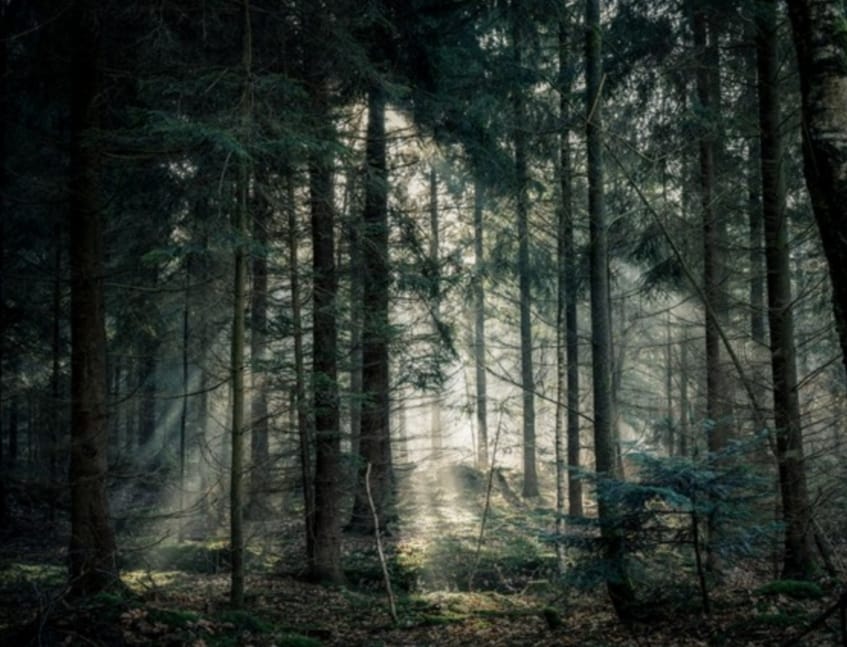
America’s woodlands are headed for a difficult time. Climate change is raising temperatures and lowering moisture levels across the country, which is bad news for trees.
Researchers at UC Santa Barbara and University of Utah sought to determine how our sylvan ecosystems might fare in the near future.
The authors combined mathematical models and data collected by the US Forest Service and plant physiologists to understand the vulnerability of woodlands to drought. Their findings suggest that, while most forests have the potential to adapt to hotter, dryer conditions, they aren’t changing quickly enough to avoid the impending stress. The study, published in Global Change Biology, serves as a benchmark for future forest research, as well as a guide for conservation and management. “We were concerned to find that forests were not changing fast enough to avoid increased water stress due to climate change,” said first author Greg Quetin, an assistant project scientist in the UCSB Department of Geography. “But there is hope, as most forests in the continental U.S. contained enough functional diversity to increase their drought tolerance through shifts in species composition.”
There are a few ways forests can adapt to drier conditions. Individual trees can alter their activity, physiology and gene expression to the new conditions they face. Drought-tolerant species already present in the ecosystem can also become more dominant. The forest composition can change as well, with hardier species migrating in as more vulnerable species die off. Evolution can also change species via natural selection, although the effect will be negligible over the next century for such long-lived organisms.
Greg Quetin and his co-authors investigated whether the traits and species already present in the country’s forests are sufficient for them to acclimate to future climate change without widespread mortality. Much of the data came from the Forest Inventory and Analysis program, a comprehensive database run by the US. Forest Service on the state of the country’s woodlands that has been standardized since the year 2000. This database includes forest inventory plots that document location, species, size, density and health of trees, as well as tree growth, mortality and harvesting. Greg Quetin and his colleagues also used data from the Xylem Functional Traits Database, where measurements of tree physiology and hydraulic traits are compiled, cross-referencing this database with the Forest Inventory.
Finally, the team developed a model that simulates a forest’s response to increased water stress. The model predicts photosynthesis (or CO2 in), respiration and growth (CO2 out), as well as plant stress. They also included an optimization technique to look at how changes to leaf area could mediate the stress caused by changing environmental conditions.
“All the data to date suggest that leaf area is just the biggest lever that individual trees can throw to manage water stress,” said co-author Lee Anderegg, an assistant professor in the Department of Ecology, Evolution, and Marine Biology. Forests in drier areas tend toward sparser canopies, while forests in wetter climes can afford thick foliage.
The researchers found that many of America’s forests have the capacity to adapt. The model revealed that 88% of the forests across the continental US have the trait and species diversity to acclimate to climate change, and they are starting to. However, most weren’t adapting as quickly as the model predicted was necessary to avoid increased water stress and subsequent mortality.
“It’s concerning that we don’t see the required shifts that our model predicts need to happen,” said co-author Anna Trugman, an assistant professor in the Department of Geography. “But I think there’s still room for hope.” For instance, biodiversity stood out in its ability to buffer the impact of climate change on a given forest.
“Trees are slow movers, as we know,” Trugman continued. “I’ve seen the pace of those Ents in ‘The Lord of the Rings.'”
“They’re still holding the Entmoot at the moment,” Anderegg added. Higher carbon dioxide concentrations introduce a confounding factor in the team’s calculations. Plants lose water through the same pores that they use to take up carbon dioxide. So if there’s more CO2 in the atmosphere, plants can decrease the size of these pore openings and still acquire the carbon they need for photosynthesis. This reduces the amount of water escaping from their leaves.
But the atmosphere is also dryer in a warming climate, Anderegg explained, so leaves lose more water. It’s a complex system with a lot of uncertainty and compensating factors, which requires nuanced models to disentangle. And the energy involved in transporting this water is far from negligible, as the authors discovered in a previous paper.
The team is now collecting their own data on changes in tree physiology following climate-driven fires in Sequoia National Park, trying to empirically verify how much trees can adjust their physiology.
The authors are also investigating if trees can avoid future water stress entirely through changes to their leaf area, and whether maximizing carbon gain or stress avoidance is more limiting.
Forests are already beginning to change. Sparser canopies will become more common as the atmosphere becomes drier. Woodlands will also likely have a different mix of species than they historically had. These factors all impact forest carbon storage as well. Forests currently sequester about 30per cent of anthropogenic emissions, but the group recently found that this would likely decrease under climate change.
Management strategies that encourage forests to adapt will be critical. “We need to be thinking about these forests not as static things — that need to exist just as they are right now — but as healthy things that need to change to keep up with the climate,” Anderegg said.
Facilitating gradual change will help prevent abrupt, catastrophic changes, like wildfires and die-offs, that are detrimental to the forests, wildlife and people living nearby.
Resource managers could begin planting areas with more drought-tolerant species and conducting prescribed burns to promote healthy woodlands. But most of all, we need to mitigate climate change, the authors said.
Our future depends on society’s emission trajectory. Climate adaptation is no easier than climate mitigation, Quetin noted. And less climate change means less adaptation is necessary.
(with inputs from ANI)
















Comments