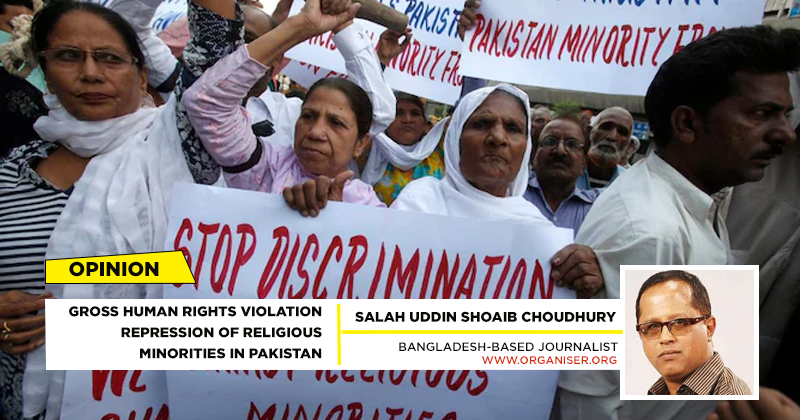
Despite constitutional guarantees of freedom of religion, religious minorities in Pakistan face severe discrimination, persecution, and gross human rights violations as the country’s founding principles are to prioritise Islam and Sharia rule, thus considering non-Muslims as infidels and violating their fundamental rights. The most alarming fact is one of the key principles of Pakistani state machinery is to promote and patronise militancy and terrorism with the dangerous agenda of terrorising neighbouring India in particular.
At the same time, the country has been actively involved in maintaining links with radical Islamic outfits in neighbouring Afghanistan, using the ‘Afghanistan’ card to blackmail Saudi Arabia, China and other nations and extorting financial benefits. Following the 9/11 terrorist attacks on US soil, Pakistan became America’s key ally in its war on terror, which had turned into a “milking cow” to Pakistani state machinery, particularly its intelligence agency, and Islamabad has succeeded in extorting billions of dollars both from the United States and Saudi Arabia by using Afghan Taliban and Al Qaeda as scare-crow.
Pakistan’s state patronisation of terrorism
Pakistan has long been accused of providing state patronisation to terrorist organisations within its borders and the region. This phenomenon has had far-reaching consequences for regional stability, counter terrorism efforts, and the security of neighbouring countries. This article describes Pakistan’s state patronisation of terrorism, highlighting its causes, manifestations, and implications.
Pakistan’s involvement in supporting terrorist organisations can be traced back to the Soviet-Afghan War in the 1980s. During this period, Pakistan’s intelligence agency, the Inter-Services Intelligence (ISI), was pivotal in supporting and training Afghan mujahideen fighters, including groups like the Taliban. The assistance provided by Pakistan, with the backing of the United States and other countries, was aimed at countering Soviet influence in the region.
Pakistan has been accused of providing safe havens to various terrorist groups, allowing them to operate freely within its territory. These groups, such as the Afghan Taliban, Haqqani Network, and Lashkar-e-Taiba (LeT), have exploited these safe havens to plan, coordinate, and launch attacks in Afghanistan and India.
Pakistan’s state patronisation of terrorism involves providing training facilities, weapons, and financial support to terrorist organisations. This support enables these groups to enhance their capabilities, recruit new members, and effectively carry out attacks.
Despite claims of counterterrorism cooperation, evidence suggests that elements within Pakistan’s intelligence apparatus maintain ties with certain terrorist organisations. This cooperation includes sharing intelligence, providing logistical support, and facilitating their activities.
Pakistan has been accused of using terrorist groups as proxies to further its strategic objectives, particularly in its rivalry with India. These groups, such as LeT and Jaish-e-Mohammed (JeM), have been implicated in numerous attacks targeting Indian security forces and civilians.
Implications and consequences
Pakistan’s state patronisation of terrorism has had severe repercussions for regional stability. The activities of terrorist organisations based in Pakistan have contributed to ongoing conflicts in Afghanistan and Kashmir, undermining efforts for peace and reconciliation.
By nurturing terrorist groups, Pakistan inadvertently threatens its national security. These groups often turn against the state itself, leading to internal security challenges and acts of terrorism within Pakistan’s borders.
Pakistan’s support for terrorism has strained its diplomatic relations with neighbouring countries, particularly India and Afghanistan. Accusations of harbouring and supporting terrorists have increased tensions and a lack of trust among regional nations.
The presence of terrorist groups operating from Pakistan makes counter terrorism efforts by other countries more difficult. The flow of fighters, weapons, and funds across porous borders adds complexity to counter terrorism operations.
Blasphemy law and repression of religious minorities
Religious minorities, including Christians, Hindus, Sikhs, and Ahmadis, among others, comprise a significant portion of Pakistan’s population. However, they often find themselves marginalised and subjected to discriminatory practices that hinder their social, economic, and political progress.
One of the most notorious aspects contributing to the repression of religious minorities in Pakistan is the country’s blasphemy laws. Originally intended to protect religious sentiments, these laws have often been misused to target individuals from minority communities. False accusations of blasphemy can lead to severe consequences, including imprisonment and even extrajudicial killings. The mere existence of these laws fosters an atmosphere of fear and persecution.
Religious minority communities frequently face violent attacks, including mob violence, arson, and forced conversions. Places of worship and religious gatherings have been targeted, leading to loss of life and property. Such incidents not only violate the fundamental rights of religious minorities but also contribute to a climate of fear and insecurity.
Discrimination against religious minorities is further perpetuated by discriminatory legislation. For example, the Ahmadiyya Muslim community faces legal restrictions that prevent them from identifying as Muslims or practising their faith freely. This denial of basic rights and recognition severely curtail their social, political, and economic opportunities.
Religious minorities in Pakistan often face limited access to education, healthcare, and employment opportunities. Discrimination in these sectors hampers their ability to improve their socio-economic conditions and leads to further marginalisation.
One of the significant challenges in addressing the gross human rights violations against religious minorities in Pakistan is the prevailing culture of impunity. Perpetrators of violence and discrimination often go unpunished, as law enforcement agencies and the judicial system fail to adequately investigate and prosecute the offenders. The lack of effective legal protection contributes to a cycle of violence and further emboldens the oppressors.
Pakistan is a signatory to various international human rights conventions and is obligated to protect all its citizens’ rights, irrespective of their religious beliefs. However, the government’s response to religious persecution has been insufficient, with minimal efforts to address the underlying causes and provide meaningful protection to religious minorities.
International human rights organisations and governments worldwide have consistently raised concerns about the situation of religious minorities in Pakistan. Diplomatic pressure, advocacy, and constructive dialogue must continue to encourage the Pakistani government to uphold its commitments and take concrete actions to protect the rights of religious minorities.
The international community has been recommending the following points for Pakistan:
The blasphemy laws should be reformed to ensure they are not used as a tool for persecution. The process should include safeguards against false accusations and provide fair trials for those accused.
The government must immediately strengthen legal protection for religious minorities, ensure their safety and prosecute those responsible for violence and discrimination. Initiatives to promote interfaith dialogue and tolerance should be encouraged to foster mutual respect and understanding among different religious communities.
Educational institutions and media outlets should actively promote tolerance and understanding of religious diversity, aiming to counter stereotypes and prejudices. Religious minorities should be given equal opportunities for socio-economic and political participation. Policies should be implemented to ensure their representation in decision-making processes and public offices.
The gross human rights violations and repression faced by religious minorities in Pakistan are a matter of grave concern. To build a just and inclusive society, the government, civil society, and international actors must work collectively to address the root causes of discrimination and violence. By upholding human rights, religious freedom, and equality, Pakistan can create an environment where all citizens can coexist peacefully and contribute to the nation’s progress.
The Bitter reality is – a country like Pakistan, which was created based on religious hatred, may not feel interested in adopting reforms in its state system and abandoning decades-old notorious practices of promoting and funding terrorism and treating religious minorities as mere enemies of the country.